
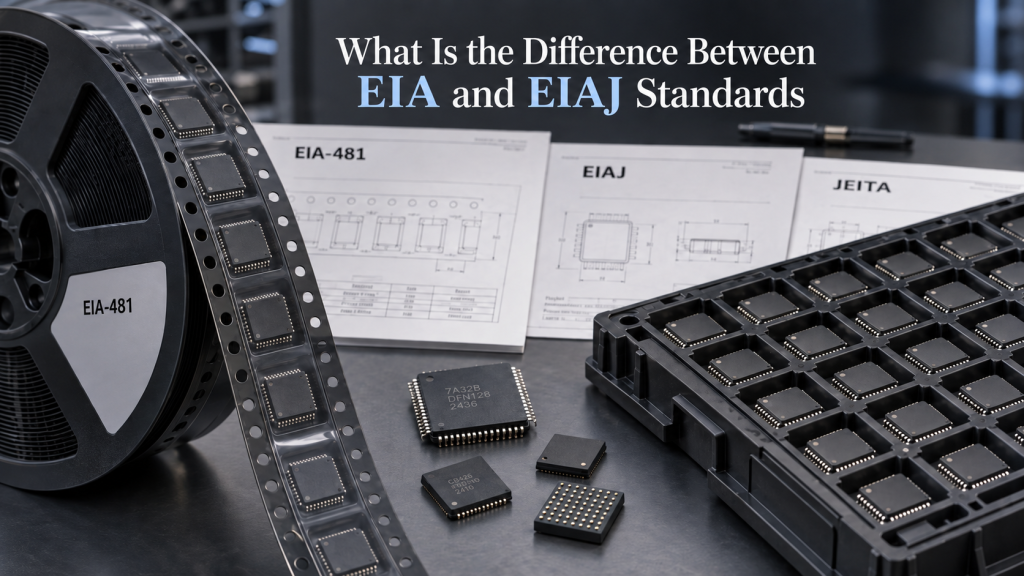
EIA and EIAJ can appear side by side in electronics packaging drawings, component specifications and legacy documentation, but they do not mean the same thing and should not be treated as interchangeable standards.
From a packaging engineering perspective, the more useful question is not simply, “Should I follow EIA or EIAJ?” The first task is to identify the exact standard number, revision, packaging format and customer requirement. A carrier tape specification, component package drawing and matrix tray standard can all belong to different standards families while applying to the same component.
At SuperPak, this distinction matters when we translate a component drawing into carrier tape, reel or tray geometry. The standard provides an interface framework, but the actual packaging still has to fit the component and the customer’s manufacturing process.
Quick Summary
EIA and EIAJ are different standards families, not two revisions of the same system. Current EIA-branded standards are developed through ECIA’s EIA Standards programme, while EIAJ, the Electronic Industries Association of Japan, merged with JEIDA to form JEITA in 2000.
For surface-mount carrier tape, EIA 481-F-2021 appears on ECIA’s current American National Standards list dated 8 May 2025. Its title specifies 4 mm through 200 mm embossed carrier tape and 8 mm and 12 mm punched carrier tape for automatic handling of surface-mount components.
The practical rule is simple: identify the document number first and the acronym second. If an older drawing references EIAJ, verify exactly what that document controls before substituting a current EIA, JEITA, JIS or other standard.
What do EIA and EIAJ actually mean?
EIA and EIAJ originated from different electronics-industry standardisation systems. Current EIA-branded standards sit within ECIA’s standards programme, while EIAJ was one of the two Japanese organisations that combined to create JEITA in 2000.
Understanding that organisational history prevents a common packaging problem: assuming that standards addressing related subjects must be alternative versions of one specification.
What does EIA mean?
EIA refers historically to the Electronic Industries Association, while ECIA now develops standards under the EIA Standards trademark. ECIA states that the trademark is retained to maintain continuity with the long-recognised EIA brand.
The standards-development process is ANSI-accredited for standards intended to become American National Standards.
In 2026, ECIA stated that it maintains more than 200 American National Standards covering passive electronic components and related technologies. That broader catalogue is important because “EIA standard” by itself is far too vague to be a useful packaging requirement.
ECIA also states that an American National Standard must be reviewed every five years to determine whether it should be reaffirmed, revised, withdrawn or stabilised.
For packaging teams, that means the revision forms part of the specification. Writing only “follow EIA” on a drawing does not identify the actual requirement.
What does EIAJ mean?
EIAJ stands for the Electronic Industries Association of Japan, which ceased operating as a separate organisation when it combined with JEIDA to form JEITA.
The new organisation formally began on 1 November 2000. At launch, JEITA reported 580 members, consisting of 422 regular members and 158 supporting members.
The organisational change does not make every older EIAJ document irrelevant. It means engineers need to interpret that document using its identifier, revision, scope and role within the customer’s controlled specification.
Why do old EIAJ references still appear?
Older EIAJ identifiers can remain relevant when they are embedded in established technical documentation, even though EIAJ itself became part of JEITA. JEITA continues to identify EIAJ as the former standards organisation and explains that EIAJ standards were incorporated into the JEITA standards environment.
Whenever an older EIAJ reference appears, record:
- the full standard number
- the revision or suffix
- the publication date, where available
- the packaging format involved
- the requirement the document is intended to control
Do not replace an old identifier solely because the issuing organisation changed. First establish what the customer, component specification and current engineering programme actually require.
Are EIA and EIAJ standards equivalent?
No blanket EIA-to-EIAJ equivalence should be assumed. The useful comparison is between individual standards, their revisions and the specific packaging interface or requirement each document controls.
This is particularly important in semiconductor packaging because one product can be affected by several different standards. Carrier tape, reels, trays, ESD control and moisture-sensitive handling are separate technical subjects.
| Comparison point | EIA | EIAJ / current Japanese context | Practical implication |
| Standards lineage | EIA-branded standards are developed through ECIA | EIAJ became part of JEITA in 2000 | Do not specify only the organisation acronym |
| Carrier-tape reference | EIA 481-F-2021 is listed by ECIA | Older EIAJ references may appear, while current Japanese continuous-tape standards include JIS C 0806-3:2024 | Compare exact documents and revisions |
| Tray requirements | Separate tray standards can apply | EIAJ published tray-specific standards and technical reports | Do not compare tray and carrier-tape requirements as though they were the same |
| Revision control | Verify through ECIA | Verify through JEITA or the applicable Japanese standards source | Record the revision before design release |
| Customer requirements | May add product-specific controls | May preserve older references | Resolve customer-specific requirements before tooling |
| Equivalence | Not automatic | Not automatic | Compare requirement by requirement |
A useful current Japanese reference is JIS C 0806-3:2024, published in August 2024 for the packaging of surface-mount components on continuous tapes. Its freely accessible preview identifies it as an identical adoption of IEC 60286-3:2022 and states that it specifies taping requirements for components intended for automatic mounting.
That does not mean JIS C 0806-3, an older EIAJ specification and EIA-481 can automatically be substituted for one another. It means engineers have several standards systems that may address similar packaging functions, so the actual requirements need to be compared.
Which EIA standard applies to carrier tape and tape-and-reel?
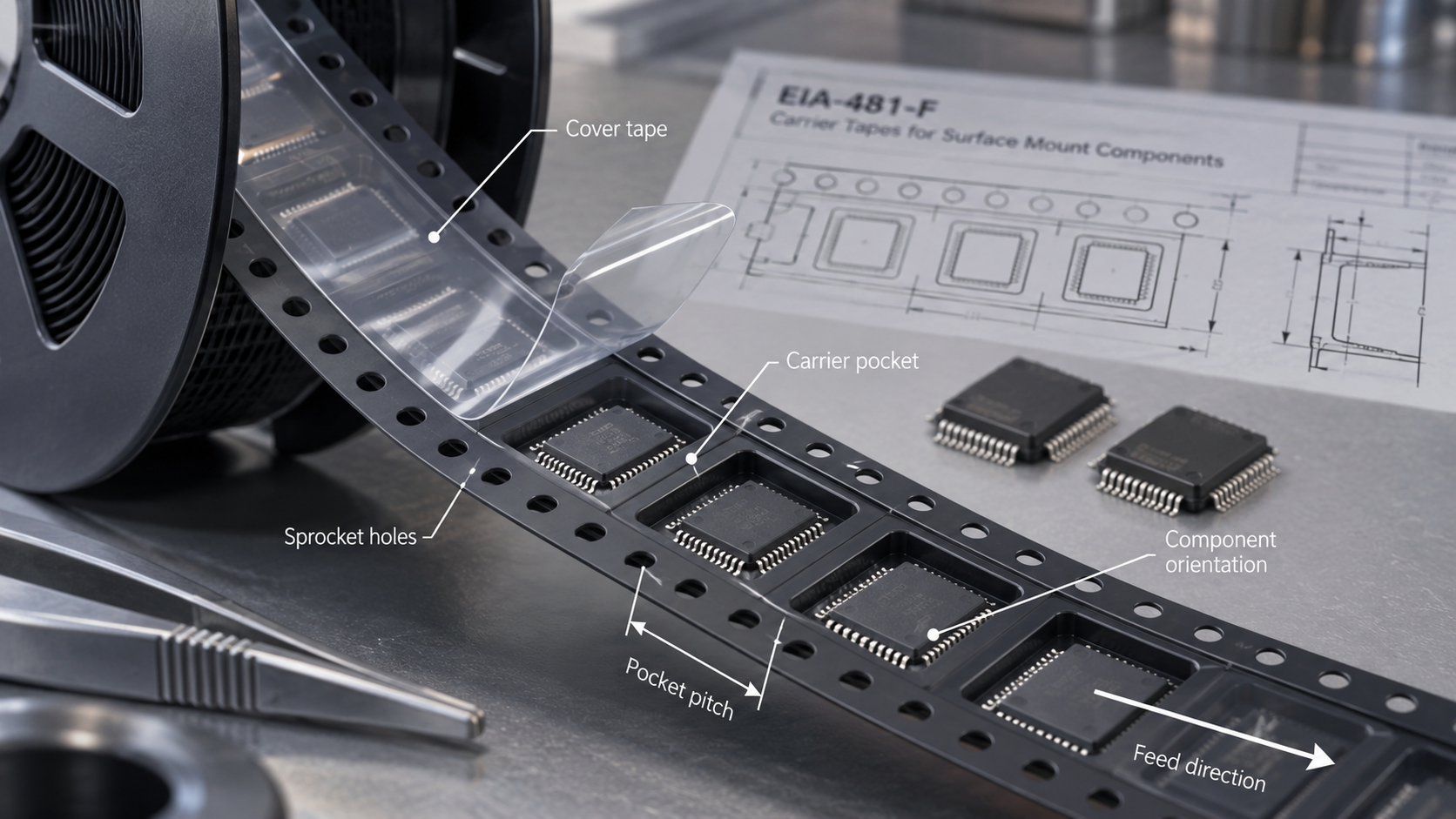
For surface-mount components supplied on continuous carrier tape, EIA 481-F-2021 is the key current EIA reference to establish first. ECIA’s current list identifies it as the revision of EIA 481-E-2015 approved on 5 August 2021.
This is directly relevant to SuperPak’s tape-and-reel products, where carrier tape, cover tape and plastic reels are supplied as parts of the overall packaging system.
What is EIA-481-F?
EIA-481-F addresses carrier taping of surface-mount components for automatic handling. The current ECIA listing gives its scope as 4 mm through 200 mm embossed carrier taping and 8 mm and 12 mm punched carrier taping.
For an engineer reviewing a carrier-tape design, practical questions include:
- Is the carrier format appropriate for the component?
- Does the pocket provide adequate clearance around the body and terminals?
- Are the indexing features suitable for the intended automatic-handling process?
- Is component orientation consistent with the assembly requirement?
- Do the carrier tape, cover tape and reel work as one packaging system?
- Has the precise standard revision required by the customer been recorded?
There is also a current Japanese continuous-tape reference. JIS C 0806-3:2024 is based on IEC 60286-3:2022 without changing its technical content or structure, according to the freely available standards preview.
Why isn’t EIA-481-F a complete packaging specification?
EIA-481-F establishes a carrier-taping framework, but a component’s complete packaging requirement can extend beyond carrier geometry. ESD protection, moisture control, cleanliness, material selection and customer-specific qualification can all need separate consideration.
A complete programme may therefore need requirements for:
- ESD protection
- moisture-sensitive handling
- packaging material
- cleanliness
- pocket clearance
- component orientation
- cover-tape compatibility
- environmental exposure
- inspection criteria
- customer-specific acceptance limits
This is why a statement such as “EIA-481 carrier tape” does not, by itself, answer every packaging question.
At SuperPak, our part-fit analysis and simulation testing supports the component-to-packaging fit stage rather than relying on the standards reference alone.
Why does physical component fit still need to be checked?
A standard can define the handling interface, but the actual component still has geometry and dimensional tolerances that must work inside the pocket. A nominal package dimension alone is therefore not sufficient for final tooling approval.
Part-fit assessment should consider the body, terminals, orientation features, pickup area and any surfaces that cannot contact the carrier. Pocket geometry should allow loading and removal while controlling unnecessary movement.
Cross-sectional review is particularly useful for tall or unusually shaped components where wall angles, pocket depth and local clearances interact.
SuperPak’s custom deep-pocket carrier tape guide explains how component geometry, pocket depth and cover-tape behaviour need to be considered together.
Need help resolving the standard and pocket requirement before tooling? Contact SuperPak with your component drawing, dimensions and intended packaging format.
Where do EIAJ and JEITA standards fit into electronics packaging?
EIAJ references need to be interpreted document by document rather than treated as one alternative to EIA-481. Some EIAJ documents relate to package or tray geometry, while other references encountered in older documentation may address different packaging functions.
JEITA’s standardisation activities supplement international and national standards with industry standards for electronics and information technology.
What should you do with an EIAJ RC-1009B reference?
If an existing drawing cites EIAJ RC-1009B, treat it as a specific controlled reference that needs verification rather than assuming it is equivalent to EIA-481-F. The first question should be what part of the packaging requirement the reference is intended to control.
Check:
- the full identifier shown on the controlled drawing
- any revision or suffix attached to it
- whether the customer still requires that reference
- whether another current standard also applies
- whether the requirements are compatible
The goal is not to replace legacy terminology automatically. It is to remove ambiguity before the packaging design is released.
Are all EIAJ standards carrier-tape standards?
No. EIAJ published documents for different semiconductor packaging formats, including matrix trays. A clear example is EIAJ EDR-7602, which is titled Design guideline of tray for integrated circuits.
The document was established in June 2000 and specifies tray shapes and dimensions for shipment and production of integrated circuits, including QFP, TSOP, SOP, PGA and BGA packages.
Its dimensions make the difference from continuous carrier tape obvious. In 2000, EDR-7602 specified a nominal tray width of 135.9 mm with a ±0.25 mm tolerance, a length including end tabs of 322.6 mm ±0.25 mm, and a length excluding end tabs of 315.0 mm ±0.25 mm.
Those figures are tray-interface requirements. They should not be used as carrier-tape dimensions.
Does JEITA replace every EIAJ requirement automatically?
No. An organisational merger does not mean engineers can automatically replace every EIAJ identifier found on a controlled drawing. The individual document and its status still need to be reviewed.
EIAJ ED-7611 illustrates why prefixes alone can be misleading. The freely accessible document is titled Tray for Thin Small Outline Packages, was established in April 2001, and was published by JEITA while retaining the EIAJ ED-7611 identifier.
For a production programme, the controlling requirement should therefore come from the approved specification, drawing and agreed revision, not from an assumption based on the prefix.
How are carrier-tape standards different from tray standards?
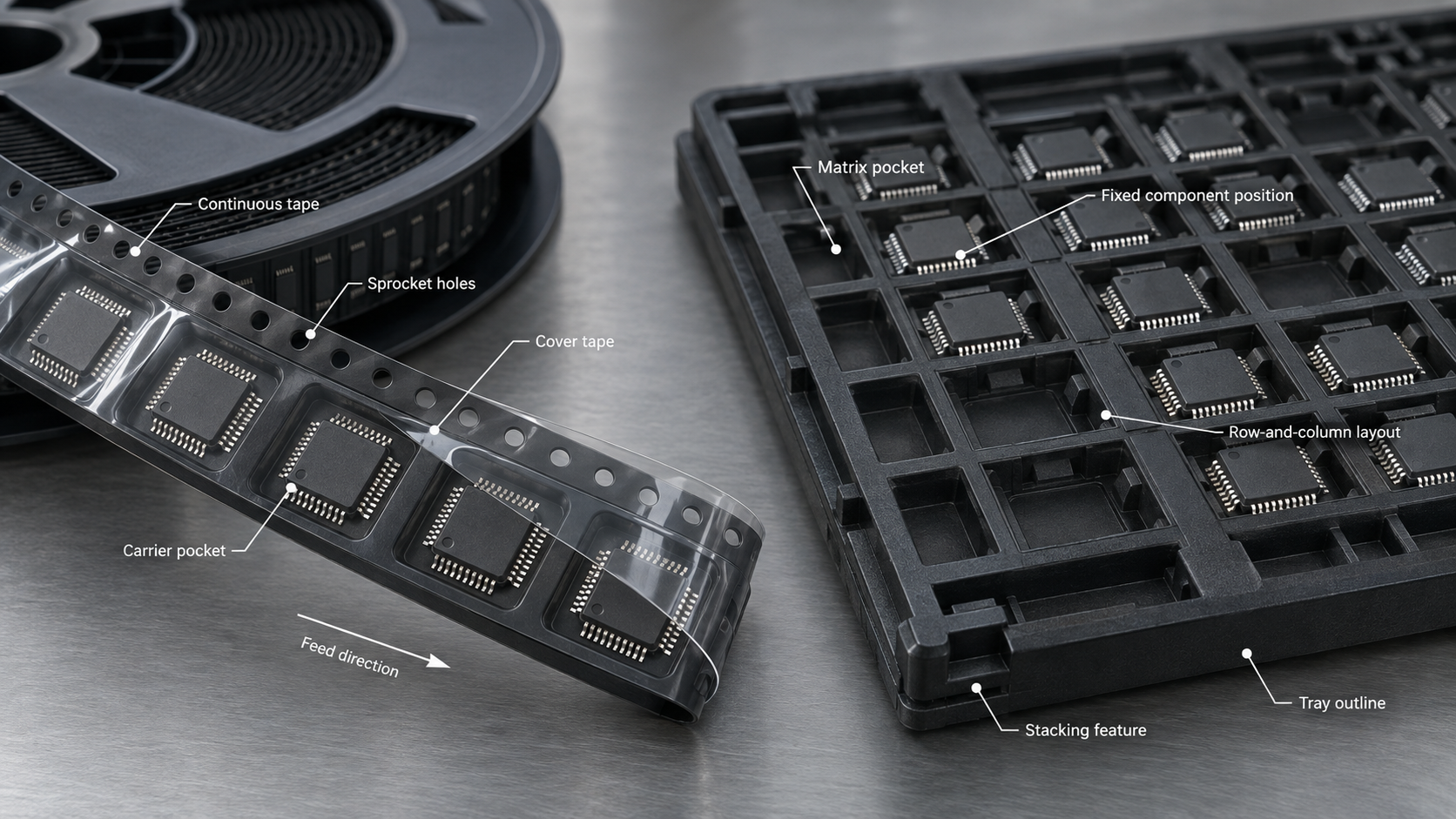
Carrier tape and matrix trays solve different handling problems and consequently control different mechanical interfaces. Carrier tape works as a continuous indexed medium, while a tray presents components in a fixed two-dimensional pocket matrix.
SuperPak’s tape-and-reel versus tray packaging guide provides additional guidance on choosing between the two formats.
| Requirement | Carrier tape | Matrix tray |
| Component location | Repeating pocket along continuous tape | Pocket within a two-dimensional matrix |
| Machine interface | Indexed tape feeder | Tray-handling system |
| Component retention | Pocket and cover tape | Pocket and tray-stack geometry |
| Main geometry | Tape width, indexing and pocket design | Tray outline, pocket matrix and stacking |
| Qualification focus | Feed, retention, cover-tape behaviour and pickup | Fit, stacking, orientation and handling |
| Typical engineering concern | Pocket fit while maintaining standard tape interface | Part fit while maintaining tray dimensions and stackability |
EIAJ EDR-7602, for example, controls tray outside dimensions, pocket arrangements and related stacking geometry rather than continuous tape indexing.
For components better suited to a formed tray, SuperPak also provides custom thermoformed products for electronic, semiconductor, automotive, medical and consumer applications.
How do you determine which packaging standard actually applies?
Start with the component and controlled customer documentation, then map every standard reference to the requirement it actually governs. Doing this before tooling reduces the risk of discovering conflicting requirements after a packaging design has already been released.
A practical standards review can follow nine steps.
Step 1: Identify the component and package
Start with the actual device rather than the acronym printed beside the packaging requirement. Record the controlled component drawing, dimensions, tolerances, terminal geometry, polarity features and critical pickup or contact surfaces.
The final carrier or tray must fit the specific component, not merely a generic package-family description.
Step 2: Identify the packaging format
Determine whether the component will use carrier tape, a matrix tray, a tube or another packaging system. This immediately narrows the standards and mechanical interfaces that are relevant.
Do not start a carrier-tape design from a tray specification simply because both documents address semiconductor handling.
Step 3: Record every standards reference
Record the complete identifier and revision for every cited standard. Organisation acronyms alone are not enough.
For each reference, capture:
- standard number
- revision or suffix
- publication or approval date
- issuing organisation
- requirement it controls
Revision control matters because ECIA requires American National Standards to undergo a five-year review cycle.
Step 4: Determine what each document controls
Separate the standards according to their function rather than treating them as one combined specification.
A useful requirements matrix can contain:
- component package outline
- carrier tape
- reel
- matrix tray
- ESD
- moisture handling
- cleanliness
- packaging material
- customer-specific requirements
This makes overlaps and gaps much easier to see.
Step 5: Compare the customer drawing
The industry standard establishes common requirements, while the customer drawing can add component-specific controls.
Check dimensions, tolerances, orientation, material requirements and inspection criteria. Any difference from the general standard should be documented rather than handled as an informal assumption.
Step 6: Resolve conflicting or legacy references
If two controlled references appear incompatible, resolve the discrepancy before tooling is released.
Three situations are common:
- Complementary requirements: one document governs carrier geometry while another controls ESD, moisture or another function.
- Intentional legacy requirement: an older EIAJ reference remains part of the customer’s controlled specification.
- Direct conflict: two references produce incompatible requirements.
The third case requires clarification from the specification owner rather than an engineering guess.
Step 7: Validate the actual component fit
Translate the approved requirements into real packaging geometry and check the component against that design.
SuperPak’s product-development and part-fit capabilities include design support and part-fit analysis for packaging applications.
Step 8: Qualify the complete packaging system
A successful pocket fit does not by itself qualify the complete packaging system.
Depending on the programme, qualification can also involve the cover tape, sealing system, dimensional stability, component presentation, material behaviour, ageing requirements and downstream handling process.
SuperPak’s tape-and-reel testing capabilities include in-house part-fit analysis, cross-section analysis, cover-tape compatibility testing and ageing testing.
Step 9: Freeze the approved revision
Record the standards revisions, component drawing revision and customer specifications used for the production release.
If the component, standard or packaging material later changes, that controlled baseline makes it easier to determine whether revalidation is required.
What requirements sit outside EIA and EIAJ dimensional standards?
Mechanical packaging standards do not necessarily define every protection requirement for an electronic component. ESD control, moisture-sensitive handling, cleanliness, material restrictions and customer-specific environmental requirements can sit outside the carrier-tape or tray dimensional specification.
For this reason, we recommend building a requirement set rather than searching for one standard that supposedly covers the whole packaging system.
ESD requirements
ESD protection needs to be treated as a separate packaging requirement. ANSI/ESD S541-2026 defines packaging properties required to protect ESD-sensitive items throughout production, transport and storage and identifies IEC 61340-5-3 as technically equivalent.
That means a carrier pocket can be dimensionally correct while the chosen material or packaging system still needs a separate ESD assessment.
SuperPak offers carrier-tape materials including conductive polystyrene and permanent static-dissipative clear polycarbonate.
Moisture-sensitive devices
Moisture-sensitive handling is also separate from carrier-tape dimensions. IPC/JEDEC J-STD-033D covers handling, packing, shipping and use of moisture, reflow and process-sensitive devices, with dedicated sections for dry packing, moisture-barrier bags, drying and floor life.
If a component is moisture sensitive, its moisture-control requirements therefore need to be identified separately from the carrier or tray geometry.
Cleanliness and material requirements
Cleanliness and material controls may come from the application, customer’s process or quality specification rather than from EIA-481 or a tray-dimensional document.
Depending on the component, relevant considerations can include:
- particulate contamination
- ionic contamination
- outgassing
- direct-contact material
- static-dissipative or conductive behaviour
- transparency for inspection
- heat exposure
- restricted substances
- customer-specific cleanliness limits
The packaging material should therefore be selected only after these requirements are understood.
What mistakes cause EIA and EIAJ packaging problems?
Most problems arise from ambiguous specifications, incorrect revision assumptions or insufficient component-level validation rather than from the standards themselves. The safest approach is to make every requirement traceable to a controlled document.
| Mistake | Why it creates risk | Better approach |
| Writing only “EIA compliant” | It does not identify a specific standard | State the document number and revision |
| Assuming EIAJ equals EIA | Similar subject matter does not prove equivalence | Compare the relevant documents |
| Ignoring revision dates | Standards can be revised or reaffirmed | Record the approved revision |
| Mixing tray and tape standards | They govern different interfaces | Identify the packaging format first |
| Designing only from nominal dimensions | Actual components have dimensional tolerance | Perform part-fit and tolerance review |
| Checking only the pocket | Carrier tape works with cover tape and downstream handling | Qualify the complete system |
| Assuming carrier geometry covers ESD | ESD requirements are separately controlled | Specify ESD performance independently |
| Tooling before resolving conflicts | Later clarification can require redesign | Resolve specification conflicts first |
A useful rule is that “compliance” should always complete a sentence. Compliant with which standard, which revision, which requirement and which acceptance method?
What should a controlled packaging specification include?
A controlled packaging specification should convert the standards review into a document that engineering, quality, procurement and manufacturing teams can interpret consistently. It should make both the applicable industry requirements and component-specific requirements explicit.
For the component, record:
- component part number
- controlled drawing and revision
- package dimensions and tolerances
- terminals or fragile features
- component orientation
For the standards references, record:
- complete standard identifier
- revision
- issuing organisation
- relevant function or clause where necessary
- any approved customer deviation
For the carrier tape or tray, specify:
- packaging format
- applicable geometry
- pocket orientation
- packaging material
- cover-tape or closure requirement
- reel or tray requirement
For protection, record:
- ESD requirement
- moisture requirement
- cleanliness requirement
- temperature or environmental exposure
- material restrictions
For qualification, define:
- part-fit approval
- dimensional inspection
- cross-sectional review where needed
- cover-tape compatibility
- ageing or environmental testing where applicable
- machine or process compatibility where required
Finally, the production-control section should identify the approved drawing revision, inspection approach, deviation procedure, change-notification requirement and any required qualification records.
The specification then becomes the bridge between an industry standard and the actual packaging that must be manufactured.

When is custom carrier tape or tray design still required?
A standardised handling interface does not mean every component can use a standard pocket. Custom pocket or tray geometry can still be necessary for unusually tall, asymmetric, fragile or non-standard components.
Common examples include:
- tall electronic components
- large connectors
- asymmetric devices
- fragile leads or terminals
- sensitive optical or contact surfaces
- restricted pickup areas
- deep-pocket applications
- non-standard electronic assemblies
The objective is usually to preserve the appropriate standardised machine interface while adapting the component-contact geometry to the actual device.
In 2026, SuperPak’s published carrier-tape capability covers widths from 8 mm to 104 mm, thicknesses from 0.2 mm to 0.6 mm and a maximum formable depth of 25 mm.
Those numbers describe SuperPak’s manufacturing capability. They do not mean every design automatically meets EIA-481 or another customer requirement.
For larger formed packaging, SuperPak’s published thermoforming capability covers a maximum forming area of 600 mm × 1,200 mm × 400 mm and material thicknesses from 0.16 mm to 10 mm.
If your component falls outside conventional tape or tray geometry, Contact SuperPak to review the component and packaging requirement before committing to tooling.
How can SuperPak help with EIA, EIAJ and packaging qualification?
At SuperPak, we help translate the applicable standard, customer drawing and component geometry into a manufacturable packaging solution. We do not treat an EIA or EIAJ label as a substitute for engineering review.
Our tape-and-reel capabilities include carrier tape, cover tape and plastic reels, together with in-house part-fit analysis, cross-section analysis, cover-tape compatibility testing and ageing testing.
Where a component is better suited to a tray, our thermoforming capability supports custom formed packaging for electronics and semiconductor applications.
The practical sequence is straightforward: identify the controlling requirements, understand the component, design the packaging, validate the fit and document the approved configuration before production.
Have an EIA, EIAJ, JEITA, JIS or mixed-standard packaging requirement? Contact SuperPak with your component drawing and packaging requirements so we can review what needs to be validated.
FAQ
Are EIA and EIAJ standards the same?
No. EIA and EIAJ originated from different standards organisations and should not be treated as interchangeable standards families. Current EIA-branded standards are developed through ECIA, while EIAJ merged with JEIDA to form JEITA in 2000.
Always identify the exact document and revision before comparing requirements.
What happened to EIAJ?
EIAJ and JEIDA combined to establish JEITA on 1 November 2000.
Older EIAJ identifiers can therefore still appear in technical documents even though JEITA is now the relevant organisation.
Is EIA-481 still current?
Yes. ECIA’s current American National Standards list dated 8 May 2025 includes EIA 481-F-2021.
Because American National Standards are periodically reviewed, check the ECIA list again when starting a new qualification rather than relying on the revision from an old programme.
Is EIAJ RC-1009B the same as EIA-481?
Do not assume that EIAJ RC-1009B and EIA-481 are equivalent. If RC-1009B appears in a controlled specification, determine what it is being used to control and compare that requirement against the applicable current specification before substitution.
The EIAJ organisation became part of JEITA in 2000, so older EIAJ identifiers need to be interpreted in their document-specific context.
Which standard should I use for carrier tape?
Use the standard and revision required by the controlled customer or component specification, then check whether additional current requirements apply. For EIA-based surface-mount carrier taping, EIA 481-F-2021 is listed in ECIA’s May 2025 current standards list.
For current Japanese continuous-tape requirements, JIS C 0806-3:2024 covers packaging of surface-mount components on continuous tapes and is identified as an identical adoption of IEC 60286-3:2022.
Can a custom carrier tape still follow EIA-481?
A custom component pocket can be engineered within an applicable standardised carrier-tape system, provided the completed design meets the controlling requirements. The machine-facing interface and the component-specific pocket do not perform exactly the same function.
The custom design should still be reviewed against the component drawing, applicable standard and qualification requirements before production. SuperPak’s deep-pocket carrier tape design guide covers this engineering problem in more detail.
What should I do if an old drawing references EIAJ?
Keep the original reference visible, identify the complete document and revision, and determine whether it remains the customer’s controlling requirement. Do not automatically replace EIAJ terminology simply because the organisation merged into JEITA.
Where an older requirement conflicts with a current standard or a new manufacturing process, resolve the discrepancy before tooling and record the agreed requirement in the controlled packaging specification.