
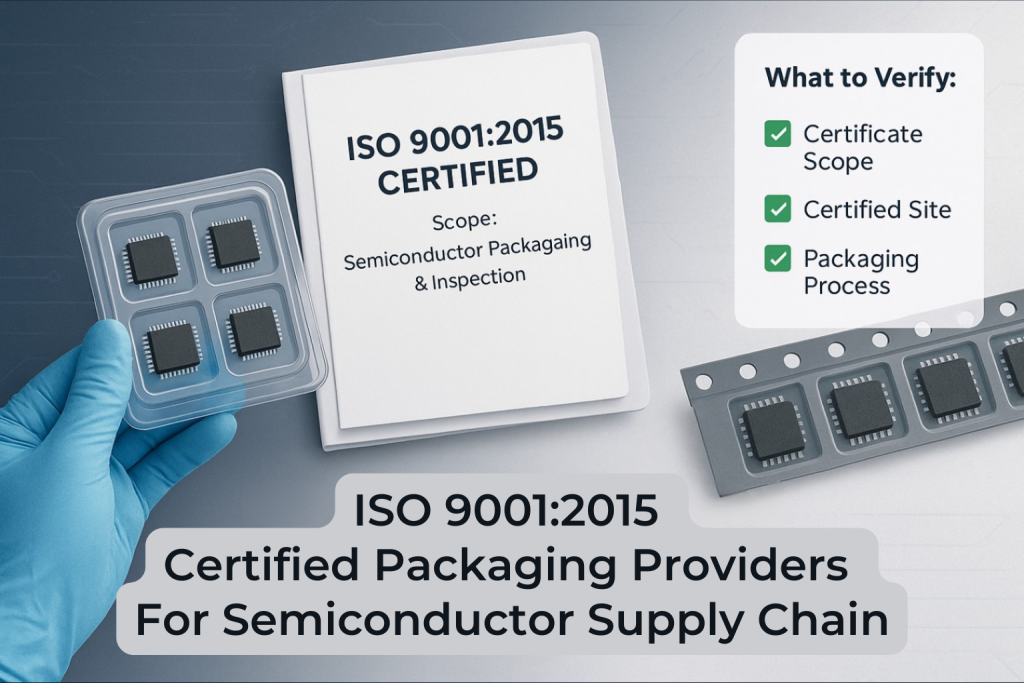
This is written for procurement, quality, and operations teams who are comparing packaging providers and need a fast, defensible way to approve one
If you are searching for ISO 9001:2015 certified packaging providers for semiconductor supply chain, you are likely close to a purchase decision. You want a packaging partner you can trust, not just for one shipment, but for repeat production, change requests, and audits.
ISO 9001:2015 certification is a strong starting filter because it is built around a quality management system that supports consistent outcomes and continual improvement. But the certificate is not the full story. In semiconductor supply chains, “good enough” packaging can still create line disruptions, handling damage, and slow investigations when something goes wrong.
This article keeps it simple. It shows how to verify ISO scope properly, what evidence to ask for, and how to qualify a provider through a short pilot. It also reflects the practical formats buyers actually purchase, such as thermoformed trays and tape-and-reel, which SuperPak lists as core services.
What ISO 9001:2015 Certification Means For Semiconductor Packaging
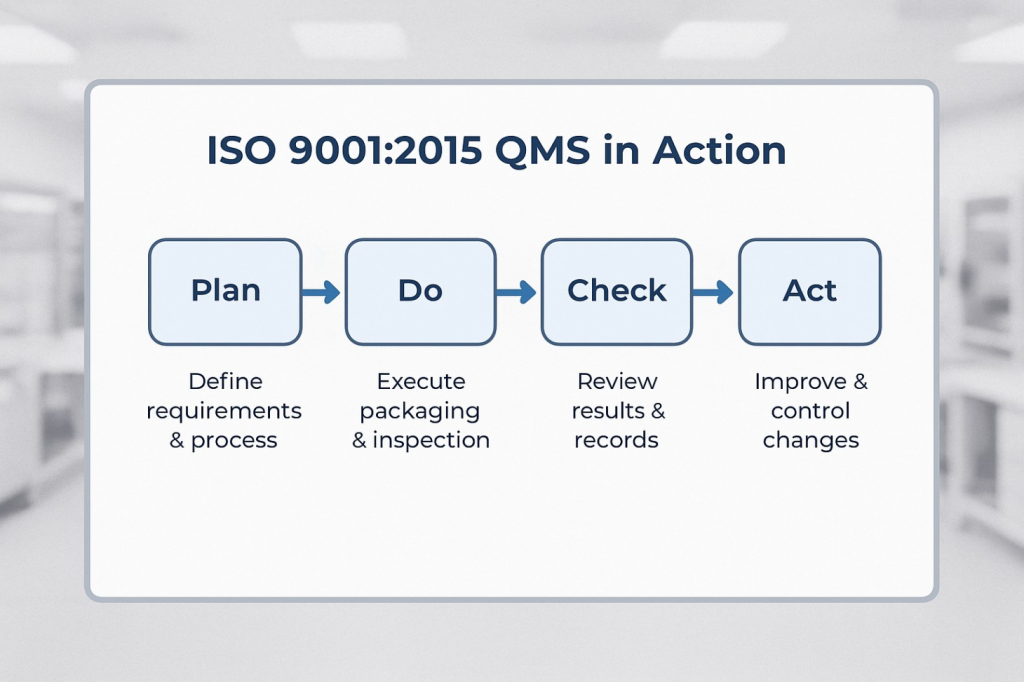
An ISO 9001 quality management system is about how a supplier runs work in a repeatable way. ISO describes a QMS as a collection of processes and procedures that help an organisation consistently deliver products and services that meet customer requirements, while improving over time.
That is the part that matters for procurement. A provider with a working QMS should be able to show clear processes, controlled checks, and a sensible way to handle issues and changes. In other words, the supplier should not rely on hero staff or “tribal knowledge” to keep output stable.
Why ISO 9001 helps, but cannot be your only decision point
ISO 9001 is a filter because it signals structured management of quality. It is not a guarantee that the supplier can support your specific semiconductor packaging needs.
Two common gaps show up in real buying decisions.
First, the scope may not cover the actual work you are purchasing. A supplier can be certified, but the certified scope could be narrower than you assume.
Second, the site doing your work may not be the one covered. When you need consistent quality across lots, location matters because processes, training, and controls are applied where the work is done.
ISO’s own guidance explains that ISO 9001 is based on a process approach that includes planning, doing, checking outcomes, then acting to improve. Your onboarding process should test whether a supplier actually works that way.
Why certificate scope and certified sites matter
Scope is not paperwork. It is the boundary of what the QMS is meant to control.
For semiconductor packaging, this matters because your risk sits in the details: dimensional fit, handling stability, and repeatability. If the scope does not clearly cover the manufacturing or packaging activity you need, you may be relying on controls that were never certified for that process.
If a supplier’s certificate and scope are not easy to explain, that is already a signal. Your goal is to reduce ambiguity early, before you invest time in engineering back and forth.
If ISO 9001:2015 certification is on your shortlist, SuperPak is ISO 9001:2015 certified. You can share your pack-out requirements and ask them to confirm the certificate scope and the site that would support your order, then request a small evidence pack so you can decide whether a pilot lot makes sense.
How to verify an ISO 9001:2015 certificate before you shortlist a supplier
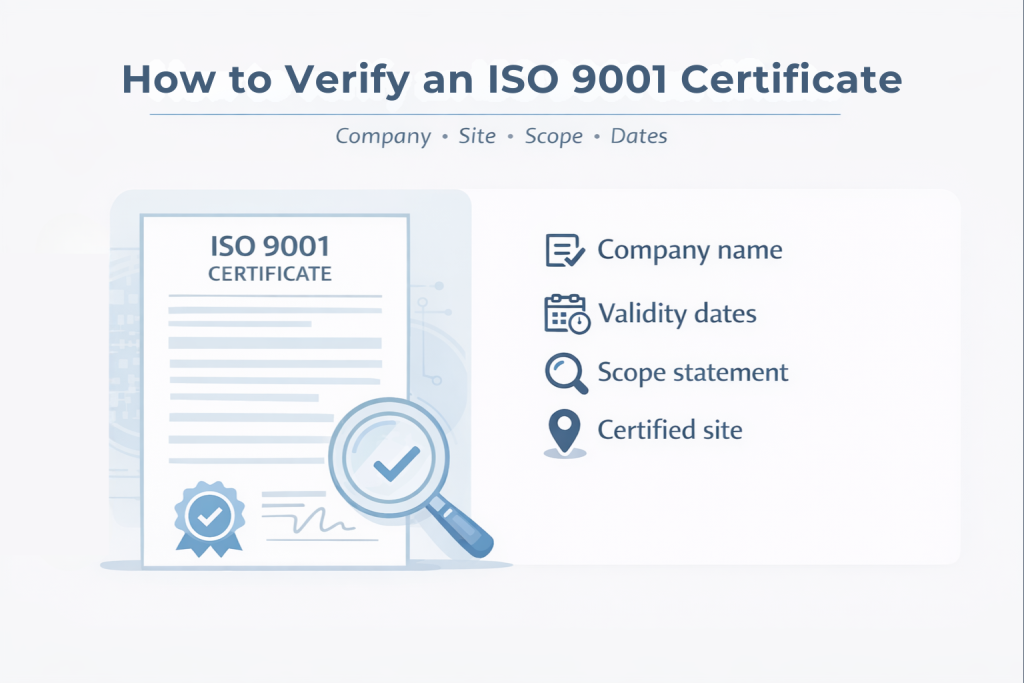
You do not need a full audit to confirm the basics. You just need to check that the certificate applies to the company, the site, and the work you are buying. ISO 9001 is a quality management system standard, so your focus should be whether the supplier’s QMS actually covers the packaging process that will support your order.
What to check on scope wording, sites, and validity dates
This is one place where a short step list is useful because it is truly procedural.
- Confirm the legal entity name matches the company you will contract with.
- Check the validity period so you know the certificate is current.
- Read the scope statement and look for the activity you are buying, such as thermoforming, tape-and-reel packaging, or kitting.
- Confirm the certified site address and verify that it is the location that will produce or control your order.
- If you expect ongoing changes, ask whether the supplier’s QMS covers development and change control in the way you need.
What to ask for when the scope does not match what you buy
If the scope is vague or does not clearly match your requirement, ask for clarity in writing. Keep the questions practical.
Ask:
- Which site will manufacture our packaging?
- Is that site covered under the ISO 9001 certificate you are presenting?
- Does the scope cover the exact activity we are buying, or is it a different category?
- If you use any subcontractors, what controls do you apply and what records exist?
If a supplier cannot answer those questions cleanly, it is hard to trust them with tight tolerances and fast ramps.
What Packaging Types You Will Typically Need In A Semiconductor Supply Chain
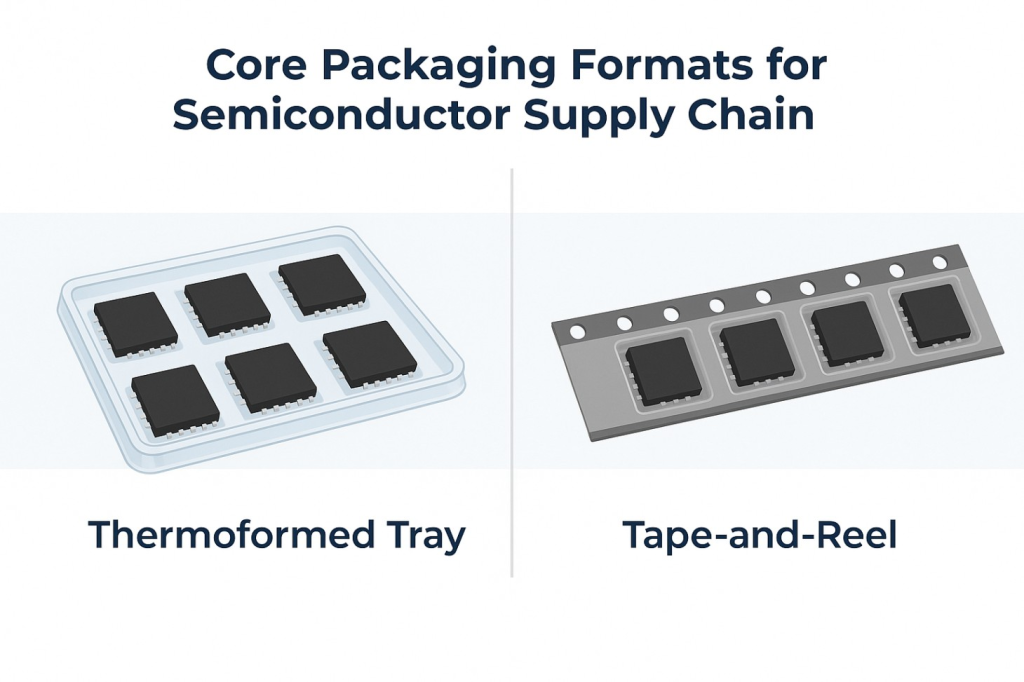
Most semiconductor packaging buying decisions come down to a few formats that support handling, transport, and production flow. The core point is that packaging is often a production input, not a last-minute purchase.
For buyers considering providers like SuperPak, two common categories are thermoformed trays and tape-and-reel, both listed on SuperPak’s service pages.
When thermoformed trays are the right choice
Thermoformed trays are commonly used when you need stable orientation, repeatable handling, and less part-to-part contact. They are often chosen when the way parts sit and move matters as much as the transport protection.
SuperPak describes thermoforming as heating sheet material and forming it onto a mould, then finishing with die-cutting or CNC machining. It also states it offers vacuum formed and pressure formed parts and lists electronic and semiconductor applications.
When you evaluate tray suppliers, focus on what causes real problems in production: drift in critical dimensions, tool wear that changes fit, or inconsistent finishing steps. The supplier should be able to explain how they inspect, how they control change, and what happens when something is out of spec.
When tape-and-reel is the right choice
Tape-and-reel is often the right choice when the packaging format supports automated feeding and consistent handling. It can also reduce touch points and simplify storage, but it introduces a different risk profile. Small variation can become line disruption.
SuperPak’s tape-and-reel service description explains the process and states it can perform part fit and cross section analysis for carrier tape, plus cover tape compatibility and ageing tests in-house using precision equipment. Superpak
That kind of capability is worth prioritising because it is directly linked to repeatability. It also gives you a clear basis for qualification: you can ask what checks they run, what the outputs look like, and how they handle changes.
What “fit and consistency” should look like in production
“Fit and consistency” should not stay as a vague phrase.
In practical terms, it means the part sits correctly, presentation stays stable across lots, and any change is documented so performance does not shift quietly. If a supplier cannot show evidence, you end up relying on trust and memory, which is exactly what a good supply chain should avoid.
What To Request Before You Approve A Packaging Provider
If you are buying from ISO-certified suppliers, do not request long policy documents first. Ask for real evidence that shows how the supplier controls work.
ISO’s quality management guidance emphasises consistent delivery and improvement through a process approach. Evidence is how you confirm the process approach is real.
What design support should cover for trays and tape-and-reel
If your packaging partner will do more than manufacture, and will support packaging development or revisions, ask how they handle requirements and changes.
A reliable supplier can explain, in plain words:
- how requirements are captured and agreed
- how revisions are reviewed and approved
- how changes are communicated to prevent drift
This matters because most packaging issues do not come from the first design. They come from later “small adjustments” that were not controlled.
What testing and inspection evidence matters most
Ask for a small set of real examples. You learn more from three records than from a polished deck.
SuperPak has developed an in-process inspection system with offline dimension measurement and automated output generation that produces reports with statistical data and graphs. That is a useful reference point for what you can ask to see when qualifying repeat packaging.
Request:
- an example of a dimensional inspection report (with lot reference and measured results)
- an example of an in-process check record
- an example of a nonconformance record and how it was closed out
You do not need confidential customer details. You need to see that the discipline exists.
Talk to SuperPak with your tray or tape-and-reel requirements
If you are shortlisting suppliers now, you can contact SuperPak and share your component type, preferred format (tray or tape-and-reel), and the constraints that matter most (volume, handling steps, shipping conditions). Ask for an evidence-led discussion that includes how fit is checked for tape-and-reel and what inspection outputs are available for dimensional control.
How Kitting Support Can Reduce Packing Mistakes And Rework
In many operations, packaging errors are not dramatic. They are frequent: missing items, wrong combinations, and inconsistent pack-outs. Kitting reduces this by turning multiple items into one controlled unit.
At SuperPak, kitting as a core contract manufacturing service and explains it involves assembling multiple items into a single kit or package to streamline operations and reduce errors.
A good kitting workflow does not need complicated systems. It needs discipline: a defined bill of materials, a controlled pick process, and a simple verification step before release. The key is consistency across shifts, not cleverness.
How To Run A Short Pilot That Gives A Clear Pass Or Fail
A pilot is the fastest way to turn “we can do it” into “we did it consistently”.
Keep the pilot small, structured, and measurable. You are not trying to prove perfection. You are trying to confirm fit, repeatability, and controlled change.
What to include in the pilot plan and acceptance checks
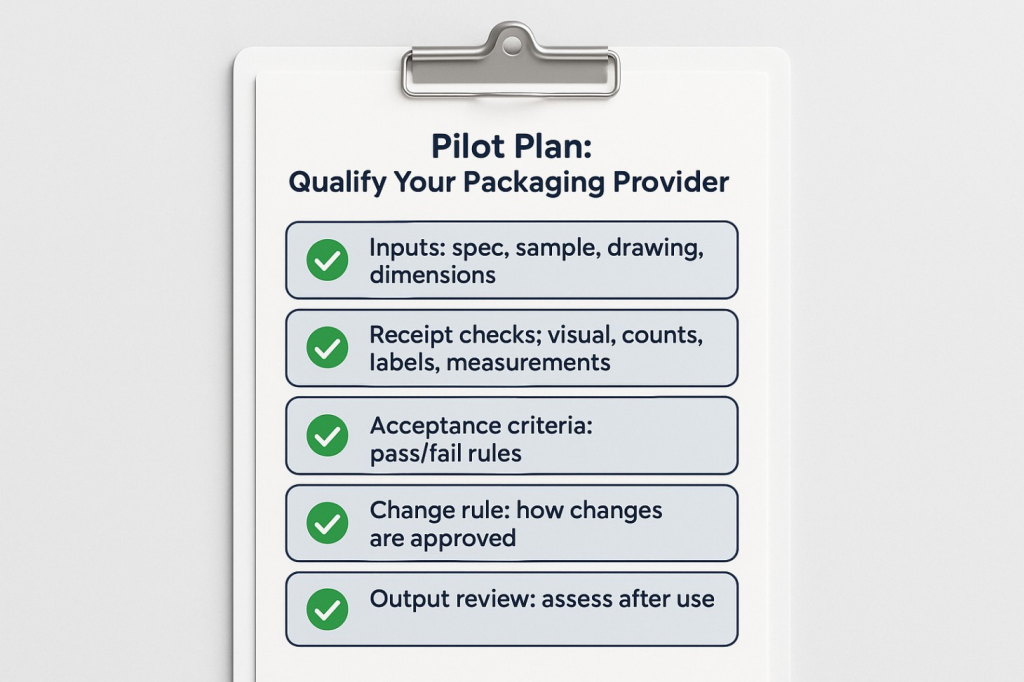
Use a short pilot plan with clear evaluation criteria. Bullets help here because these are checks and pass/fail rules.
- Inputs: specification, sample, drawing, and critical dimensions
- Checks on receipt: visual condition, counts, labelling consistency, key measurements
- Acceptance criteria: what counts as pass and what counts as fail
- Change rule: how changes are proposed and approved during the pilot
- Output review: what you will assess after the packaging is handled or used in your flow
If you are buying tape-and-reel, include the checks that relate to pocket fit and cover tape behaviour. If you are buying trays, include the checks that relate to dimensional stability and handling performance.
Run a short pilot with SuperPak before you scale
If you want to reduce uncertainty quickly, ask SuperPak to support a short pilot for your tray or tape-and-reel requirement. Share your acceptance criteria upfront, then align on what inspection outputs and checks will be used to confirm fit and consistency before you scale.
Common Mistakes When Choosing ISO-Certified Packaging Providers
Most failures come from skipping basics.
One common mistake is approving “ISO certified” without verifying scope and site. A certificate can be valid and still not cover the work you are buying.
Another mistake is approving on capability claims without asking for evidence. Inspection records and closed nonconformance examples are often more predictive than meetings.
The final mistake is ramping before the pilot is stable. A small pilot is usually cheaper than months of rework and argument later.
FAQ About ISO 9001:2015 Certified Semiconductor Packaging Providers
Does ISO 9001 mean a supplier is automatically semiconductor-ready?
No. ISO 9001 sets requirements for a quality management system and supports consistency and improvement. Semiconductor readiness depends on whether scope, site, packaging format capability, and day-to-day controls match your requirements.
What documents should we request before onboarding?
Start with the certificate and scope details, then request a small set of evidence items: an inspection report example, a nonconformance example, and a change control example. You are checking how the supplier works in practice.
Can one supplier cover trays, tape-and-reel, inspection evidence, and kitting?
Sometimes, yes, but only if stable processes exist across each area and the supplier can show records that support it. SuperPak lists thermoforming, tape-and-reel, in-house testing and inspection support, and kitting services, so it is reasonable to explore an integrated approach if it fits your flow.
How To Choose An ISO 9001:2015 Packaging Partner With Less Risk
The safest way to select ISO 9001:2015 certified packaging providers for semiconductor supply chain is straightforward. Confirm the certificate scope and site first, ask for a small set of real records next, then run a short pilot with clear acceptance criteria before you scale. That sequence keeps decisions factual and reduces surprises after onboarding.
If you want to move from shortlisting to a decision, contact SuperPak with your device type, packaging format, volumes, and handling constraints. Request a quotation and a short pilot plan, so you can confirm fit, consistency, and change control early, before volume. SuperPak’s service pages cover thermoformed trays, tape-and-reel, inspection and testing support, and kitting, which are often the practical building blocks buyers look for in production flows.