
If you searched recycling wafer ring, chances are you are trying to solve a real production problem. You want fewer disposables going out, fewer urgent replacement buys coming in, and a reuse workflow that does not create new cleanliness headaches.
Where teams get stuck is not the idea of reuse. It is the lack of control. Wafer rings come back in mixed condition, sorting is inconsistent, and “clean enough” becomes a recurring debate between Operations and Quality. The fix is rarely complicated. It is usually a tighter loop: collect, sort, wash, inspect, pack, return, and remove rejects early.
SuperPak describes this type of work under its collection of packaging items for recycling and washing service and includes an example of collection and refurbishment of shipper boxes and wafer rings using aqueous washing for the semiconductor industry, with an emphasis on cleanliness and contamination prevention.
What Is Recycling Wafer Ring In Semiconductor Packaging?
In day to day semiconductor packaging operations, “recycling wafer ring” usually means a controlled reuse and refurbishment programme. Wafer rings that are still fit for purpose are returned, washed, checked, and put back into use. Rings that are damaged or risky are removed early and handled separately.
It also helps to set boundaries, because search results sometimes drift into reclaimed silicon wafer cleaning or wafer reclaim processes. That is a different scope and a different vendor set. If you are running a packaging reuse loop, the practical levers are sorting rules, consistent washing, and agreed acceptance checks.
A simple definition you can use internally is:
Recycling wafer rings is a controlled programme where wafer rings are collected, sorted, washed, inspected, and returned, and damaged or risky rings are rejected early so they do not re-enter the loop.
Why Reuse These Wafer Rings?
Most programmes start because replacement cost adds up quietly, supply availability is not always predictable, and sustainability targets are moving from “nice to have” to real reporting. But even when sustainability is the trigger, the programme only survives if it works operationally.
In practical terms, reuse only becomes easy when it becomes predictable. Predictable means your returns look similar week to week, decisions are consistent, and Quality can sign off on the checks without holding up production.
SuperPak’s positioning is in that direction. It frames collection and washing as a structured service, and it uses a specific wafer ring example rather than vague “recycling” language.
Which Wafer Rings Can Be Reused, And Which Should Be Rejected?
You do not need a complex scoring system to begin. What you need is a small set of rules that reduce debate at the sorting table. If people are spending minutes arguing over borderline cases, it usually means the criteria are too vague.
What damage means a wafer ring should be rejected immediately?
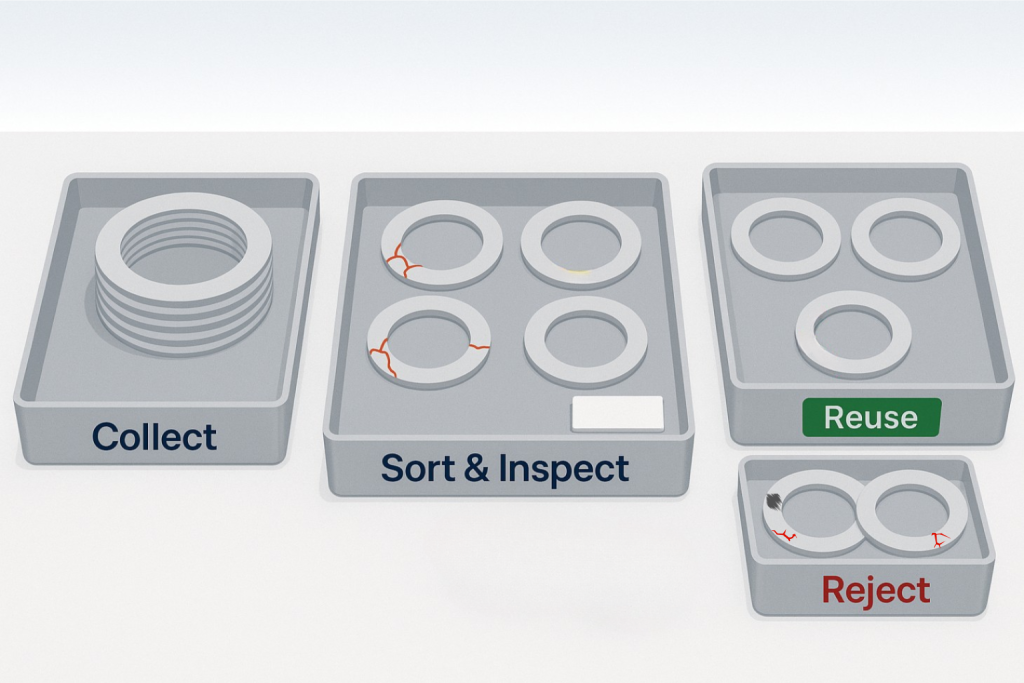
While exact criteria differ by company, most teams quickly agree on the obvious ones. Cracks or chips, sharp edge damage, and deformation that affects fit or stability are common reject triggers. If your process requires traceability, rings that cannot be identified or linked to a batch should not be allowed back into the reuse pool.
A healthy reuse programme does not try to save every ring. It tries to save enough rings consistently, without adding risk.
What contamination signs should be quarantined instead of washed?
Not every questionable ring should be scrapped immediately, but not every questionable ring should enter the standard wash flow either. Rings with unknown exposure history, heavy residues that smear or transfer easily, or rings returned in poor packing condition are often better handled as quarantine first.
Quarantine is a control that protects the rest of the batch. It prevents a few high risk items from spreading residue and creating inconsistent outcomes.
How do you sort wafer rings before washing?
A simple three way triage is enough for many programmes. Rings go into a reuse batch when they pass basic visual checks and have known return history. Rings go into quarantine when history is unclear or residue risk is higher. Rings go into the rejection pile when damage or deformation makes safe reuse unrealistic.
The point of this triage is speed and consistency. It reduces rework, protects washing capacity, and makes acceptance decisions easier for Quality.
How Does A Wafer Ring Collection And Washing Loop Work?
Many pages talk about cleaning, but a stable programme depends on the workflow, not the marketing label. A controlled loop is predictable because it has defined steps and clear ownership.
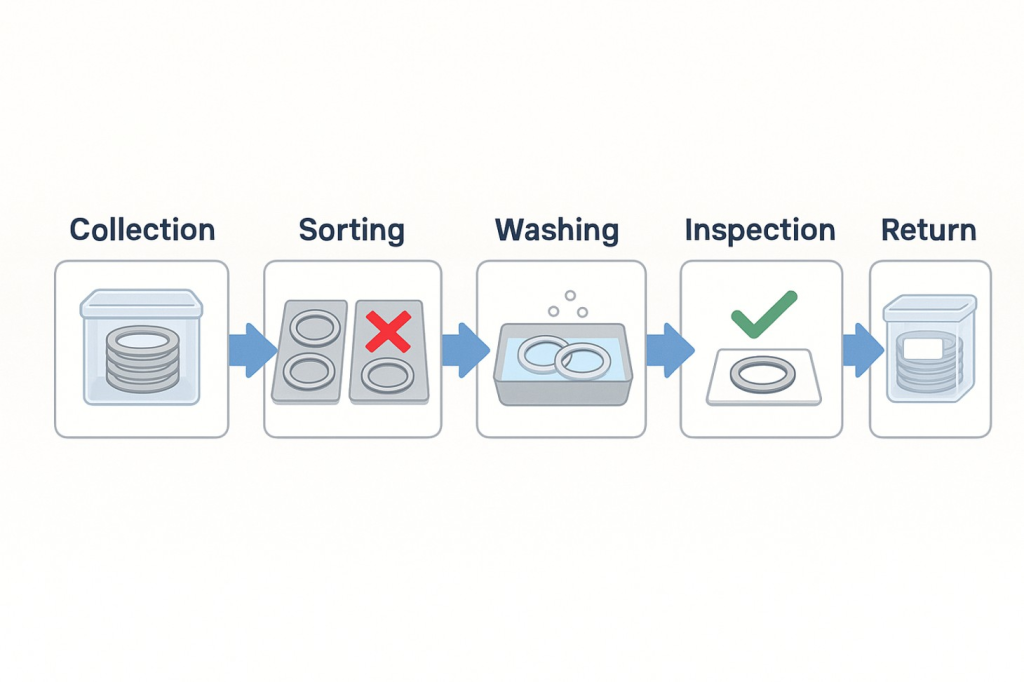
A practical “pickup to return” loop looks like this:
- Collection and pickup from defined points, with consistent packing
- Receiving and sorting into reuse, quarantine, and reject batches
- Washing and refurbishment using the agreed method
- Inspection and acceptance against agreed criteria
- Packing and return in a way that preserves cleanliness
This matches how SuperPak describes its service scope, including collection of packaging items for recycling and washing and its example involving wafer rings and aqueous washing.
How should wafer rings be packed and collected for transport?
This does not need to be complicated, but it must be consistent. Rings should not be thrown loosely into dusty cartons, and “good” and “questionable” rings should not be mixed together to save time. If packing methods change by shift or site, results will change too.
Most teams get better outcomes by standardising collection so receiving teams can process returns quickly. If you label batches clearly and keep quarantine separate from the start, you avoid confusion later and reduce the risk of cross contamination.
What happens during aqueous washing and refurbishment?
Exact details vary by programme, but the typical flow is straightforward. Rings are received and confirmed against the agreed scope, washed using the agreed method, dried or processed in a way that reduces recontamination, inspected post wash, and packed for return under controlled handling.
SuperPak references aqueous washing in its described refurbishment example for shipper boxes and wafer rings in the semiconductor industry.
How should rejects be removed so they do not re-enter the loop?
Reject handling is a common failure point because it is easy to treat it as an afterthought. If rejects are not separated immediately and recorded simply, they often return in the next batch and the same issues repeat.
A reliable approach is to separate rejects physically at receiving or inspection, keep reject reasons short and consistent, and define a clear path for what happens next. Even if you do not recycle those items yet, the key is that they do not drift back into the reuse flow.
If your team is still aligning internally on what a controlled programme looks like, it can help to review SuperPak’s collection of packaging items for recycling and washing service description and use it as a reference point for the workflow and scope.
What Cleanliness Checks Should You Set Before You Reuse Wafer Rings?
Most programmes struggle because “clean enough” is not defined. Operations wants fast turnaround. Quality wants consistent evidence. You can satisfy both by agreeing on a small, practical set of checks and keeping the loop auditable.
What should “clean enough” mean?
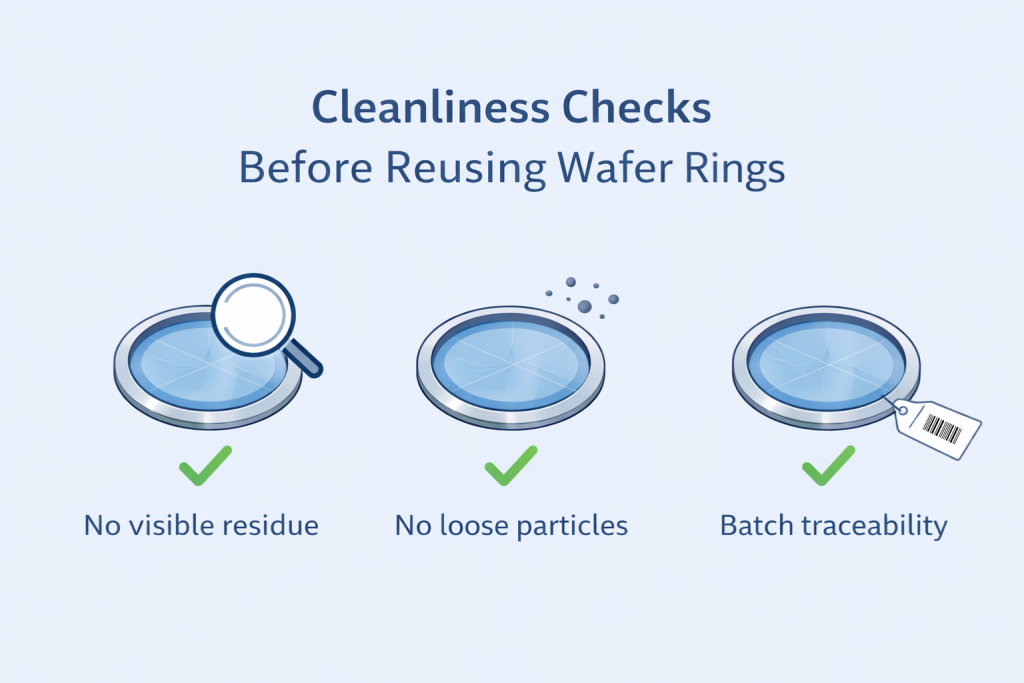
Start with plain language that your team can apply consistently. Many programmes begin by defining clean enough as: no visible residue on defined surfaces, no loose particles observed during handling, and no obvious film or smear that suggests residues remain. It also helps to define what acceptable return packing looks like, because many issues are introduced after washing.
If you need quantitative thresholds, define them with Quality and specify how they will be measured. Do not assume a supplier’s standard checks match your internal requirements.
What should Quality approve upfront?
Quality sign off becomes easier when acceptance criteria are realistic. A common approach is to agree on a visual inspection standard with examples, a short non-negotiable reject list, and a sampling approach that scales with volume. On top of that, keep a simple batch record so traceability does not become a guess.
SuperPak’s service description emphasises cleanliness and contamination prevention as part of the refurbishment workflow it describes for wafer rings and shipper boxes.
What traceability should you keep?
You do not need a complicated system to start. A simple batch record is often enough: pickup date, source location, counts received and returned, reject count, and exception notes. Traceability is how you stop recurring exceptions and how you prove the loop is controlled when it is time to scale.
How Do You Keep Wafer Rings Clean During Packing And Transport?
A common frustration is that rings leave washing clean and return not clean. That is usually a handling and packing issue, not a washing issue. If you want stable results, post wash packing has to be treated as part of the cleanliness system.
SuperPak’s cleanroom packaging guidance highlights that ordinary packaging materials like paper, cloth, and cardboard shed fibres and particles, which is why cleanroom packaging relies on material choices and best practices designed to maintain cleanliness.
In practical terms, that means controlling what touches the cleaned items, standardising how items are sealed, and avoiding packing methods that reintroduce dust during transport or storage. When this is consistent, washing outcomes become far more predictable.
What Usually Goes Wrong, And How Do You Prevent It?
Most failures come from process drift. Washing might be fine, but the loop fails because inputs are inconsistent and decisions are not owned.
Programmes often break down when rings with unknown history are mixed into the standard flow, quarantine is not enforced, rejects are not removed properly, or acceptance criteria are debated repeatedly instead of being defined once and improved over time. Another common issue is that packing and collection habits vary across sites, so receiving teams face unpredictable batches week after week.
The fixes are usually practical. Enforce triage every batch. Start small, then scale only when outcomes are stable. Define acceptance criteria in plain language, then refine based on real exceptions. Standardise packing so items do not recontaminate after washing. Most importantly, assign ownership so borderline cases do not become weekly negotiations.
How Do You Run A Small Pilot Before Scaling Wafer Ring Recycling?
A pilot is meant to prove the loop is stable, not perfect. If you include every ring type and every return lane from day one, you will get too many variables at once. That makes it hard to tell whether problems are coming from sorting, packing, transport, or washing.
Start small and keep the inputs consistent. Pick one ring type and one site or return lane. Keep weekly volumes predictable, agree on simple reject rules upfront, and standardise how rings are packed at pickup and on return. Run the pilot long enough for patterns to show up, then expand one step at a time.
A practical pilot flow looks like this:
- Choose one ring type and one return lane.
- Define three buckets at receiving: reuse, quarantine, reject.
- Lock down packing rules for pickup and return so handling does not change week to week.
- Review results weekly with Ops and Quality, using the same acceptance criteria each time.
- Scale only after the results are steady, not after one good batch.
To keep the pilot measurable without overloading the team, track a small set of metrics:
- received count
- accepted count
- quarantined count
- rejected count
- turnaround time
- exceptions noted
If these stabilise and Quality is comfortable with the checks, you can scale to the next ring type or lane. If they do not, tighten scope and fix sorting and handling first.
SuperPak explicitly recommends piloting the loop and encourages you to share lanes, volumes, and item photos so they can propose a practical pickup-to-return workflow and pilot approach before scaling.
What Should You Include In An RFQ For Recycling Wafer Ring Services?
A strong RFQ is one of the fastest ways to improve outcomes because it removes guesswork. It also helps you compare suppliers on the things that matter, instead of comparing vague promises.
Keep your RFQ short, but specific. Describe your wafer ring types and size range, what the typical return condition looks like, and the volumes you expect weekly or monthly. State whether you are running a pilot or launching a full programme and what turnaround time you are aiming for. Include pickup locations and how items are currently packed at pickup, because that impacts sorting and risk. Then define “clean enough” in plain language and clarify any acceptance checks or traceability needs. Finally, specify how quarantine and rejects should be handled, and what return packing requirements matter for your receiving process.
If you want to compare vendors quickly, these evaluation criteria usually improve decision quality:
- Can the supplier describe the end to end workflow clearly, including sorting and rejects?
- Can the supplier explain how cleanliness is preserved after washing through packing and return?
- Can the supplier support batch control and documentation that matches your Quality expectations?
SuperPak lists collection of packaging items for recycling and washing as a service and encourages enquiries for quotation based on packaging needs, so a structured RFQ like this helps you get a faster, more accurate response.
If you want a quote that reflects real operations, send SuperPak an RFQ with the details above and ask what inputs they need for wafer ring collection, washing, and refurbishment.
Why Choose Superpak For Wafer Ring Recycling And Washing?
If you are shortlisting partners, focus on who can support a controlled loop, not just a washing step. SuperPak positions itself as a packaging partner with contract manufacturing services that include collection of packaging items for recycling and washing, and it provides a concrete example of wafer ring and shipper box refurbishment using aqueous washing for the semiconductor industry.
That is useful because many suppliers describe “recycling” in generic terms. When a supplier can discuss collection, sorting, cleanliness control, and reject handling as a single operational programme, it is usually easier to build a stable workflow that Quality can approve.
FAQs
Is wafer ring recycling the same as washing and refurbishment?
Teams often use the terms loosely. In practice, washing and refurbishment keep rings in use, while recycling is what happens when rings are no longer fit for safe reuse. A strong programme treats both as parts of one controlled loop, with clear reject rules.
Should you start with reuse before recycling?
In most cases, yes. Stabilise the reuse loop first so you can measure what portion truly cannot return to use. That makes recycling decisions clearer and prevents the loop from being flooded with exceptions.
What should you do with heavily contaminated rings?
Do not mix them into the standard batch. Quarantine them, assess separately, and decide whether separate handling is sensible. If risk is high, reject early and remove them from the loop.
What should you prepare before contacting a vendor?
Prepare your ring types, rough volumes, pickup locations, turnaround needs, and a plain language definition of clean enough. If you can also describe common residues or reasons for rejection, your quote and workflow recommendations will be more accurate.
Conclusion
A recycling wafer ring programme works when it is run as a controlled process. Sorting rules, reject control, agreed acceptance checks, and consistent packing are what keep the loop stable. Washing matters, but it cannot compensate for mixed batches and inconsistent handling.
If you are planning a wafer ring reuse or refurbishment programme, contact SuperPak and ask about its collection of packaging items for recycling and washing service. Share your wafer ring types, estimated volumes, pickup locations, cleanliness expectations, and target turnaround time. If you are still exploring options, start by checking SuperPak’s services catalogue, then reach out with your questions so the recommendation matches your real workflow.