
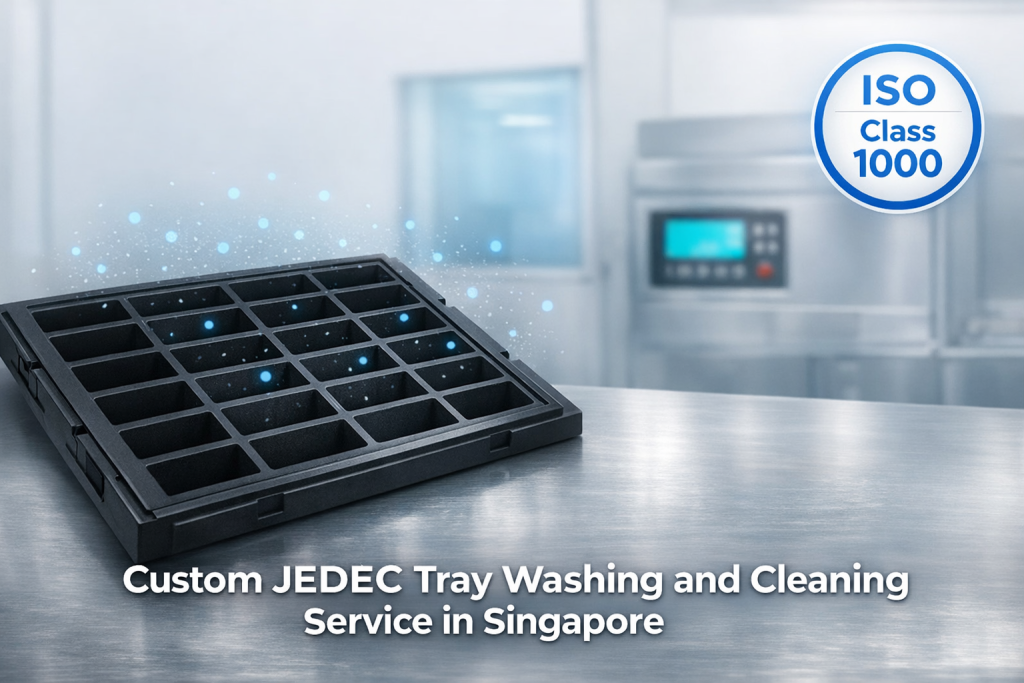
If you are searching for custom JEDEC tray washing and cleaning in Singapore, you most likely need to return used IC trays to semiconductor packaging, testing, or storage workflows without introducing contamination. That is a high-stakes requirement. A single particle smaller than the minimum circuit linewidth can cause a fatal device defect, and studies estimate that contamination accounts for roughly 75% of yield loss in integrated circuit fabrication.
At SuperPak, we operate cleanroom DI washing facilities with aqueous washing machines, a dedicated tray washer, vacuum ovens, and an in-house laboratory equipped with ion chromatography, liquid particle counters, FTIR, and UV spectrophotometry. We have been running collection and refurbishment programmes for the semiconductor industry for years, including cross-border collection from South Korea and Vietnam.
This guide covers what JEDEC tray washing involves, when it makes sense versus replacement, the step-by-step process, equipment requirements, cleanliness standards, common mistakes, and how to evaluate a service provider. It is written for procurement, quality, and operations teams at semiconductor companies and OSATs who need practical, verifiable information to make a sourcing decision.
Quick Summary: What Is Custom JEDEC Tray Washing?
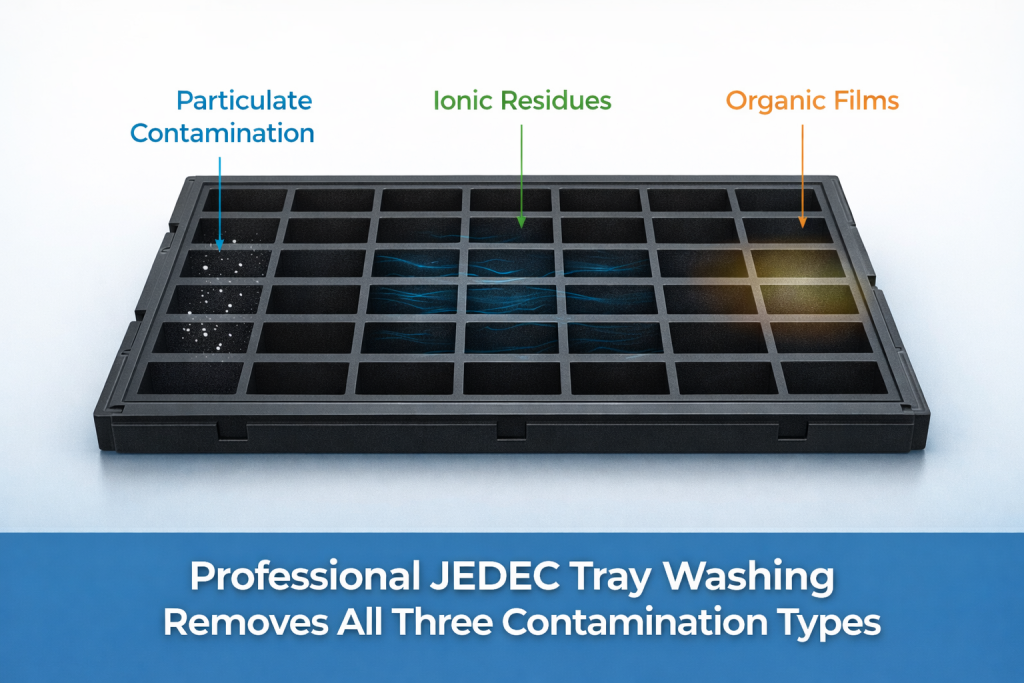
Custom JEDEC tray washing is a controlled cleanroom process that removes particulate, ionic, and organic contamination from reusable semiconductor IC trays using aqueous (deionized water-based) methods, restoring them to a cleanliness level suitable for re-entry into semiconductor packaging and testing workflows. It is used when trays must meet micro-contamination standards for automated handling environments, and it requires ISO-classified wash facilities, validated cleaning chemistries, and post-wash laboratory verification. Not all trays are candidates for washing; structural damage or degraded ESD properties disqualify reuse.
What this article covers:
- What JEDEC trays are and why they need professional cleaning
- When to wash versus replace
- The step-by-step washing process
- Equipment, standards, and common mistakes
- How to evaluate a tray cleaning provider in Singapore
- Cross-border collection and sustainability considerations
What Is a JEDEC Tray and Why Does It Need Professional Cleaning?
A JEDEC tray, also called an IC matrix tray or waffle tray, is a standardised ESD-safe plastic container used to transport, test, and store semiconductor IC packages. JEDEC stands for the Joint Electron Device Engineering Council, which is the leading standards organisation for the microelectronics industry. Professional cleaning is required because residual particles, ionic contaminants, and organic films on tray surfaces can transfer to sensitive ICs, causing yield loss, ESD failures, or moisture-related damage during reflow soldering.
The global plastic IC JEDEC tray market was valued at approximately US$371 million in 2024 and is projected to reach US$539 million by 2031, growing at a compound annual growth rate (CAGR) of 5.6%. That growth is driven by increasing semiconductor packaging volumes and tighter quality requirements. As the trays cycle through more automated handling environments, they accumulate contamination that cannot be removed by simple wiping or blowing.
JEDEC trays are typically manufactured from conductive or static-dissipative plastics such as modified polyphenylene oxide (MPPO), conductive polycarbonate, or carbon-filled ABS compounds. These materials are engineered to provide ESD protection with surface resistivity in the range of 10⁴ to 10¹¹ ohms per square, which is the safe range for IC handling. After repeated use in packaging and testing environments, trays pick up contamination from multiple sources: airborne molecular contamination (AMC), handling residue, process chemicals, and outgassing from surrounding materials.
In semiconductor manufacturing, contamination is the primary cause of production failure and demands the highest level of contamination control . The same principle applies to the packaging and carriers that physically touch the product. A tray that looks clean to the naked eye may carry ionic residues invisible to human inspection but measurable by ion chromatography, or it may harbour particles that show up only under a liquid particle counter. Professional cleaning addresses all of these contamination types in a controlled, repeatable process.
When Should You Wash JEDEC Trays Instead of Replacing Them?
Washing is the more cost-effective and sustainable first option whenever the tray is structurally intact, its contamination type is compatible with aqueous cleaning, and the tray material can withstand repeated wash cycles without degrading ESD or dimensional properties.
Singapore’s semiconductor market reached US$10.16 billion in 2025. At that scale, even modest improvements in packaging cost efficiency translate into meaningful savings. JEDEC trays are engineered for repeated use, and discarding a structurally sound tray after a single cycle wastes both money and material.
Use this three-check decision framework to decide whether a tray is a candidate for washing:
1. Structural condition. Inspect the tray for cracks, warping, broken stacking features, or cavity deformation. If any of these are present, the tray cannot reliably protect ICs or interface with automated pick-and-place equipment. Washing will not fix structural damage, so these trays should be routed to recycling.
2. Contamination type. Aqueous washing is highly effective at removing particulate, ionic, and many organic contaminants. However, some heavily cross-linked organic residues or chemical stains may require specialised treatment. If the contamination history is unknown, the tray should be quarantined and assessed before entering the standard wash flow.
3. Material wash tolerance. Tray materials like MPPO and conductive polycarbonate are generally compatible with aqueous washing and resist degradation across multiple cycles. However, repeated exposure to certain cleaning chemistries or high-temperature drying can eventually reduce ESD performance or dimensional stability. Set maximum wash-cycle limits and verify ESD properties periodically.
If two of these three checks are positive, washing is typically worth pursuing. If one or none are positive, the tray should be routed out of the reuse loop.
From a regulatory perspective, washing and reusing trays also aligns with Singapore’s Resource Sustainability Act, under which producers must report on packaging placed on the market and submit plans to reduce, reuse, or recycle packaging . Tray washing programmes directly support these reuse obligations.
Need help deciding whether your JEDEC trays are candidates for washing? Contact SuperPak for an assessment.
How Does the JEDEC Tray Washing Process Work? (Step-by-Step)
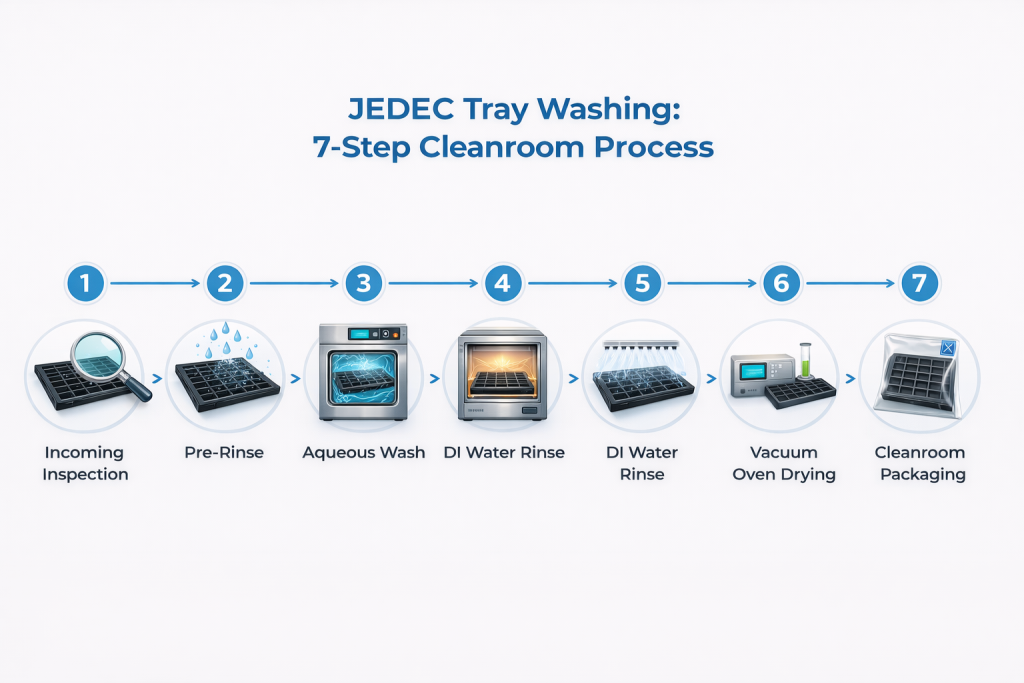
A professional JEDEC tray washing process follows a controlled sequence: incoming inspection and sorting, pre-rinse, aqueous wash in a cleanroom-grade machine, multi-stage DI water rinse, vacuum oven drying, post-wash laboratory verification, and cleanroom packaging for return. Each step is designed to remove a specific contamination type while preventing recontamination.
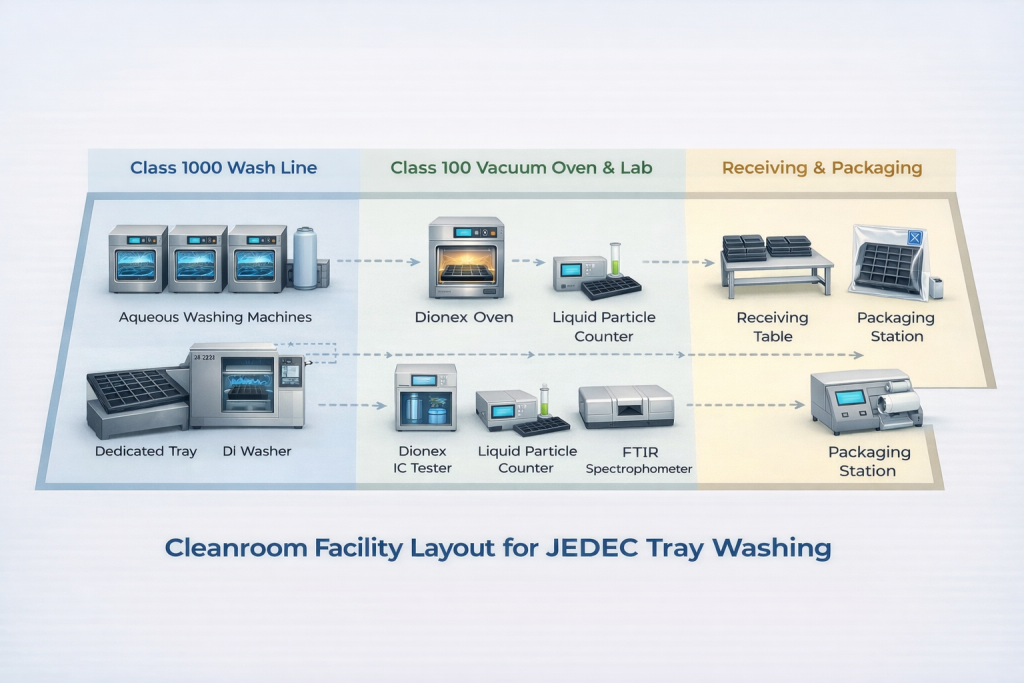
At SuperPak, our cleanroom DI washing facilities provide micro-contamination cleaning services across multiple industries, with washing lines classified at Class 1,000 and vacuum ovens operating at Class 100. Here is how a typical tray washing programme works:
Step 1: Incoming inspection and sorting. Every tray batch is visually inspected upon arrival. Trays are sorted into three categories: ready for wash (structurally intact, normal residue), quarantine (uncertain history or heavier contamination), and reject (cracked, warped, or otherwise unfit for reuse). This sorting step is critical because mixing damaged or heavily contaminated trays into the standard wash flow increases reject rates downstream.
Step 2: Pre-rinse. Trays receive an initial rinse with deionized water to remove loose particles and surface debris. This step prevents heavy contamination from carrying over into the primary wash cycle and extending process times.
Step 3: Aqueous wash cycle. Trays are loaded into aqueous washing machines that use DI water-based cleaning chemistry at controlled temperature. The machines may use spray, immersion, or ultrasonic agitation depending on the contamination profile. Aqueous washing is the preferred method for semiconductor packaging cleaning because DI water is an excellent solvent for ionic contaminants and, when combined with surfactants, effectively removes organic films without the material compatibility risks of organic solvents.
Step 4: Multi-stage DI water rinse. After the wash cycle, trays pass through multiple rinse stages using fresh deionized water. The purpose is to flush away any residual cleaning chemistry and dissolved contaminants. The final rinse water is typically monitored for resistivity to confirm cleanliness.
Step 5: Vacuum oven drying (Class 100). Trays are dried in a vacuum oven operating within a Class 100 (ISO Class 5) environment. Vacuum drying prevents water spots and airborne particles from redepositing on the freshly cleaned surfaces. This is a step often overlooked in less controlled washing operations, and it makes a significant difference to final cleanliness results.
Step 6: Laboratory verification. Post-wash, a representative sample from each batch undergoes laboratory testing. This may include liquid particle counting to measure surface particle levels, ion chromatography (using equipment such as a Dionex IC tester with autosampler) to quantify ionic residues, FTIR to identify any remaining organic contamination, and UV spectrophotometry for additional surface cleanliness validation.
Step 7: Cleanroom packaging and return. Verified trays are packaged in a cleanroom environment to prevent recontamination during storage and transport. Documentation, including batch records and test results, accompanies each shipment for traceability.
This seven-step process is designed to be repeatable. The key to a stable programme is discipline in the early stages. If incoming inspection and sorting are handled rigorously, the wash process itself becomes predictable, and your return yield stabilises.
What Equipment and Facilities Are Needed for Cleanroom Tray Washing?
Effective JEDEC tray washing requires cleanroom-classified washing lines (typically Class 1,000 or better), aqueous washing machines with built-in or external vacuum ovens, a deionized water plant, and in-house laboratory equipment for post-wash verification.
The cleanroom classification of the wash environment is not a marketing detail. It determines the maximum allowable airborne particle concentration. ISO 14644-1, the international standard for cleanroom classification, defines the maximum permitted concentrations of airborne particles by size for each cleanliness class. For JEDEC tray washing, wash lines typically operate at ISO Class 6 (roughly equivalent to the older Fed Std 209E Class 1,000), and drying/final inspection should happen at ISO Class 5 (Class 100) or better.
SuperPak’s washing facility lists the following capabilities, which represent a well-equipped tray washing operation:
|
Capability |
What It Does |
Why It Matters for JEDEC Tray Washing |
|
Aqueous wash machines (3 units) with built-in vacuum oven (Class 100) |
Clean trays using DI water-based chemistry under controlled conditions, then dry under vacuum |
Remove particulate, ionic, and organic contamination without solvents; prevent recontamination during drying |
|
Dedicated tray washer (1 unit) |
Purpose-built for tray geometry and stacking |
Ensure uniform cleaning across all cavities and surfaces |
|
DI water plant |
Produce ultrapure deionized water on-site |
Prevent recontamination from dissolved minerals or ions in water supply |
|
Washing lines (Class 1,000) |
ISO-classified cleanroom environment for the wash process |
Prevent airborne particles from redepositing on trays during processing |
|
External vacuum oven (Class 100) |
Additional drying capacity in a particle-controlled environment |
Handle overflow capacity without compromising cleanliness |
|
Dionex IC tester with autosampler |
Detect and quantify ionic residues through ion chromatography |
Confirm removal of ionic contaminants that cause corrosion or ESD risk |
|
PMS SO2 and SO5 liquid particle counter |
Measure particle levels in rinse water or on tray surfaces |
Validate that trays meet surface cleanliness specifications |
|
FTIR spectrophotometer |
Identify organic residue composition using infrared spectroscopy |
Verify organic contamination has been eliminated |
|
UV spectrophotometer |
Measure organic contamination levels through UV absorption |
Provide additional verification of surface cleanliness |
|
Crest ultrasonic tank (68 kHz and 132 kHz) |
Deliver ultrasonic energy for particle removal |
Dislodge embedded particles that spray washing alone cannot reach |
The in-house laboratory is what separates a professional washing operation from a basic rinse-and-dry service. Without particle counting and ion chromatography, there is no way to verify that the wash actually achieved the required cleanliness level. You are relying on assumptions rather than data.
What Industries Need JEDEC Tray Cleaning Services?
Semiconductor packaging and testing is the primary industry, but cleanroom-grade tray washing also serves hard disk drive manufacturing, pharmaceutical packaging, automotive electronics, and aerospace component handling. Any sector where micro-contamination control is critical is a potential user of professional tray cleaning services.
SuperPak has cleanroom DI washing facilities provide micro-contamination cleaning for the following industries:
- Semiconductor. IC packaging, wafer-level packaging, and outsourced semiconductor assembly and test (OSAT) facilities are the largest users. In 2024, Asia-Pacific accounted for over 54% of the global semiconductor packaging market, and Singapore contributed more than 10% of the world’s total semiconductor output.
- Hard disk drive. HDD manufacturing requires similar contamination control to semiconductor fabrication, particularly for media and head components.
- Pharmaceutical. Cleanroom trays used to handle sterile drug products or medical devices must meet strict particulate and microbial standards.
- Automotive. Advanced driver-assistance systems (ADAS) and electric vehicle power electronics demand high-reliability semiconductor components, which means the packaging must meet stringent cleanliness levels throughout the supply chain.
- Aerospace. Components for avionics and satellite systems require documented contamination control across every handling step.
If your operation uses JEDEC trays or similar packaging in any of these sectors, professional cleaning is worth evaluating. For context on how cleanroom packaging fits into semiconductor and pharmaceutical operations, see our cleanroom packaging guide for Singapore.
Aqueous Washing vs. Solvent Cleaning for JEDEC Trays: Which Is Better?
Aqueous (DI water-based) washing is the preferred method for JEDEC tray cleaning because it avoids the material compatibility risks, environmental concerns, and residue issues associated with solvent-based cleaning, while still achieving the micro-contamination removal levels that semiconductor workflows require.
The semiconductor industry has largely moved toward aqueous cleaning methods for a range of process steps. DI water is an excellent solvent for ionic contaminants, and when combined with controlled surfactant chemistry, it effectively removes organic films and particulate matter. The shift away from solvent-based cleaning was driven partly by environmental regulations and partly by the recognition that solvent residues themselves can become contaminants.
Here is how the two methods compare when applied to JEDEC tray cleaning:
|
Factor |
Aqueous (DI Water-Based) Washing |
Solvent-Based Cleaning |
|
Cleaning mechanism |
Surfactant chemistry combined with DI water and ultrasonic or spray energy |
Chemical dissolution of contaminants using organic solvents |
|
Material compatibility |
Safe for MPPO, polycarbonate, and conductive polymers commonly used in JEDEC trays |
Risk of swelling, crazing, or degrading ESD properties in some tray materials |
|
Residue risk |
Very low since DI water rinse leaves minimal residue |
Higher because solvent residue may require secondary cleaning |
|
Environmental impact |
Lower because water-based processes have easier waste treatment |
Higher due to volatile organic compound (VOC) emissions and hazardous waste disposal requirements |
|
Cleanroom suitability |
Excellent and standard in semiconductor cleanrooms |
Limited because solvent vapours can be a contamination and safety concern in clean environments |
|
Effectiveness on ionic contaminants |
Strong because DI water is an excellent ionic solvent |
Variable and depends on the specific solvent type |
|
Cost per cycle |
Typically lower operating cost due to water-based consumables |
Typically higher due to solvent procurement, handling, and disposal costs |
SuperPak uses aqueous washing with DI water in its semiconductor tray cleaning operations, describing it as “a highly effective, environmentally friendly, and cost-efficient cleaning method suitable for a range of applications, particularly in industries that require stringent cleanliness standards.”
What Cleanliness Standards Apply to Washed JEDEC Trays?
Washed JEDEC trays must meet the cleanliness standards defined by the end-user’s semiconductor process. These requirements typically reference ISO 14644 for the wash environment classification, IEST-STD-CC1246E (or its successor) for surface particle cleanliness, and ANSI/ESD S541 for ESD packaging requirements.
ISO 14644-1: Cleanroom classification. This international standard defines maximum permitted concentrations of airborne particles by particle size for each cleanroom class. For semiconductor fabrication, most processes take place in ISO Class 4 to 6 environments. The tray washing facility itself should operate at a classification consistent with where the trays will be used. Washing lines at Class 1,000 (approximately ISO Class 6) and drying at Class 100 (ISO Class 5) are typical benchmarks.
IEST-STD-CC1246E: Surface cleanliness. This standard, published by the Institute of Environmental Sciences and Technology, defines cleanliness levels for surfaces based on the number and size of particles present. It is commonly referenced for specifying the acceptable surface particle counts on washed trays, carriers, and other packaging components.
ANSI/ESD S541: ESD packaging. Published by the ESD Association, this standard provides requirements for packaging materials used to protect ESD-sensitive devices. After washing, JEDEC trays must retain their static-dissipative or conductive properties. The washing process should not degrade the surface resistivity of the tray material. Post-wash ESD testing confirms compliance.
Ionic contamination thresholds. These are often customer-specific and measured using ion chromatography. Common anions and cations (chloride, sulfate, sodium, potassium, ammonium) are quantified, and acceptable limits are defined by the semiconductor manufacturer’s process requirements. There is no single universal threshold because the tolerance depends on the IC technology node and the specific process step.
The important point is that cleanliness is not a single number but a combination of particle, ionic, and organic specifications that must all be met. Post-wash laboratory testing, using instruments like those in SuperPak’s in-house lab, is the mechanism for verifying compliance across all of these dimensions.
5 Common Mistakes in JEDEC Tray Cleaning (And How to Avoid Them)
The most common mistakes in JEDEC tray cleaning are skipping incoming inspection, using non-DI water, drying outside a controlled environment, omitting post-wash verification, and reusing trays with degraded ESD properties. Each of these can introduce contamination back into the semiconductor workflow or allow defective trays to reach the production line.
Mistake 1: Skipping incoming inspection. When trays arrive for washing without being sorted, damaged or heavily contaminated items enter the standard wash flow. They may not clean properly, they can contaminate the wash chemistry for the rest of the batch, and they create unexpected rejects after washing. The fix is straightforward: sort every batch before it enters the wash process. Use a three-category system (ready for wash, quarantine, reject) and enforce it consistently.
Mistake 2: Using tap water or non-DI water. Tap water contains dissolved minerals and ions that will deposit onto tray surfaces during washing and rinsing. This is the opposite of cleaning. In the semiconductor wet cleaning process, deionized water is essential because the cations and ions in raw water can contaminate device structures and change surface resistivity. The fix: mandate DI water for all wash and rinse stages, and monitor water quality from your DI plant.
Mistake 3: Drying in an uncontrolled environment. After washing, trays are at their cleanest and most vulnerable. If they are dried in an open factory environment or even a general clean area, airborne particles will redeposit on the freshly cleaned surfaces. Semiconductor cleanrooms operate with high air changes per hour and ULPA or HEPA filtration for precisely this reason. The fix: use vacuum oven drying within a classified cleanroom environment (Class 100 or better).
Mistake 4: No post-wash verification. Assuming the wash worked without measuring the result is a common and costly gap. Without particle counting and ionic analysis, you have no evidence that the trays meet specification. You also cannot detect process drift in your washing operation until defective trays cause problems downstream. The fix: require particle count and ionic testing on a defined sample from every batch. Use the data to track trends and flag process issues early.
Mistake 5: Ignoring tray material degradation. Repeated wash cycles, combined with exposure to cleaning chemistry and high-temperature drying, can gradually reduce ESD surface resistivity or cause dimensional changes in tray cavities. If degraded trays re-enter the production line, they may fail to protect ICs from electrostatic discharge or may not interface correctly with automated handlers. The fix: set maximum wash-cycle limits based on the tray material, and test ESD properties periodically. Replace trays that no longer meet specification.
SuperPak’s in-house laboratory catches these issues before trays re-enter your process. Contact SuperPak to discuss your tray cleaning requirements.
How to Evaluate a JEDEC Tray Cleaning Service Provider
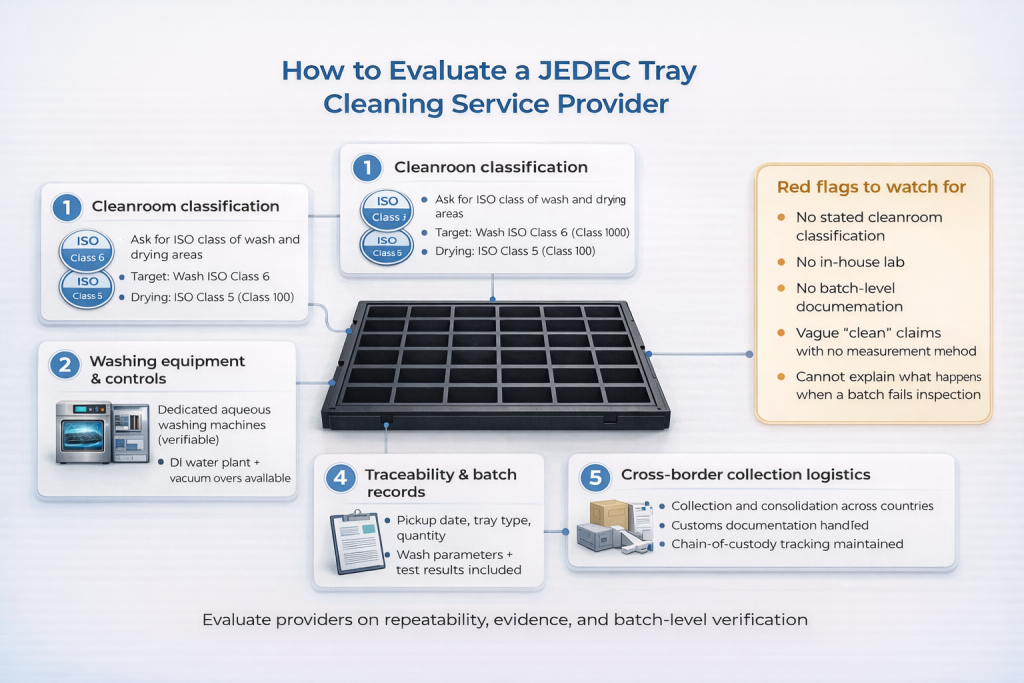
Evaluate a tray cleaning provider on five operational criteria: cleanroom classification of their wash environment, washing equipment and process controls, in-house laboratory and testing capabilities, traceability and batch documentation, and cross-border collection logistics.
If you are sourcing a tray cleaning partner in Singapore or the broader Asia-Pacific region, you do not need a full audit to get a useful signal. You need evidence that the provider can run a stable, repeatable loop that protects your product and your process. Here is what to check:
1. Cleanroom classification. Ask for the ISO classification of their washing lines and drying areas. Verify that the wash environment is at least Class 1,000 (ISO Class 6) and drying is at Class 100 (ISO Class 5). If the provider cannot state their cleanroom classification clearly, that is a red flag.
2. Washing equipment and process controls. Look for dedicated aqueous washing machines (not repurposed general-purpose equipment), a DI water plant, and vacuum ovens. Ask about temperature and chemistry controls during the wash cycle. The equipment list should be specific and verifiable.
3. In-house laboratory. This is the single most important differentiator. A provider with ion chromatography, liquid particle counters, FTIR, and UV spectrophotometry can verify cleanliness quantitatively. A provider without a lab is asking you to trust their process on faith.
4. Traceability and batch documentation. Each batch of washed trays should come with a record that includes pickup date, tray type and quantity, wash parameters, test results, and pass/fail status. Without traceability, every quality issue becomes an argument, and programme improvement is impossible.
5. Cross-border collection capability. If your trays originate from multiple countries, your provider needs logistics infrastructure to handle collection, consolidation, customs documentation, and chain-of-custody tracking across borders.
Red flags to watch for: No stated cleanroom classification. No in-house lab. No batch-level documentation. Vague references to “clean” or “washed” without specifying how cleanliness is measured. Inability to explain what happens when a batch fails inspection.
Beyond these five criteria, it is worth considering whether the provider can support your wider packaging needs. SuperPak operates as a one-stop packaging solutions provider, offering manufacturing, supply chain management, product development, and contract manufacturing alongside cleaning services. For semiconductor companies, having a single partner who handles thermoformed products, tape and reel packaging, and tray washing simplifies vendor management and improves accountability.
For a broader discussion of how to evaluate ISO-certified packaging partners for the Singapore electronics industry, see our guide on ISO 9001 certified packaging supply chain providers.
How Cross-Border Tray Collection Works (Singapore, South Korea, Vietnam)
Cross-border JEDEC tray collection involves coordinating pickup from semiconductor facilities in countries like South Korea and Vietnam, consolidating shipments, and routing trays to a Singapore-based washing facility while maintaining chain-of-custody documentation and customs compliance.
The semiconductor supply chain is inherently international. In 2024, Asia-Pacific accounted for approximately 75% of the global semiconductor assembly and packaging equipment market. Semiconductor companies routinely operate across multiple countries in the region, which means their used JEDEC trays are scattered across sites in South Korea, Vietnam, China, Malaysia, the Philippines, and beyond.
SuperPak has one of its key projects as the “collection and refurbishment of shipper boxes and wafer rings from South Korea and Vietnam with aqueous washing for the semiconductor industry“. This cross-border collection capability is essential for running a tray washing programme at scale.
A typical cross-border collection workflow looks like this:
Pickup and consolidation. Used trays are collected from the client’s semiconductor facility, sorted on-site or at a local consolidation point, and packed for international shipping. Basic tracking at this stage (batch identifier, pickup date, site, tray type, quantity) creates the traceability foundation for the entire programme.
Shipping and customs. Trays are shipped to Singapore with appropriate customs documentation. Since JEDEC trays are classified as plastic packaging items rather than electronic components, the customs process is relatively straightforward, but accurate classification and documentation are still required to avoid delays.
Receiving, wash, and return. Upon arrival at the Singapore facility, trays are re-inspected, washed according to the standard process described earlier in this article, and returned to the client’s designated location with batch records and test results.
For companies already working with SuperPak’s supply chain services, adding cross-border tray collection to an existing logistics relationship is a natural extension. SuperPak’s regional operations span Singapore, Malaysia, Indonesia, and China, which provides the logistics footprint needed to manage multi-country collection efficiently.
How JEDEC Tray Washing Supports Sustainability Goals
Washing and reusing JEDEC trays extends their service life, reduces plastic waste sent to landfill or incineration, and helps semiconductor companies meet Singapore’s mandatory packaging reporting requirements under the Resource Sustainability Act.
Singapore’s National Environment Agency (NEA) requires businesses with annual turnover exceeding S$10 million to submit packaging data and plans to reduce, reuse, or recycle packaging. Tray washing programmes directly support the “reuse” component of these obligations. Every tray that is washed and returned to service is a tray that does not need to be manufactured, shipped, and disposed of as new.
SuperPak holds ISO 14001:2015 certification for environmental management, which provides a framework for systematically managing the environmental aspects of its operations, including waste reduction and resource efficiency in its washing and recycling services. The company has a documented focus on sustainability, including creating recyclable and biodegradable packaging materials.
The circular economy logic for JEDEC tray washing is clear: wash and reuse first, recycle only when reuse is no longer viable. This approach mirrors the hierarchy that guides Singapore’s Resource Sustainability Act and global best practice for industrial packaging management. For semiconductor companies tracking their environmental footprint, a tray washing programme is a practical, measurable contribution to sustainability goals.
Ready to set up a JEDEC tray washing programme? Contact SuperPak to get a quotation tailored to your tray types, volumes, and cleanliness requirements.
Frequently Asked Questions About JEDEC Tray Washing
What types of JEDEC trays can be professionally washed?
Most JEDEC-standard IC matrix trays made from MPPO, conductive polycarbonate, or carbon-filled ABS polymers can be washed using aqueous methods, provided they are structurally intact and have not exceeded their recommended wash-cycle limit. Custom or non-standard trays should be assessed on a case-by-case basis. Contact SuperPak with your tray specifications for confirmation.
How clean do JEDEC trays need to be after washing?
Cleanliness targets are defined by the end-user’s semiconductor process requirements and may reference ISO 14644 for the wash environment, IEST-STD-CC1246E for surface particle levels, and ANSI/ESD S541 for ESD packaging. Post-wash verification using particle counters and ion chromatography confirms that trays meet specifications. The specific thresholds vary depending on your IC technology node and process step.
What is aqueous washing and why is it preferred for semiconductor trays?
Aqueous washing uses deionized (DI) water combined with controlled cleaning chemistry, rather than organic solvents, to remove contamination from tray surfaces. It is preferred for semiconductor applications because DI water is highly effective at removing ionic contaminants, it is compatible with most JEDEC tray materials, and it avoids the VOC emissions, residue risks, and disposal costs associated with solvent-based methods.
How many times can a JEDEC tray be washed before it needs to be replaced?
The number of wash cycles a tray can withstand depends on its material composition, the washing chemistry used, and the drying conditions. There is no single universal number. The key is to monitor ESD surface resistivity and dimensional stability after washing. Trays should be retired when they no longer meet specification, regardless of how many cycles they have completed. Ask your cleaning provider whether they track and test for material degradation.
Can JEDEC trays be collected from overseas for washing in Singapore?
Yes. Cross-border collection is a standard part of professional tray cleaning programmes, particularly in the semiconductor industry where supply chains span countries like South Korea, Vietnam, China, and across Southeast Asia. SuperPak states that it collects shipper boxes and wafer rings from South Korea and Vietnam for aqueous washing at its Singapore facility.
What is the difference between JEDEC tray washing and JEDEC tray recycling?
Washing restores a tray to reusable condition by removing contamination while preserving the tray’s structural and ESD properties. Recycling breaks the tray down into raw material, typically through regrinding, for manufacturing new products. Washing should be the first option for intact trays; recycling is the appropriate route for trays that are damaged, warped, or have degraded beyond recovery. For more on how this loop works, see our guide on shipper box and wafer ring refurbishment.
How long does a typical JEDEC tray washing turnaround take?
Turnaround time varies based on batch size, tray condition, cleaning specifications, and collection logistics. Exact timelines should be confirmed with your service provider as part of the quotation process. Factors that tend to extend turnaround include heavy contamination requiring additional wash cycles, cross-border collection from multiple sites, and custom cleanliness verification requirements beyond standard parameters.