
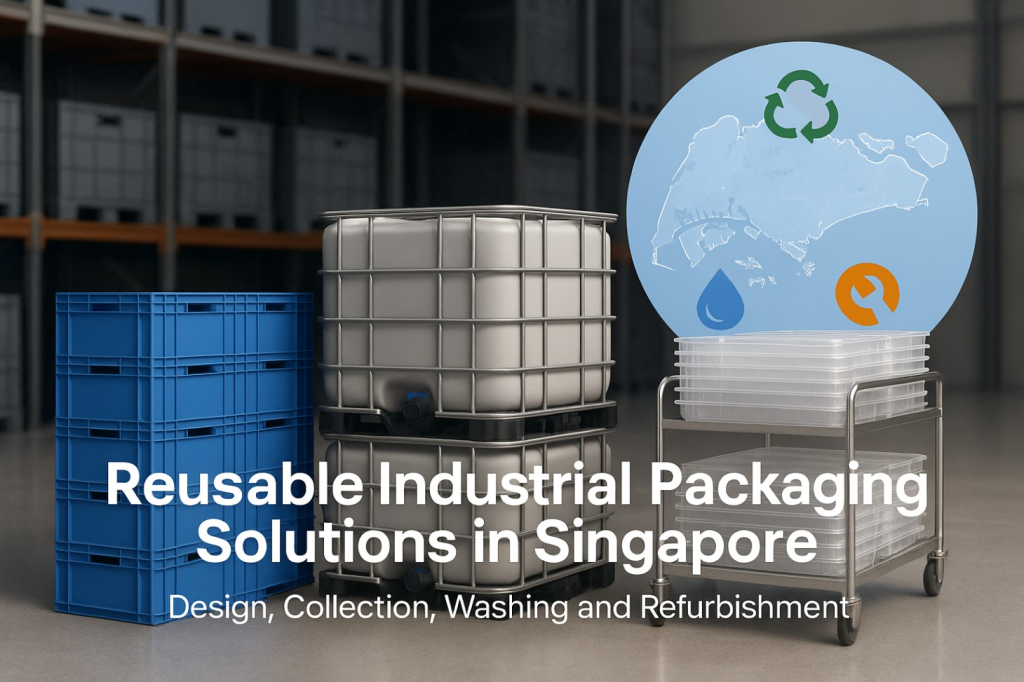
Single-use packaging is getting more expensive, Singapore’s packaging rules are tightening, and supply-chain teams want more resilience from every dollar they spend. These pressures are pushing manufacturers toward closed-loop, reusable industrial packaging in 2026. At SuperPak, we design, collect, wash, and refurbish reusable packaging from our Singapore base, with a particular focus on industries where cleanliness cannot be compromised. This guide explains how to build a reuse programme that holds up to those standards.
Quick Summary
Reusable industrial packaging is durable transport packaging, including crates, trays, shipper boxes, and wafer rings, that is designed to be collected, cleaned, inspected, and redeployed across many trips instead of discarded. Use it for repeated, high-volume logistics loops where contamination control and total cost of ownership matter. Key criteria are durability, a reliable reverse-logistics loop, and certified washing. The main caveat is that reuse only pays off with consistent collection and cleaning capacity.
In this guide you will find:
- A plain definition of reusable industrial packaging and how it differs from recycling.
- Why demand is accelerating in Singapore in 2026, including what NEA now requires.
- A reusable versus single-use comparison, plus a step-by-step launch plan.
- How collection, cleanroom washing, and refurbishment actually work.
- The mistakes to avoid and how to choose the right partner.
What is reusable industrial packaging?
Reusable industrial packaging, also called returnable transport packaging, is durable, multi-trip packaging built to be collected, cleaned, inspected, and reused within a closed-loop or pooled system, replacing single-use cartons and foam. It is defined as durable transport packaging designed for repeated use within closed-loop or pooled logistics networks.
It helps to separate three terms that often get used interchangeably. Reusable packaging is used many times before disposal, recyclable packaging is reprocessed into new material after a single use, and circular packaging is the broader system that keeps materials in use for as long as possible. Reuse sits higher in the waste hierarchy than recycling, and research consistently finds that shorter loop strategies such as reuse, repair, and refurbish create more environmental and economic value than recycling alone.
Common formats in this category include:
- Reusable plastic crates, totes, and pallets.
- Intermediate bulk containers (IBCs) for liquids and bulk solids.
- Thermoformed trays, carrier tape, and tape and reel for electronics.
- Semiconductor shipper boxes and wafer rings.
You can see several of these formats in our thermoformed products range and our reusable crate and pallet solutions.
Why is reusable packaging accelerating in Singapore in 2026?
Demand is rising because single-use packaging costs more over time, NEA now requires large companies to report packaging and submit reduction plans, and reusable systems strengthen supply-chain resilience. The economic case is also clear at the market level: the global reusable packaging market is forecast to grow from USD 141.34 billion in 2026 to USD 232.78 billion by 2035, a compound annual growth rate of 5.7%.
Two structural forces sit behind this. First, raw-material and disposal costs make single-use packaging a recurring expense rather than a one-time one. Second, regulation in Singapore and across Southeast Asia is moving steadily toward producer responsibility and reuse targets. Asia Pacific is now the fastest-growing region for returnable circular packaging, driven by rapid industrialisation and rising corporate sustainability commitments.
What is Mandatory Packaging Reporting and does it affect me?
Mandatory Packaging Reporting (MPR) is a Singapore requirement under the Resource Sustainability Act for larger companies to report their packaging data and submit a plan to reduce, reuse, or recycle it. The framework applies to companies with annual turnover above S$10 million that import packaged goods or use packaging in Singapore.
Timing matters this year. For packaging data collected in the 2025 calendar year, the submission window runs from January to March 2026, with a deadline of 31 March 2026. MPR is also designed to lay the foundation for a broader Extended Producer Responsibility framework for packaging waste.
How reuse supports a 3R plan
A 3R plan documents how your business will reduce, reuse, and recycle packaging, and switching to reusable formats gives you a concrete, measurable reuse action to report. Because reuse keeps assets in circulation, it directly supports the waste-reduction intent behind the reporting framework.
Practically, a reuse programme generates the kind of data that strengthens a 3R submission, such as the number of units kept in service and the volume of single-use packaging displaced. To understand our full sustainability approach, see SuperPak’s company background and certifications.
Not sure whether MPR applies to your packaging? Contact SuperPak for a reuse-readiness review of your operation.
Reusable vs. single-use packaging: which is right for your operation?
Reusable packaging usually wins on total cost of ownership for repeated, predictable logistics loops, while single-use can still make sense for one-way or low-volume shipments. Total cost of ownership analyses consistently favour reusable systems after roughly 10 to 15 rotation cycles in 2025, depending on how intensively the packaging is used.
The environmental and cost gap widens with each cycle. Lifecycle comparisons in 2025 indicate that reusable transport packaging reduces carbon emissions by 28 to 30% relative to disposable alternatives, while lowering per-trip logistics costs after about 4 to 6 usage cycles. The decision is less about the packaging itself and more about whether your route is reuse-friendly, meaning high volume, predictable, and with control over returns.
The table below summarises how the two approaches compare.
Factor | Single-use packaging | Reusable industrial packaging |
Upfront cost | Low per unit | Higher initial capital outlay |
Cost over many trips | Recurs every shipment | Spread across rotation cycles, with break-even after multiple uses |
Waste and disposal | High, with recurring disposal cost | Minimal, and supportive of 3R reporting |
Contamination control | Variable | Controlled through certified washing and inspection |
Best fit | One-way, low-volume, unpredictable routes | High-volume, repeated, closed-loop routes |
Reverse logistics | Not required | Required, through a collection and cleaning loop |
What does a reusable packaging programme involve?
A working reusable packaging programme runs as a continuous loop: design for reuse, collect used packaging, wash and inspect it to specification, refurbish or repair, then redeploy, with quality records captured at every step. The loop only works when collection and washing capacity are reliable, which is why these are treated as core operations rather than afterthoughts.
Thinking in terms of a system, rather than a product purchase, is the key shift. The four stages work together as follows:
- Design: select durable, washable formats engineered for repeated handling.
- Collection: return used packaging from customer or overseas sites to a washing facility.
- Washing and inspection: clean to the required cleanliness standard and verify the result.
- Refurbishment and redeployment: repair, re-qualify, and put assets back into service.
Each stage is covered in detail in the sections that follow, and all of them sit within our integrated collection, recycling, and washing service.
How do you design industrial packaging for reuse?
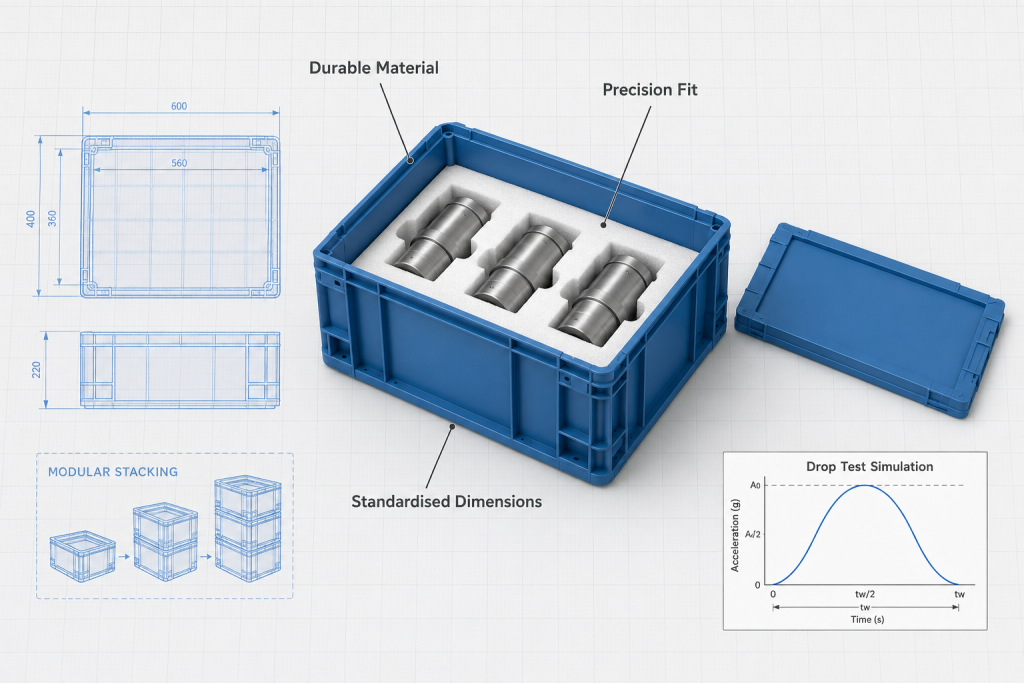
Designing for reuse means choosing durable, washable materials, standardising dimensions for stacking and pooling, and protecting the product across many handling and cleaning cycles. Well-designed reusable packaging must be durable, easy to clean, and versatile enough to handle different product types without degrading.
Good design balances three priorities. The packaging has to survive repeated washing and handling, it should be standardised enough to stack and pool efficiently, and it must protect the product precisely. Standardisation matters more than many buyers expect, because the wider market is moving toward modular container systems that reduce the number of custom designs and improve pooling efficiency .
Key design considerations include:
- Material durability and resistance to repeated washing.
- Standardised, modular dimensions for stacking and pooling.
- Precise product fit to prevent damage in transit.
- Design validation before full production.
Why part-fit analysis and simulation testing matter
Part-fit analysis and simulation testing confirm that a design protects the product and survives transit before you commit to tooling and volume. Validating the fit early prevents expensive redesigns and reduces product damage across the asset’s service life.
This is where design discipline pays off, because a reusable asset is used hundreds of times, so a small fit problem repeats hundreds of times too. Our design and product development capabilities include part-fit analysis and simulation testing for exactly this reason.
How does collection and reverse logistics work?
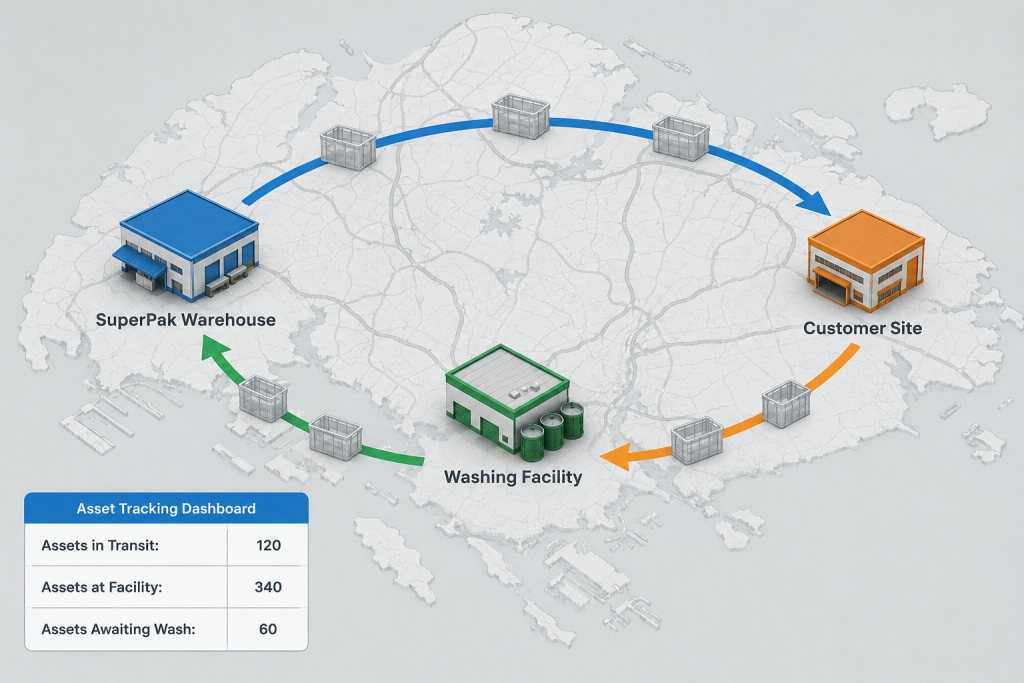
Collection is the reverse-logistics step that returns used packaging from customer or overseas sites back to a washing facility, and it is the part that makes or breaks reuse economics. Efficient reverse logistics and high asset utilisation are what make reusable systems financially viable, and the wider industry treats network density as a central success factor.
In practice, collection means scheduling returns, tracking assets so they are not lost, and consolidating flows so that transport stays efficient. At SuperPak, this includes a cross-border collection of shipper boxes and wafer rings, which we bring back for refurbishment and washing. The key variables to manage are:
- Route density, because predictable, high-volume lanes are easier to serve.
- Asset tracking, so units are accounted for across each cycle.
- Scheduling, so washing capacity is used evenly rather than in spikes.
These flows form part of our broader supply-chain services, which connect collection to washing and redeployment.
Need a regional collection loop for your reusable assets? Contact SuperPak to map your reverse logistics.
How are reusable packaging items washed and decontaminated?
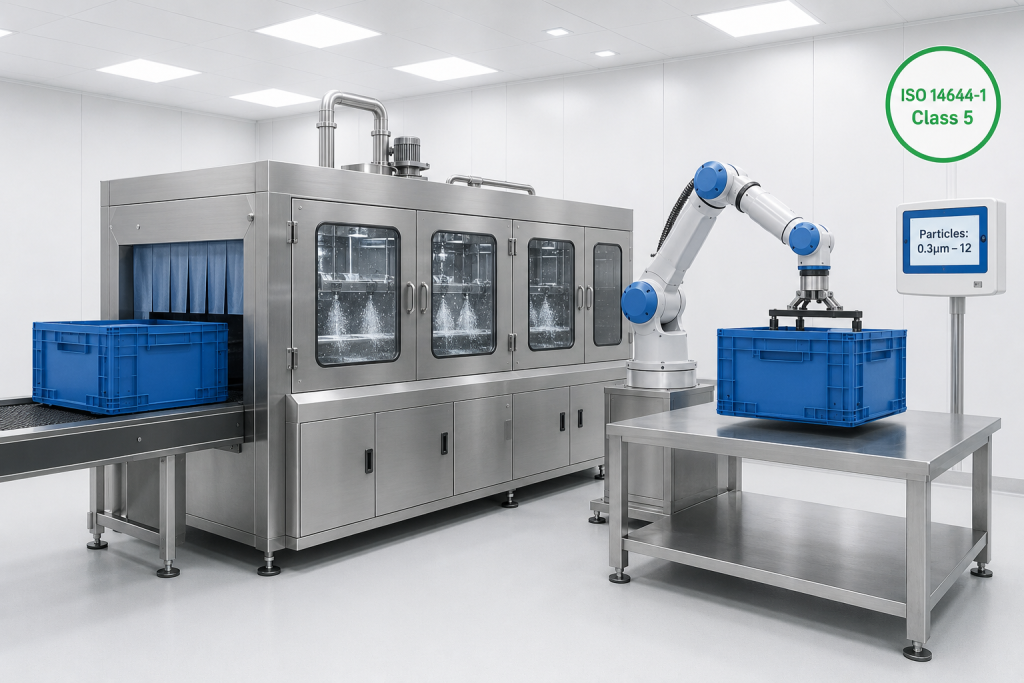
Reusable packaging for cleanliness-critical industries is cleaned using aqueous and deionised (DI) water washing in controlled cleanroom environments, then verified against particle and ionic-contamination limits. For the most demanding sectors, this is non-negotiable, because contaminants measured in fractions of a micron can ruin semiconductor components.
Our washing operations run in cleanroom-class environments and pair washing with in-house laboratory verification. Cleanroom cleanliness is classified under the ISO 14644 family of standards, and the operational best-practice guidance for maintaining these standards was updated in ISO 14644-5:2025. You can see the full facility and laboratory setup on our collection, recycling, and washing page.
What is aqueous washing, and why use it?
Aqueous washing is a water-based cleaning method that removes contaminants from reusable packaging without relying on harsh solvents. It is widely used where stringent cleanliness is required because it is effective, environmentally friendlier than solvent washing, and cost-efficient at scale.
For industries such as semiconductor and hard-disk-drive manufacturing, aqueous and DI washing remove particulate and ionic residues that would otherwise transfer to sensitive components. Most semiconductor processing depends on tightly controlled environments, typically ISO 14644-1 Class 4 to Class 6 during wafer fabrication, which sets the bar for how clean reusable carriers must be.
How is cleanliness verified after washing?
Cleanliness is verified by measuring the packaging against defined particle and ionic-contamination limits using laboratory instruments, rather than relying on a visual check. Verification turns “it looks clean” into documented, repeatable evidence that an asset meets specification.
Typical verification methods include:
- Liquid and air particle counting to quantify residual particles.
- Ion chromatography to detect ionic contamination.
- Fourier-transform infrared (FTIR) analysis to identify residues.
Because even a small deviation in cleanliness can cause yield loss or defective devices, this verification step is essential for contamination-sensitive supply chains.
What is packaging refurbishment, and when is it worth it?
Packaging refurbishment restores collected packaging through cleaning, inspection, minor repair, and re-qualification, so it can re-enter service instead of being scrapped. Refurbishment extends asset life and cuts replacement spending, which is why reuse and refurbishment are considered higher-value circular strategies than recycling.
The decision to refurbish rather than replace comes down to condition and cost. An asset that passes inspection after cleaning and minor repair should go back into service, while an asset that fails re-qualification should be retired and recycled. A simple refurbish-versus-replace checklist looks like this:
- Refurbish when the asset passes inspection and needs only cleaning or minor repair.
- Refurbish when re-qualification confirms it still meets cleanliness or fit specifications.
- Replace and recycle when structural damage or contamination cannot be corrected.
- Replace when repeated repair costs approach the cost of a new asset.
You can see examples of refurbishment and recyclable-material work across SuperPak’s services.
Step-by-step: how to launch a reusable packaging programme
To launch a reusable packaging programme, start by auditing your highest-volume, most repeatable shipping loops, then pilot a reusable design with a defined collection-and-washing cycle before scaling. A staged rollout reduces risk, because you prove the cost-per-trip on one lane before committing across the network.
The following steps provide a practical sequence:
- Audit packaging spend, shipment volumes, and route predictability to find the best reuse candidates.
- Identify the cleanliness and contamination requirements for your industry.
- Design or select a reusable format, then validate it with fit and simulation testing.
- Set up the collection and reverse-logistics loop, including tracking.
- Define the washing and inspection specification with clear acceptance criteria.
- Pilot on one lane and measure cost-per-trip, cycle time, and defect rate.
- Document the results for NEA 3R reporting, then scale to further lanes.
When you are ready to design and run this loop, our end-to-end services cover each step from design through washing and redeployment.
Common mistakes to avoid with reusable packaging
The biggest reuse failures are rarely about the packaging itself. They are usually caused by weak collection loops, under-specified washing, and skipping the total-cost-of-ownership maths before scaling. Across the market, the most cited barriers to reuse are exactly these: complex reverse logistics, high upfront investment, and a shortage of cleaning, repair, and storage infrastructure.
A useful way to avoid these traps is to name each mistake and its fix:
- Treating reuse as a one-off product purchase rather than a system. The fix is to plan collection, washing, and tracking from day one.
- Running a reuse programme without a reliable return loop. The fix is to secure route density before scaling.
- Specifying washing that does not match your industry’s cleanliness needs. The fix is to set acceptance criteria and verify them in a lab.
- Skipping inspection or re-qualification gates. The fix is to make re-qualification a required step before redeployment.
- Scaling before a pilot proves cost-per-trip. The fix is to validate the economics on one lane first.
Avoiding these missteps is far cheaper than correcting them later. Contact SuperPak for a facility assessment and a quotation tailored to your industry.
Which industries benefit most from reusable and cleanroom-washed packaging?
Contamination-sensitive, high-volume sectors gain the most from reusable packaging combined with certified washing, which is why demand concentrates in industries where a single defect is expensive. In the returnable transport packaging market, intermediate bulk containers held the largest product share at 38.3% in 2025, reflecting strong demand from chemical, pharmaceutical, and food applications.
The sectors that benefit most from our reuse and washing programmes include:
- Semiconductor, where wafer rings and shipper boxes must meet strict particle limits.
- Hard-disk-drive manufacturing, where residue control protects sensitive components.
- Pharmaceutical, where cleanliness and documentation are tightly regulated.
- Automotive, where high-volume parts logistics suit closed-loop containers.
- Aerospace, where traceability and durability are critical.
You can explore relevant examples across SuperPak’s contract manufacturing and services.
How to choose a reusable packaging partner in Singapore
The right reusable packaging partner covers the full loop, from design and collection through certified washing and refurbishment, under recognised quality and environmental certifications and with verifiable laboratory capability. Choosing a single integrated partner reduces handoffs and keeps quality records consistent across every cycle.
Use this checklist when evaluating a partner:
- In-house design and product-development capability, including fit and simulation testing.
- Regional collection reach for reliable reverse logistics.
- Cleanroom-class washing supported by in-house laboratory verification.
- Recognised certifications such as ISO 9001 and ISO 14001 quality and environmental management.
- Refurbishment plus responsible recycling at end of life.
- Documentation that supports your NEA reporting and 3R plan.
SuperPak is built around exactly this integrated model, and you can review our credentials on our About Us page or start a conversation through our contact page.
Frequently Asked Questions
What is the difference between reusable and recyclable packaging?
Reusable packaging is used many times before disposal, while recyclable packaging is processed into new material after a single use. Reuse generally sits higher in the waste hierarchy because it keeps the existing product in service for longer.
Does Singapore require companies to report packaging?
Yes. Under the Resource Sustainability Act, companies with annual turnover above S$10 million that supply or use packaging in Singapore must submit a packaging data report and a 3R plan to NEA.
What is aqueous washing in packaging refurbishment?
Aqueous washing is a water-based cleaning method that removes contaminants from reusable packaging. It is widely used where stringent cleanliness is required because it is effective and more environmentally friendly than solvent-based cleaning.
How many times can reusable industrial packaging be used?
It depends on the material, handling intensity, and the washing and inspection regime. Durable formats are designed for many trips and are retired only when they no longer pass inspection, and total cost of ownership generally turns favourable after roughly 10 to 15 rotation cycles in 2025.
Is reusable packaging cheaper than single-use?
Often, over many trips, because the cost is spread across rotation cycles, although it requires upfront investment and a reliable collection-and-washing loop. Lifecycle analysis in 2025 found per-trip logistics costs fall after about 4 to 6 usage cycles.
Can reusable packaging meet semiconductor cleanliness standards?
Yes, when it is washed in cleanroom-controlled facilities and verified against particle and ionic-contamination limits aligned with ISO 14644 classifications. Semiconductor processing commonly relies on ISO 14644-1 Class 4 to Class 6 environments.
What industries use reusable industrial packaging most?
High-volume, contamination-sensitive sectors use it most, including semiconductor, hard-disk-drive, pharmaceutical, automotive, and aerospace. In 2025, intermediate bulk containers alone held a 38.3% share of the returnable transport packaging market, reflecting strong industrial demand.