

The artificial intelligence build-out has turned semiconductor packaging into one of the most strained links in the supply chain, and the reel of components sits right at the centre of it. In 2025, global semiconductor equipment billings reached US$135 billion, up 15% year on year, with assembly and packaging equipment sales rising 21% as advanced packaging adoption accelerated. At SuperPak, we manufacture carrier tape, cover tape, and plastic reels from our Singapore headquarters, so we wrote this guide to help procurement and quality engineers specify tape-and-reel that keeps AI-hardware lines running.
Quick summary
Tape-and-reel packaging loads electronic components into pocketed carrier tape, seals them under a cover tape, and winds them onto a reel for automated SMT assembly. Use it when AI-hardware production needs high-speed, low-defect pick-and-place feeding. Prioritise EIA-481 dimensional compliance, JEDEC moisture-sensitivity (MSL) handling, and ESD-safe processing. Remember that these are guidelines rather than law, so verify a provider’s in-house testing and lot traceability before committing to volume.
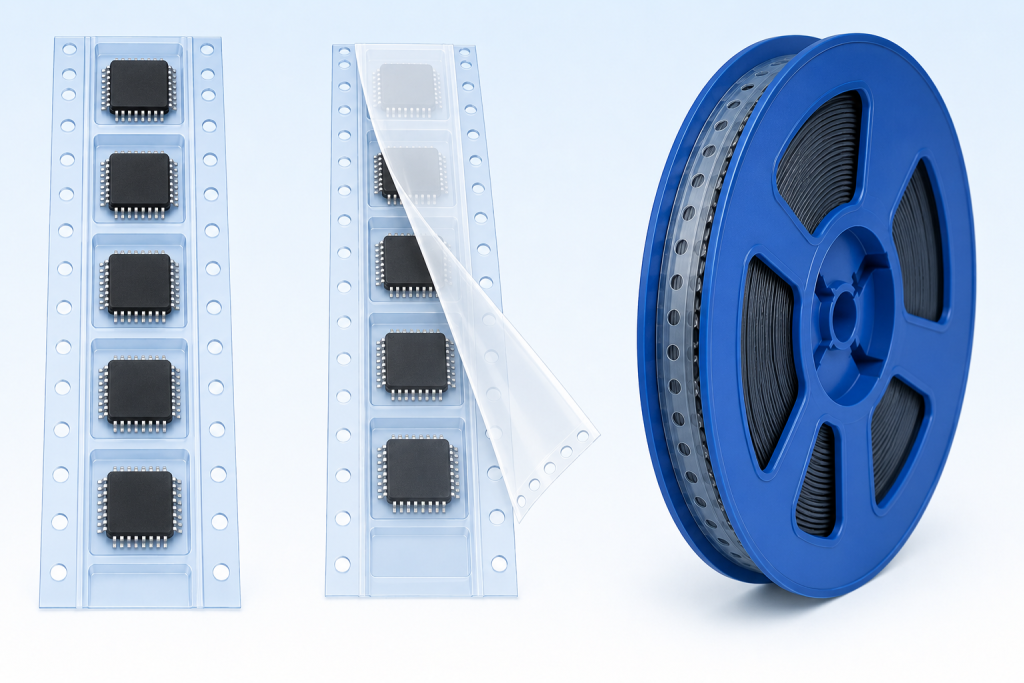
What is tape-and-reel packaging, and why does it matter for AI hardware?
Tape-and-reel seals components into pocketed carrier tape under a cover tape and winds them onto a reel, so pick-and-place machines can feed them at high speed. For AI hardware, it is the physical link between component makers and the high-volume surface mount technology (SMT) lines that build accelerator boards and servers.
The format exists because automation needs predictability. Components are placed into individual embossed pockets, the pockets are sealed with cover tape, and the strip is wound onto a plastic reel that drops straight into a feeder. One reel can hold thousands of parts, which keeps a pick-and-place machine fed through a full production run and minimises line stoppages. That is very different from trays or tubes, which suit lower volumes, larger bodies, or prototype runs, and we cover that trade-off in detail in our guide to choosing tape-and-reel versus trays for SMT components.
A complete tape-and-reel system has three parts working together:
- Carrier tape: holds each component in a precisely formed pocket sized to its body and leads.
- Cover tape: seals the pockets to protect against contamination, then peels cleanly during assembly.
- Plastic reel: winds the sealed tape for stable, repeatable feeding.
We manufacture all three in-house at SuperPak, which lets us match the pocket, the seal, and the reel to the same component before anything reaches the customer’s line.
How is the AI boom reshaping demand for component packaging?
AI infrastructure has made packaging, not just wafers, a first-order constraint, and that pressure flows all the way down to component-level tape-and-reel. As accelerator and server volumes climb, the number of supporting parts that must be taped, sealed, and reeled climbs with them.
The headline numbers show how fast the back end is growing. In 2025, the global semiconductor packaging market was forecast to reach US$618.9 billion, with demand for 2.5D and 3D packaging expected to grow by more than 30% as chipmakers chase higher bandwidth. Reliability stakes are rising alongside volume, because packaging already represents 20% to 25% of total manufacturing cost and accounts for more than 65% of field returns in high-performance computing as of 2025. The memory super-cycle adds urgency, with consumer memory prices rising roughly fourfold between September and November 2025 as suppliers prioritised AI servers.
The practical takeaway for a hardware programme is that packaging capacity and packaging quality now move yield, not just cost. When a single feed defect can halt a high-value line, the discipline behind the reel matters as much as the part inside it.
Scaling an AI-hardware build and worried about reel quality at volume? Talk to our team about tape-and-reel capacity.
Which AI-hardware components actually ship on tape and reel?
Beyond the headline processors and high-bandwidth memory, AI boards are dense with supporting parts, and most of those parts arrive on tape and reel for automated placement. These are the components that make a board work, and they are exactly the ones a feeder expects in reel form.
Typical AI-hardware components that ship on tape-and-reel include:
- Power-management ICs and voltage regulators that condition power for hungry accelerators.
- Passives such as multilayer ceramic capacitors (MLCCs) and resistors, often placed by the thousand per board.
- Connectors and interface components for high-speed data movement.
- Sensors and small logic ICs used across the board.
Demand for the advanced building blocks around these components is growing quickly. The global interposer market, central to AI accelerator integration, was valued at US$1.43 billion in 2025 and is expected to reach US$4.12 billion by 2035, a CAGR of 11.2% driven largely by AI and high-performance computing. As board complexity rises, the volume and value of taped components rise with it.
Why higher component value raises the stakes for packaging quality
When the part in the pocket is expensive and sensitive, a packaging defect stops being a nuisance and becomes a yield and cost event. A reel of high-value ICs carries far more risk per metre than a reel of generic passives.
The reason is simple economics combined with physics. A jam, a tombstone, or a damaged component on a high-value line can halt automated assembly and scrap costly parts, and electrostatic discharge or trapped moisture can cause failures that only appear later in the field. That is why pocket fit, cover-tape peel, and ESD or moisture protection deserve real qualification before volume begins, which is exactly what our in-house testing is built to confirm.
What standards govern AI-grade tape-and-reel packaging?
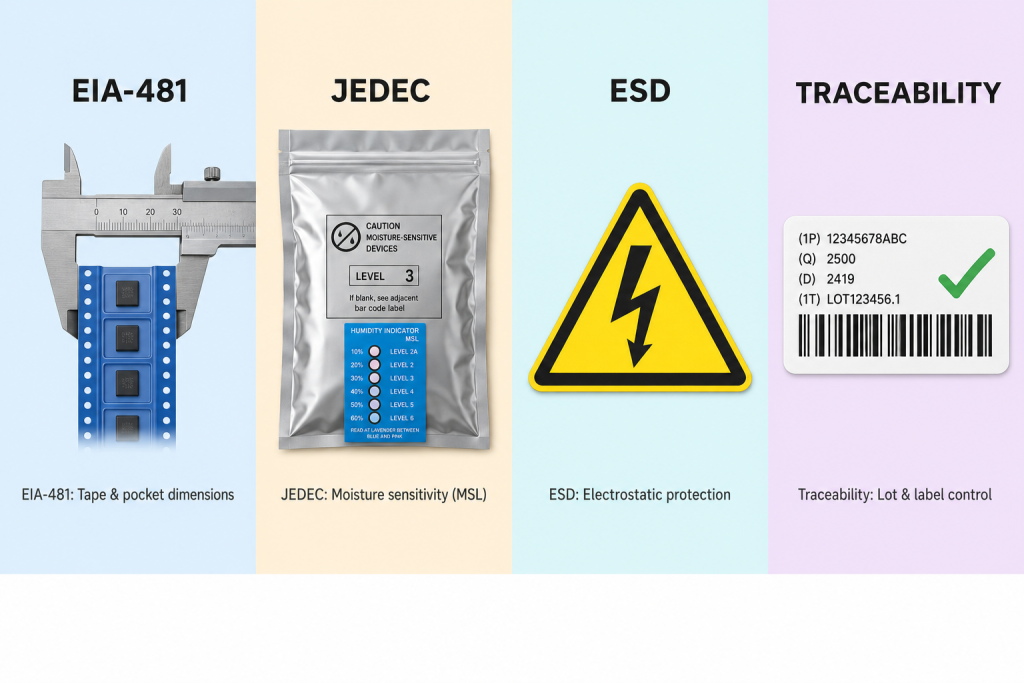
Compliant tape-and-reel is defined by a small set of standards: EIA-481 for mechanical dimensions, JEDEC J-STD-020 and J-STD-033 for moisture sensitivity, and ESD standards including ANSI/ESD S20.20 and IEC 61340-5-1 for handling. Meeting them is what lets components from different makers run reliably on different pick-and-place machines.
Each standard controls a different failure mode. EIA-481 governs pocket dimensions, sprocket pitch, and feed orientation so feeders index correctly. JEDEC moisture rules classify components by moisture-sensitivity level (MSL 1 to 6) and require moisture barrier bags, desiccant, and a humidity indicator card for MSL 2 and above, because trapped moisture can cause “popcorn” cracking during reflow. ESD standards matter because modern semiconductor devices can be damaged by as little as 100 volts of electrostatic discharge, so conductive or static-dissipative materials are essential. The geography behind these reels is concentrated too, with Asia-Pacific accounting for around 62% of global carrier-tape production capacity in 2025.
The table below summarises what each standard governs and what a buyer should verify.
Standard | What it governs | Why it matters for AI hardware | What to verify with your provider |
EIA-481 | Carrier and cover tape dimensions, sprocket pitch, feed orientation, tolerances | Reliable high-speed pick-and-place across mixed equipment | Pocket fit, sprocket-hole integrity, no consecutive missing parts |
JEDEC J-STD-020 and J-STD-033 | Moisture-sensitivity levels (MSL 1 to 6) and reflow handling | High-value AI ICs are moisture-sensitive, and trapped moisture causes reflow cracking | MSL rating, moisture barrier bag plus desiccant plus humidity indicator card, baking policy |
ANSI/ESD S20.20 and IEC 61340-5-1 | ESD-protected handling and dissipative materials | A single discharge can latently damage a die | ESD-safe handling, dissipative tape and reel, grounding |
Companion material and label specs | Packaging-material and barcode or label requirements | Traceability across a long AI supply chain | Lot traceability, label scheme, material certificates |
Because these standards are recommendations rather than law, the real differentiator is whether a provider actually tests against them, which is the focus of the next two sections.
How does the tape-and-reel process work, step by step?
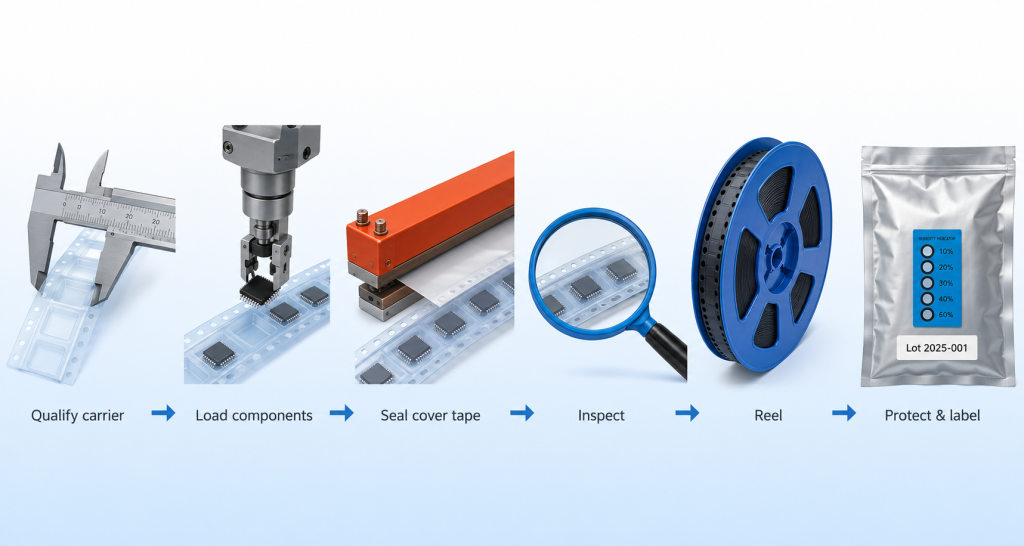
The tape-and-reel flow is consistent across the industry: qualify the carrier, load the components, seal the cover, inspect, reel, then protect and label for shipment. Each step is where a defect is either prevented or passed downstream.
Here is the process as we run it, with the quality checks built in:
- Select and qualify the carrier tape. Match pocket size and depth to the component, then confirm fit with part-fit and cross-section analysis. Our carrier tapes run from 8mm to 104mm wide with a maximum formable depth of 25mm, in materials including conductive PS, APET, PP, and static-dissipative clear PC.
- Load components into pockets. Each part is seated so it cannot shift during reel advance yet releases cleanly at pick-up.
- Seal the cover tape. Apply heat-activated or pressure-sensitive cover tape and verify peel force, which we supply in a PET base from 53 to 65 microns with peel forces between 20g and 90g per mm.
- Inspect. Check for missing components, wrong orientation, and pocket or seal defects before the strip is wound.
- Reel and enclose. Wind onto an 8-inch or 12-inch reel with proper leader and trailer, then place into a reel box.
- Protect and label. Apply MSL handling where required, with a moisture barrier bag, desiccant, and humidity indicator card, then add ESD-safe labelling and lot traceability.
We run part-fit analysis, cross-section analysis, and cover-tape compatibility and ageing testing on precision equipment before production starts, so the complete system is qualified on the customer’s own pick-and-place setup rather than discovered on the line.
What AI-ready QC and traceability should mean in a quote
In practice, an AI-ready quote should commit to verifiable inspection and traceability, not just a price per reel. The goal is evidence that defects are caught before they reach your feeder.
When you compare providers, look for clear commitments on the following points:
- Inspection method: how missing-component, orientation, and pocket or seal defects are detected and at what coverage.
- Lot traceability: whether each reel carries a traceable lot record and label scheme.
- Qualification evidence: documented part-fit, cross-section, and cover-tape results before production.
- Handling controls: ESD and MSL handling stated explicitly for sensitive parts.
How do you choose a tape-and-reel partner in Singapore?
Evaluate a tape-and-reel partner on standards compliance, in-house testing, ESD and MSL discipline, traceability, capacity, and proximity to the semiconductor cluster, rather than on price alone. The cheapest reel is rarely the cheapest outcome once line stoppages and field returns are counted.
Singapore is a strong base for this decision. The country attracted more than S$30 billion in semiconductor investments from 2022 to 2025 and accounts for about one in 10 chips and one in five semiconductor equipment units worldwide, supported by strong intellectual-property protection and efficient logistics. That depth means a regional AI-hardware maker can qualify and source close to home. We have manufactured tape-and-reel from our Singapore headquarters since 1985, and we can package millions of components weekly to EIA and JEDEC standards.
Questions to ask before you commit volume
Before you commit volume, ask questions that expose whether a provider qualifies the full system or only sells materials. The answers reveal how a partner behaves when a part is difficult.
A practical shortlist to raise in your first conversation:
- Do you perform part-fit and cross-section analysis in-house before production?
- How do you verify cover-tape peel force and ageing for my specific component?
- What is your MSL and ESD handling for sensitive parts?
- What carrier widths, depths, and reel sizes can you support?
- How is each reel traced and labelled?
Want to put this checklist to work? Request a tape-and-reel capability review from our team.
What are the most common tape-and-reel mistakes, and how do you avoid them?
Most tape-and-reel failures trace to a short list of avoidable errors: poor pocket fit, out-of-spec cover-tape peel, skipped moisture handling, weak ESD control, and gaps in traceability. Each one is preventable with qualification before volume.
The pattern is consistent across programmes, so it helps to name each mistake alongside its consequence and its fix.
Common mistake | Consequence | How to avoid it |
Pocket or part-fit mismatch | Components shift or jam, causing pick errors | Qualify with part-fit and cross-section analysis first |
Cover-tape peel out of spec | Tombstoning or feed interruptions at pick-up | Verify peel force and ageing for the exact component |
Ignoring moisture sensitivity (MSL) | Reflow “popcorn” cracking and latent failures | Use moisture barrier bag, desiccant, and humidity indicator card for MSL 2 and above |
Inadequate ESD control | Latent die damage from discharge | Use dissipative materials and ESD-safe handling throughout |
No lot traceability | Slow root-cause analysis and line stoppage | Trace and label every reel |
The common thread is that each fix happens before production, not during it. You can read more on matching materials to component sensitivity in our guide to choosing trays, tape and reels, and shielding bags.
How does tape-and-reel fit a sustainable, traceable AI supply chain?
Reel reuse, recyclable materials, and clean lot traceability let AI-hardware makers cut packaging waste without compromising protection. Sustainability and quality are not in tension here, because both rely on disciplined material choices and good records.
Many core tape-and-reel materials, including polystyrene, PET, and polypropylene, are widely recyclable, and returnable or washable systems can reduce waste as long as the materials are tested to confirm they still meet ESD requirements. As an ISO 14001:2015 certified manufacturer, we treat environmental performance as part of the specification rather than an afterthought, and we also refurbish shipper boxes and wafer rings through aqueous washing for semiconductor customers. Strong traceability supports this work twice over, since the same lot records that speed up quality investigations also document material handling for environmental reporting.
Why Singapore for AI-era tape-and-reel packaging?
Singapore sits at the centre of the AI supply chain, with a deep packaging-and-test base, strong intellectual-property protection, and efficient logistics. For a regional hardware maker, that means qualifying and sourcing tape-and-reel close to where boards are built.
The investment signals are clear. Singapore’s semiconductor market grew to about US$70 billion in 2025 and is projected to reach roughly US$74 billion by 2026, driven by memory and AI-focused high-performance computing. The country is also investing more than S$1 billion in artificial-intelligence research and talent from 2025 to 2030, reinforcing an ecosystem that already spans design, fabrication, advanced packaging, and test. We have been part of that ecosystem since 1985, and you can read more about our background and certifications on our About Us page.
Build your AI hardware on a Singapore partner that has produced and tested tape-and-reel since 1985. Contact SuperPak for a quote.
Frequently asked questions
What is tape-and-reel packaging used for? It packages surface mount components into carrier tape on a reel, so automated pick-and-place machines can feed them quickly and accurately during PCB assembly.
Why is tape-and-reel demand rising with AI? AI servers and accelerators need large volumes of supporting ICs, passives, and connectors, and most of those parts reach high-speed assembly lines in tape-and-reel form, so packaging demand scales with AI hardware output.
What standards apply to tape-and-reel? Mechanically it follows EIA-481, moisture-sensitive parts follow JEDEC J-STD-020 and J-STD-033 (MSL levels), and ESD-sensitive parts follow ANSI/ESD S20.20 and IEC 61340-5-1.
What is an MSL (moisture-sensitivity level), and why does it matter? MSL rates how much exposure a moisture-sensitive component can tolerate before reflow. Ignoring it can cause “popcorn” cracking, so MSL 2 and above ship in moisture barrier bags with desiccant and a humidity indicator card.
Can tape-and-reel be done sustainably? Yes. Reels and barrier materials can often be reused or recycled and traceability maintained, which aligns with ISO 14001 environmental practice, provided the materials are tested to confirm they still meet ESD requirements.
Why source tape-and-reel in Singapore? Singapore is a trusted semiconductor hub with a deep packaging-and-test ecosystem, strong intellectual-property protection, and efficient logistics, which shortens lead times for regional AI-hardware makers.
How do I get a tape-and-reel quote from SuperPak? Share your part numbers, quantities, and any MSL or ESD requirements through our contact page, and our team will respond with a quotation.
Conclusion
AI has made the back end of the semiconductor supply chain a first-order constraint, and tape-and-reel quality is now a yield and reliability lever rather than a commodity line item. The providers that stand out are the ones that qualify the full system against EIA-481, JEDEC moisture rules, and ESD standards before volume begins, and that keep clean traceability on every reel. We built our in-house testing and our Singapore manufacturing around exactly that discipline. If you are planning an AI-hardware build, contact SuperPak and we will help you specify tape-and-reel that keeps your line running.