
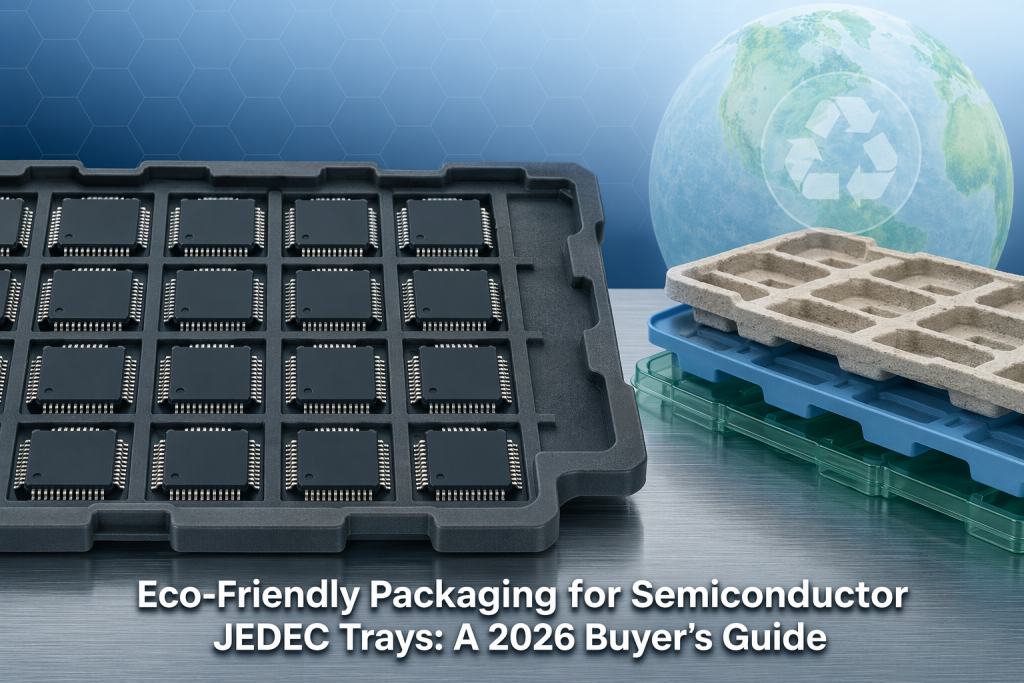
The semiconductor industry is growing rapidly, and so is the volume of plastic packaging flowing through its supply chain. JEDEC trays alone represent a significant portion of this material: in 2024, the global plastic IC JEDEC tray market was valued at USD 371 million and is projected to reach USD 539 million by 2031, growing at a compound annual growth rate of 5.6%. Meanwhile, in 2022, the world generated 62 million tonnes of electronic waste, with only 22.3% formally collected and recycled. The pressure on semiconductor companies to rethink their packaging materials and processes is no longer hypothetical.
This guide is for procurement engineers, packaging managers, and sustainability teams evaluating greener JEDEC tray options. At SuperPak, we have manufactured thermoformed products for the semiconductor industry for over 30 years, and we are seeing this shift firsthand across our operations in Singapore, Malaysia, Indonesia, and China. Here is what you need to know to make an informed transition without compromising IC protection.
Quick Summary
Environmentally friendly packaging for semiconductor JEDEC trays refers to IC carrier trays designed to JEDEC standards (JESD30-C) using recycled polymers, bio-based compounds, or closed-loop reuse programmes that reduce single-use plastic waste. These trays must still meet electrostatic discharge (ESD) protection requirements (surface resistivity 10⁵ to 10¹¹ Ω/sq), dimensional stability, and automation compatibility. Buyers should verify that any sustainable material substitution passes both JEDEC dimensional tolerances and the facility’s specific bake-temperature and cleanliness specifications before qualifying at scale.
This guide covers the definition of eco-friendly JEDEC trays, material options and their trade-offs, how to set up a closed-loop reuse programme, relevant standards and regulations, common mistakes, supplier evaluation criteria, cost considerations, and a practical transition roadmap. Whether you are responding to customer ESG requirements, preparing for the EU Packaging and Packaging Waste Regulation (PPWR), or simply looking to reduce waste, the principles here apply.
What Are JEDEC Trays and Why Does Their Environmental Impact Matter?
JEDEC trays are standardised plastic carriers, governed by the Joint Electron Device Engineering Council’s publication JESD30-C, that hold integrated circuits (ICs) securely during testing, shipping, and automated pick-and-place assembly. The vast majority of these trays are used only once and then discarded, contributing to a growing stream of industrial packaging waste.
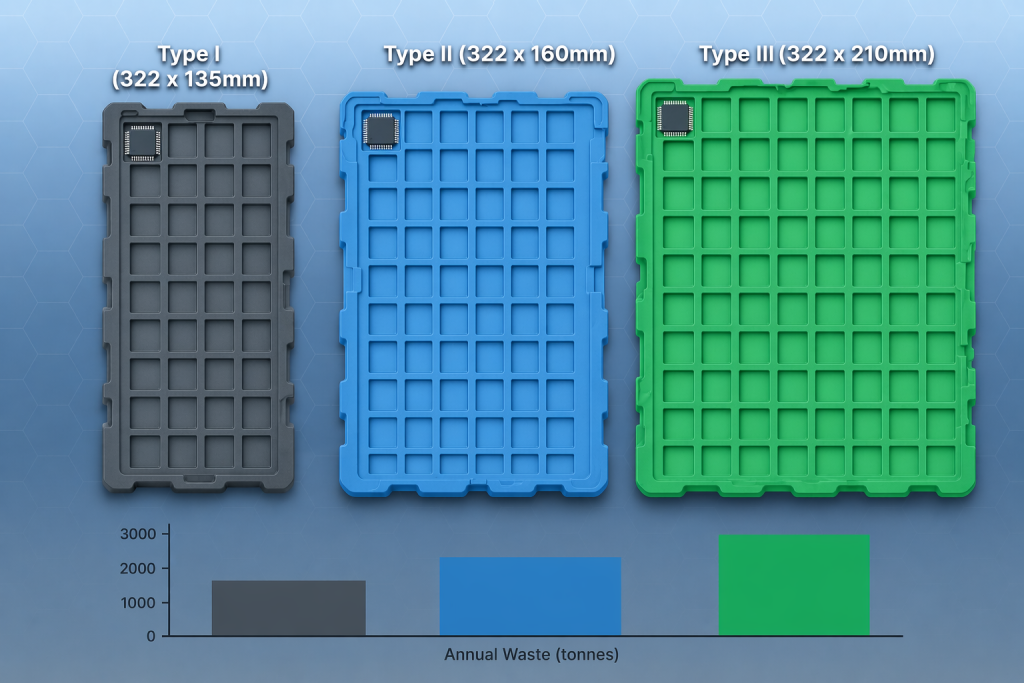
The JEDEC standard defines tray outer dimensions, cavity arrays, and stacking features to ensure universal compatibility with semiconductor handling equipment. Common tray families include Type I (322mm x 135mm), Type II (322mm x 160mm), and Type III (322mm x 210mm), each suited to different IC package sizes. Materials typically used include polystyrene (PS) with carbon filler for ESD protection, polycarbonate (PC) for higher-temperature applications, and polyetherimide (PEI) for solder reflow processes.
The scale of the issue is substantial. The broader JEDEC trays market (including all material types) was valued at approximately USD 1.67 billion in 2024 and is projected to reach USD 2.5 billion by 2032 at a CAGR of 5.16%. A peer-reviewed study published in the Journal of Cleaner Production found that matrix trays (also known as JEDEC trays) are overwhelmingly single-use packaging solutions with limited reuse or recycling in practice. When you consider the millions of trays flowing through OSATs, IDMs, and EMS providers globally each year, the cumulative waste and carbon footprint becomes a material concern for any organisation with sustainability commitments.
What Makes Semiconductor Tray Packaging “Environmentally Friendly”?
Environmentally friendly semiconductor tray packaging minimises virgin plastic use through one or more strategies: recycled-content polymers, bio-based material substitution, closed-loop tray reuse programmes, or design-for-recyclability. It does not mean sacrificing JEDEC compliance or ESD performance for a “green” label.
There are four practical pillars that define a genuinely sustainable approach to JEDEC tray packaging:
- Recycled content. Using post-industrial or post-consumer recycled polymers (typically recycled PP, HDPE, or PC) to reduce dependence on virgin plastic. Many plastic IC JEDEC trays are already made from recyclable materials such as PP and HDPE, and their durability allows for hundreds of reuse cycles, significantly reducing waste compared to single-use alternatives.
- Bio-based materials. Substituting petroleum-derived plastics with bio-based alternatives (such as PLA). These materials show promise for reducing fossil-fuel dependence but currently face limitations in thermal performance and ESD capability for direct IC-contact applications.
- Reuse and refurbishment. Collecting, inspecting, cleaning, and reintroducing used trays back into the supply chain. This approach often delivers the greatest immediate environmental and cost benefit.
- Design for end-of-life recyclability. Ensuring trays are made from mono-materials (not bonded composites) so they can be efficiently recycled through established mechanical recycling streams at end of life.
At SuperPak, our ISO 14001:2015 certification underpins our commitment to environmental management across all our manufacturing operations. We also offer molded pulp packaging as a sustainable option for outer and secondary semiconductor packaging where ESD protection at the tray level is not required.
How Do Recycled and Bio-Based Polymers Perform in JEDEC Tray Applications?
Recycled PP and HDPE can match virgin-grade mechanical and ESD performance in JEDEC trays when compounded with appropriate conductive fillers. Bio-based alternatives such as PLA are still in earlier qualification stages and require more rigorous testing for dimensional stability, especially under elevated temperatures.
The key to understanding material suitability is recognising that a JEDEC tray must satisfy several simultaneous performance requirements: ESD surface resistivity (10⁵ to 10¹¹ Ω/sq depending on the application), dimensional warpage of less than 0.76mm, thermal resistance appropriate to the process (ambient handling, 120°C bake, or 180°C reflow), and contamination control (ionic contamination below 0.1 µg/cm² NaCl equivalent). Any sustainable material must meet all of these simultaneously, not just one.
The market is increasingly recognising this reality. Increased environmental concerns are driving the creation and adoption of JEDEC trays constructed from recycled plastics or bio-based polymers to minimise waste and decrease semiconductor packaging’s carbon footprint, according to a 2025 market analysis. However, adoption requires careful qualification rather than simple material swaps.
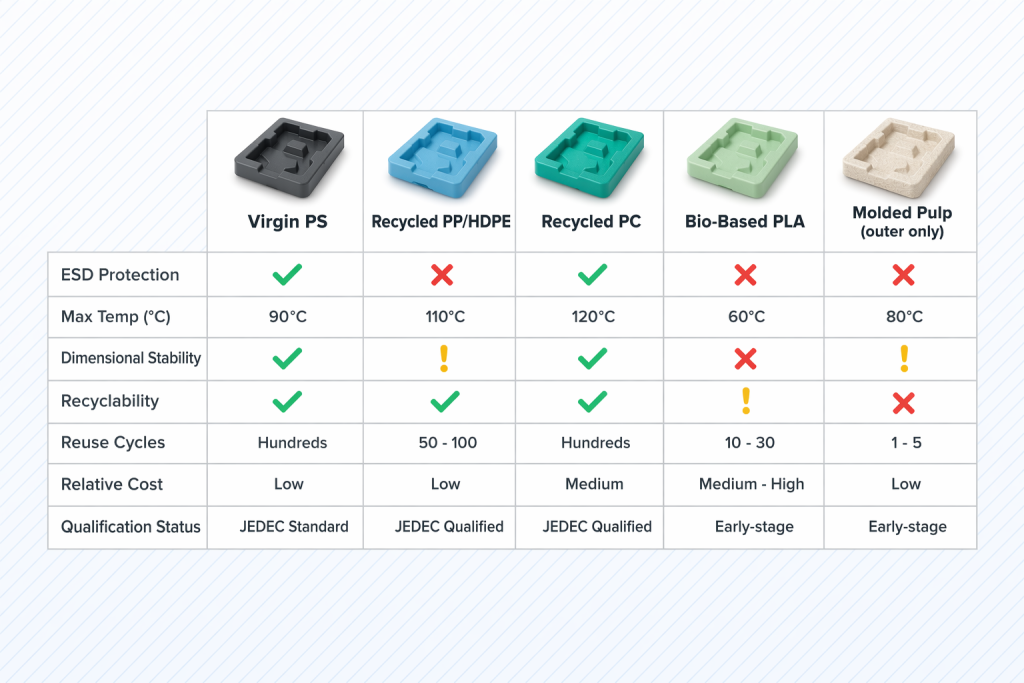
The following table compares the key properties of the most commonly considered material options:
|
Property |
Virgin PS (Baseline) |
Recycled PP/HDPE |
Recycled PC |
Bio-Based PLA |
Molded Pulp (outer only) |
|
ESD Protection (Surface Resistivity) |
10⁵ to 10⁹ Ω/sq (with carbon filler) |
Comparable when compounded with conductive additives |
Comparable when recompounded |
Requires additive development; not widely qualified |
Not inherently ESD-safe |
|
Max Operating Temperature |
Approximately 70°C (PS); up to 120°C (PC) |
Varies by grade; verify per application |
Up to 120°C |
Approximately 55 to 60°C (major limitation) |
Not applicable to IC contact |
|
Dimensional Stability / Warpage |
Established baseline (<0.76mm per JEDEC spec) |
Requires qualification testing per batch |
Good when recompounded to specification |
Poor under heat; still maturing |
N/A for IC contact use |
|
Recyclability at End of Life |
Mechanically recyclable |
Already recycled feedstock; recyclable again |
Mechanically recyclable |
Industrially compostable (limited infrastructure) |
Widely recyclable and compostable |
|
Reuse Cycles |
Typically hundreds |
Comparable when properly compounded |
Comparable |
Limited durability data available |
Single-use (outer packaging) |
|
Relative Cost vs. Virgin |
Baseline |
Comparable to slightly higher (approximately 5 to 15% premium in some cases) |
Slightly higher |
Higher; limited supply chain maturity |
Lower for outer packaging applications |
|
Qualification Status |
Fully established globally |
Growing adoption; process-specific qualification needed |
Growing adoption |
Early-stage; not widely qualified for IC-contact trays |
Proven for secondary packaging |
A material datasheet from the polymer supplier is a starting point, not a final answer. Every recycled-content or bio-based formulation should go through your facility’s own part-fit analysis and simulation testing before production-level adoption.
What Is a Closed-Loop Tray Reuse Programme and How Do You Set One Up?
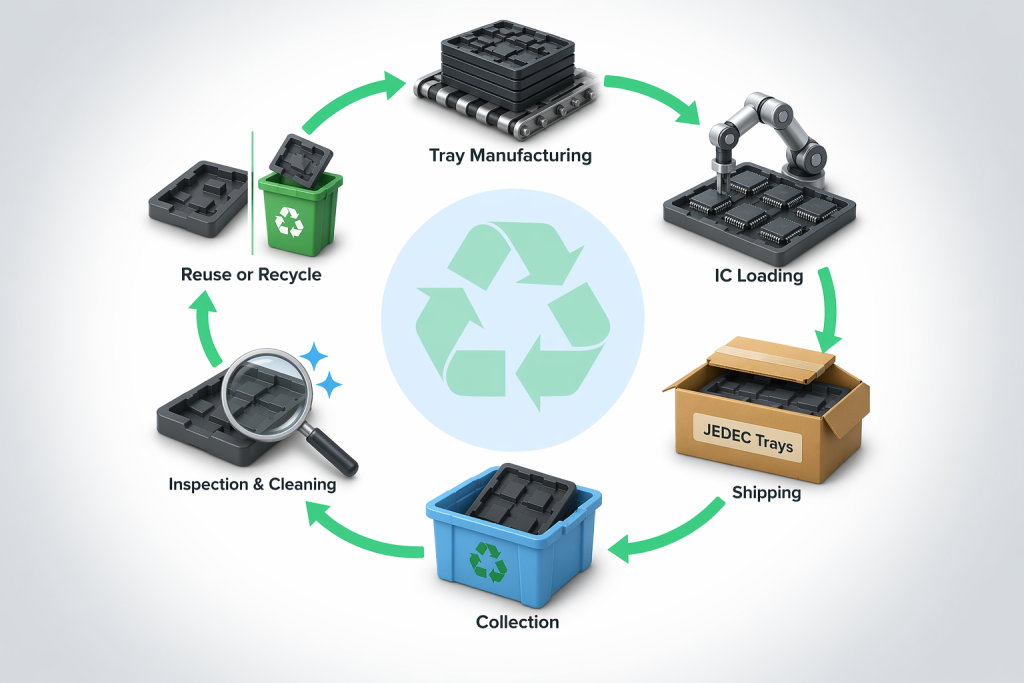
A closed-loop tray reuse programme collects used JEDEC trays from end-of-line or customer sites, inspects and cleans them to specification, and returns them to the supply chain. This approach can reduce virgin material consumption significantly per cycle while cutting per-unit tray costs.
Tray reuse is not a new concept, but it is one that many organisations still underutilise. Many semiconductor packaging operations treat JEDEC trays as disposable, even though materials like PC and PEI are engineered for repeated use. The circular economy concept of “reduce, recycle, reuse” is directly applicable here, and reusing manufacturing materials such as JEDEC trays provides both cost reduction and a positive environmental impact by reducing the need for new raw materials and energy to process them.
Here is an eight-step process for setting up an effective closed-loop programme:
- Audit current tray flows. Document the volume of trays consumed, the material types in use, where trays end up after use, and the contamination levels typically encountered. You cannot improve what you have not measured.
- Classify trays into reusable versus end-of-life categories. Not every used tray is a reuse candidate. Trays with visible warpage, cracks, or heavy contamination should be routed to recycling, not back into production.
- Establish collection logistics. Set up reverse-logistics pathways from your customers, contract manufacturers, or internal production lines back to a centralised inspection point. At SuperPak, our supply chain services include the infrastructure for managing this kind of reverse flow.
- Set up inspection and cleaning protocols. Every returned tray should be dimensionally checked (cavity pocket depth, warpage, corner radii per JEDEC specification), tested for ESD surface resistivity, and cleaned to remove particulate and ionic contamination.
- Define pass/fail criteria aligned to JEDEC tolerances. Your inspection criteria should reference the same dimensional and ESD specifications that govern new trays. Any tray that does not pass gets recycled, not re-circulated.
- Reintroduce qualifying trays into production inventory. Treat requalified trays identically to new trays in your inventory management system so they are picked and used in normal rotation.
- Track reuse cycles per tray. Assign each tray (or tray batch) a tracking identifier, whether via barcode, lot number, or RFID tag. This allows you to correlate reuse count with quality data over time and set data-driven retirement thresholds.
- Measure and report results. Track waste diverted from landfill (in kilograms), cost savings versus new-tray procurement, estimated CO₂e reduction, and the reuse rate as a percentage of total tray throughput. Report these against your ISO 14001 environmental objectives.
SuperPak also offers a collection and recycling service for packaging items, which can serve as the backbone of a closed-loop programme for customers who do not have in-house recycling capabilities.
Which JEDEC Tray Standards and Certifications Apply to Sustainable Packaging?
Sustainable JEDEC trays must comply with JESD30-C for dimensional and stacking specifications, relevant ESD protection standards, and should align with ISO 14001 (environmental management). For trays entering EU markets, the EU Packaging and Packaging Waste Regulation (PPWR, Regulation EU 2025/40) introduces additional binding obligations.
Here are the key standards and regulatory frameworks to be aware of, grouped by category:
JEDEC standards. JESD30-C defines the mechanical interfaces for JEDEC tray dimensions, cavity arrays, stacking features, and tolerances. It does not mandate specific materials, but your chosen material must meet the dimensional and functional requirements the standard sets out.
ESD protection standards. ANSI/ESD S20.20 provides the programme requirements for ESD control in electronics manufacturing. Tray materials should demonstrate appropriate surface resistivity (conductive: <10⁵ Ω/sq; static dissipative: 10⁵ to 10¹² Ω/sq) depending on the application.
ISO certifications. ISO 9001:2015 (quality management) and ISO 14001:2015 (environmental management) provide the management system framework for consistent tray quality and environmental performance tracking. At SuperPak, we hold both certifications, and their scope covers our packaging manufacturing operations.
EU PPWR (Regulation EU 2025/40). This regulation, which entered into force on 11 February 2025, sets recyclability and recycled-content requirements for all packaging placed on the EU market, including B2B industrial packaging.
Singapore Mandatory Packaging Reporting (MPR). Under the Resource Sustainability Act, producers supplying goods in Singapore with an annual turnover above S$10 million must submit annual packaging data reports and 3R (reduce, reuse, recycle) plans to the National Environment Agency (NEA). This framework lays the groundwork for a broader Extended Producer Responsibility scheme for packaging waste.
How Does the EU PPWR Affect Semiconductor Packaging Shipped to Europe?
The EU Packaging and Packaging Waste Regulation (PPWR), which applies generally from 12 August 2026, requires all packaging placed on the EU market to meet new recyclability, recycled-content, and labelling standards. This includes industrial B2B packaging such as JEDEC trays, not just consumer packaging.
The urgency is clear when you look at the numbers driving the regulation. In 2021, EU countries generated 84.3 million tonnes of packaging waste, 24% more than in 2010. Per capita packaging waste rose to 188.7 kg, an increase of 11 kg from the previous year alone. The PPWR was designed to reverse this trajectory.
Here are the key milestones semiconductor exporters to Europe need to understand:
- August 2026: General application of PPWR rules, including new packaging design requirements, substance restrictions, and registration obligations.
- 2028 to 2029: Harmonised digital labelling requirements take effect, depending on implementing acts.
- January 2030: All packaging must be recyclable in an economically viable way (minimum Grade C). Minimum recycled content thresholds for plastic packaging apply.
- January 2035: Recyclability must be demonstrated at scale.
- January 2038: Only packaging with recyclability Grades A and B will be permitted on the EU market.
If your semiconductor products are shipped to any EU country, the JEDEC trays carrying those products fall within scope. Proactively switching to recyclable or recycled-content tray materials now means you avoid scrambling to comply later, and you can position your packaging as a competitive advantage rather than a compliance liability.
Need help assessing whether your current JEDEC tray packaging meets upcoming sustainability regulations? Contact Superpak for a no-obligation packaging review.
What Are the Most Common Mistakes When Switching to Eco-Friendly JEDEC Trays?
The most common mistake is assuming a material swap is plug-and-play. Recycled or bio-based polymers may meet general specifications on paper but can fail under the specific thermal, dimensional, or ESD conditions of your production line without proper qualification testing.
Across conversations with semiconductor packaging teams, we consistently see the same seven errors:
- Skipping process-specific qualification. Relying solely on the supplier’s material datasheet without running trays through your actual bake, pick-and-place, and shipping processes is a recipe for line stoppages. Every production environment has unique thermal profiles, vibration exposures, and handling sequences that generic test data cannot fully predict.
- Ignoring ESD degradation over reuse cycles. Conductive properties in carbon-filled polymers can degrade with repeated cleaning, thermal cycling, and UV exposure. If you are implementing a reuse programme, you must test ESD performance after multiple cycles, not just at first use.
- Overlooking outgassing and contamination risks. Recycled feedstock can introduce ionic or particulate contamination that is unacceptable in cleanroom environments. Verify that recycled-content trays meet the same contamination control standards you require from virgin materials, such as ionic contamination below 0.1 µg/cm² NaCl equivalent per IEST-STD-CC1246.
- Treating “recyclable” as equivalent to “recycled.” A tray labelled as recyclable has no environmental benefit unless the recycling infrastructure and collection programme are actually in place at your site or your customer’s site. Without end-of-life pathways, recyclability is a label, not a result.
- Underestimating the scope of the EU PPWR. Some semiconductor companies have assumed the PPWR applies only to consumer packaging. In fact, the regulation covers all packaging placed on the EU market, including B2B industrial packaging.
- Choosing materials that cannot withstand required bake temperatures. Bio-based plastics like PLA have glass-transition temperatures typically around 55 to 60°C, which is far below the 120 to 180°C bake requirements common in semiconductor packaging processes. This makes PLA unsuitable for direct IC-contact trays in most production environments today.
- Failing to establish a measurement baseline. Switching to sustainable trays without first documenting your current waste volumes, per-unit costs, and carbon footprint makes it impossible to demonstrate ROI to management or report credible improvements to customers and regulators.
How Do You Evaluate an Eco-Friendly JEDEC Tray Supplier?
Evaluate an eco-friendly JEDEC tray supplier on five criteria: verified material certifications, JEDEC dimensional compliance records, environmental management certification (ISO 14001), the ability to run process-specific qualification trials, and a documented tray end-of-life or take-back programme.
Here is a practical evaluation checklist you can apply during your supplier qualification process:
- Verified material certifications. Ask for the material’s technical datasheet showing ESD surface resistivity values, thermal performance ratings, and, for recycled-content claims, third-party verification of recycled percentage (for example, ISO 14021 certification for recycled content claims).
- JEDEC dimensional compliance records. Request batch-level dimensional inspection reports demonstrating cavity pocket depth tolerances (typically ±0.05mm for packages under 1.2mm thickness), warpage measurements, and stacking rib specifications per JESD30-C.
- Dual ISO certification (9001 + 14001). A supplier holding both ISO 9001:2015 and ISO 14001:2015 has demonstrated systems for quality consistency and environmental management. Ask to see the certificate scope to confirm it covers packaging manufacturing, not just a tangential business unit.
- Process-specific qualification capability. The supplier should be willing and able to provide sample trays for you to test through your own production processes, including bake cycles, automated handling, and shipping simulation. A supplier that cannot or will not provide samples for testing is a red flag.
- End-of-life or take-back programme. Ask whether the supplier offers tray collection for recycling or reuse at end of life. A genuine sustainability commitment extends beyond the point of sale.
Watch for these red flags: vague sustainability claims without third-party verification, no sample testing available, no contamination or ESD testing capability, and an inability to provide traceability documentation for recycled-content materials.
Regional manufacturing presence also matters from a sustainability perspective. A supplier with operations close to your production sites reduces shipping distances, lowers transport emissions, and allows for faster iteration on design and material changes. At SuperPak, our network spans Singapore, Malaysia, Indonesia, and China, which gives semiconductor customers in the Asia-Pacific region shorter lead times and lower logistics-related carbon footprints.
SuperPak is ISO 9001:2015 and ISO 14001:2015 certified with over 30 years of semiconductor packaging experience. Contact Superpak to request sample trays and a sustainability assessment.
What Does an Eco-Friendly JEDEC Tray Cost Compared to Standard Trays?
Eco-friendly JEDEC trays may carry a modest per-unit material premium for recycled-content versions, but total cost of ownership (TCO) often decreases when factoring in reuse cycles, waste disposal savings, and regulatory compliance cost avoidance.
The “green premium” narrative is often misleading because it looks only at per-unit material cost in isolation. A more accurate way to evaluate the economics is through a total cost of ownership framework that accounts for five cost categories:
- Material cost per tray. Recycled-content trays may cost slightly more per unit than virgin equivalents, depending on the polymer type and recycled-content percentage. The differential varies by supplier, volume, and material grade.
- Logistics and shipping costs. Trays designed for better stacking density or made from lighter materials can reduce freight costs per IC shipped. Reusable trays shipped in a closed loop may add reverse-logistics costs but eliminate recurring new-tray procurement.
- Waste disposal costs. In regions with landfill levies or regulated waste-disposal requirements, reducing single-use tray volumes produces direct savings. Singapore’s Resource Sustainability Act and the EU PPWR are both increasing the financial accountability for packaging waste.
- Regulatory compliance costs. Non-compliance with the PPWR from 2026 onward may result in market access restrictions, fines, or product delistings in EU markets. Proactive material switching avoids these costs entirely.
- Reuse savings. If a tray is reused 10, 50, or 100 times, the effective cost per use drops dramatically compared to a single-use equivalent, even if the initial unit price is higher.
We recommend requesting a TCO comparison from your tray supplier, covering at least a 12-month projection, before making a procurement decision based on per-unit price alone.
What Role Does Packaging Design Play in JEDEC Tray Sustainability?
Design choices such as cavity layout optimisation, wall thickness reduction, material selection, and stacking efficiency directly determine how many ICs a tray carries per kilogram of plastic, how many times a tray can be reused, and whether it can be recycled as a mono-material stream at end of life.
Sustainability is not only about what material you use; it is also about how you design the tray itself. There are four design levers that drive environmental outcomes:
- Design for density. Optimising the cavity layout to fit more ICs per tray means fewer trays per shipment, less material consumed, and lower freight emissions. Even small improvements in packing density compound across high-volume production runs.
- Design for reuse. Reinforcing stacking ribs, using wear-resistant materials in high-contact areas, and specifying cleanable (smooth, non-porous) cavity surfaces all extend tray lifespan and enable more reuse cycles before retirement.
- Design for recyclability. Using a single polymer type (mono-material construction) throughout the tray eliminates the need for material separation at end of life, making mechanical recycling straightforward. Avoid bonded multi-material constructions or adhesive labels that contaminate recycling streams.
- Thermoforming versus injection moulding trade-offs. Both manufacturing methods have sustainability implications. Thermoforming typically generates less material waste per tray and allows for thinner wall sections, while injection moulding offers tighter dimensional tolerances for high-precision applications. The right choice depends on your volume, precision requirements, and material selection.
At SuperPak, our product development and design centre works with semiconductor customers from concept through to qualification, incorporating sustainability criteria alongside JEDEC compliance from the earliest design stage.
How Can Semiconductor Companies Measure and Report Tray Packaging Sustainability?
Track four metrics quarterly: virgin plastic consumed per 1,000 ICs shipped, tray reuse rate (as a percentage), total tray waste diverted from landfill (in kilograms), and estimated CO₂-equivalent reduction from reuse and recycled content. Report them against your ISO 14001 environmental objectives and any customer ESG requirements.
Here is how to define and calculate each KPI:
|
KPI |
What It Measures |
How to Calculate |
|
Virgin plastic per 1,000 ICs shipped |
Material intensity of your tray packaging |
(Total weight of new virgin-material trays purchased in period) / (Total ICs shipped in period) x 1,000 |
|
Tray reuse rate |
Circularity of your tray programme |
(Number of tray uses that were reused trays) / (Total tray uses in period) x 100% |
|
Waste diverted from landfill |
Absolute waste reduction |
Weight of trays sent to recycling or reuse programmes instead of landfill (in kg) |
|
CO₂e reduction estimate |
Climate impact of your tray sustainability efforts |
Compare the lifecycle emissions of your current tray mix (virgin + recycled + reused) against a baseline of 100% virgin single-use trays, using published emission factors for each polymer type |
These KPIs align with the continuous improvement cycle required under ISO 14001 management reviews. They also provide the data foundation you need for customer ESG reporting, Singapore’s Mandatory Packaging Reporting submissions to the NEA, and future EU PPWR compliance documentation.
The semiconductor recycling and sustainability market is itself growing rapidly, reaching USD 20.4 billion in 2024 and projected to grow at a CAGR of 15.7% through 2034. This indicates that the industry as a whole is investing in the infrastructure, measurement tools, and reporting frameworks that make tray-level sustainability tracking increasingly practical.
What Does a Sustainable JEDEC Tray Transition Look Like in Practice?
A practical transition starts with a baseline audit, proceeds through material qualification with a small pilot batch, scales to one production line, and then rolls out company-wide. The typical timeline is three to six months, with measurable checkpoints at each stage.
Here is the five-phase roadmap we recommend:
Phase 1: Baseline audit (Weeks 1 to 2). Document your current tray materials, annual volumes, per-unit costs, waste disposal methods, and estimated carbon footprint. This becomes your “before” measurement against which all improvements will be benchmarked. Involve procurement, operations, and your sustainability or EHS team.
Phase 2: Material evaluation and supplier shortlisting (Weeks 3 to 4). Request material datasheets, recycled-content certifications, and sample trays from two to three qualified suppliers. Evaluate against the five-point supplier checklist described earlier in this guide. Narrow to one or two candidates for pilot testing.
Phase 3: Pilot qualification (Weeks 5 to 8). Run 500 to 1,000 trays through your full process flow: incoming inspection, IC loading, bake cycle (if applicable), pick-and-place, shipping simulation, and (if implementing reuse) cleaning and re-inspection. Measure dimensional accuracy, ESD performance, warpage, contamination, and any pick-and-place error rates against your acceptance criteria.
Phase 4: Line-level rollout with monitoring (Weeks 9 to 16). If the pilot passes, expand to one full production line. Continue monitoring the same quality metrics and add cost tracking (per-unit tray cost, waste disposal cost, logistics cost) to build the TCO case for broader adoption.
Phase 5: Full-scale deployment with reporting (Week 17 onward). Roll out across all applicable production lines. Establish quarterly reporting cadence for the four sustainability KPIs. Update your ISO 14001 environmental objectives to include tray sustainability targets.
At each phase gate, document the results and obtain sign-off from quality, operations, and sustainability stakeholders before proceeding. This stage-gate discipline is especially important for semiconductor applications where any packaging failure can result in costly IC damage.
Ready to start your sustainable JEDEC tray transition? Contact Superpak to discuss a pilot programme tailored to your production requirements.
Conclusion
Environmentally friendly JEDEC tray packaging is not just a compliance checkbox or a marketing talking point. When done correctly, with proper material qualification, JEDEC standards compliance, and measurable reporting, it is a cost, risk, and brand advantage. The regulatory trajectory is clear: the EU PPWR is applying from August 2026, Singapore’s packaging reporting framework is tightening, and customer ESG requirements are becoming standard procurement criteria across the semiconductor supply chain.
The practical path forward is straightforward: audit your current state, evaluate materials rigorously, pilot before scaling, and measure everything. At SuperPak, we bring over 30 years of semiconductor packaging expertise, dual ISO certification (9001 and 14001), and a regional manufacturing network to help you make this transition without disrupting your production.
Contact Superpak to discuss your sustainable JEDEC tray requirements.
Frequently Asked Questions
What is a JEDEC tray?
A JEDEC tray is a standardised plastic carrier, defined by JEDEC publication JESD30-C, used to securely hold, transport, and feed integrated circuits through automated semiconductor testing, shipping, and assembly processes. Trays are designed with precise cavity pockets that prevent IC movement and are typically manufactured from ESD-safe materials such as polystyrene with carbon filler, polycarbonate, or polyetherimide.
Can recycled plastic JEDEC trays meet ESD requirements?
Yes. Recycled PP and HDPE can achieve ESD-safe surface resistivity (typically 10⁵ to 10¹¹ Ω/sq) when properly compounded with conductive carbon fillers. However, each recycled-content formulation should be independently tested against your facility’s specific ESD and dimensional requirements before full-scale adoption, as results can vary by feedstock batch and supplier.
Are bio-based plastics ready for JEDEC tray applications?
Bio-based polymers like PLA show promise for reducing fossil-plastic dependence, but they currently face limitations in thermal stability (typically below 60°C), dimensional consistency under heat, and long-term ESD performance. They are not yet widely qualified for direct IC-contact JEDEC trays, though they may be suitable for outer secondary packaging applications. Industry qualification data should be verified before adoption.
How many times can a JEDEC tray be reused before replacement?
Well-maintained JEDEC trays made from PC, PEI, or properly compounded recycled polymers can typically survive hundreds of reuse cycles. The actual number depends on material grade, operating temperature exposure, cleaning method, and the strictness of your dimensional and ESD re-qualification criteria. Implementing a tracked inspection programme is essential to determine reuse limits for your specific process.
Does the EU PPWR apply to semiconductor JEDEC trays?
Yes. The EU Packaging and Packaging Waste Regulation (PPWR, Regulation EU 2025/40), which applies generally from August 2026, covers all packaging placed on the EU market, including B2B industrial packaging such as JEDEC trays. Key requirements include recyclability by 2030 and minimum recycled content in plastic packaging.
What certifications should an eco-friendly JEDEC tray supplier hold?
At minimum, look for ISO 9001:2015 (quality management) and ISO 14001:2015 (environmental management) certifications whose scope explicitly covers packaging manufacturing. Additionally, verify that the supplier can provide material test reports for ESD compliance, JEDEC dimensional conformance data, and traceability documentation for any recycled-content claims.
How do you measure the environmental impact of switching to sustainable JEDEC trays?
Track four core KPIs: virgin plastic consumed per 1,000 ICs shipped, tray reuse rate as a percentage, total tray waste diverted from landfill in kilograms, and estimated CO₂-equivalent reduction from reuse and recycled content. Align reporting with your ISO 14001 environmental objectives and review quarterly. Exact carbon reduction figures should be calculated using a recognised lifecycle assessment methodology or verified by a sustainability consultant.