
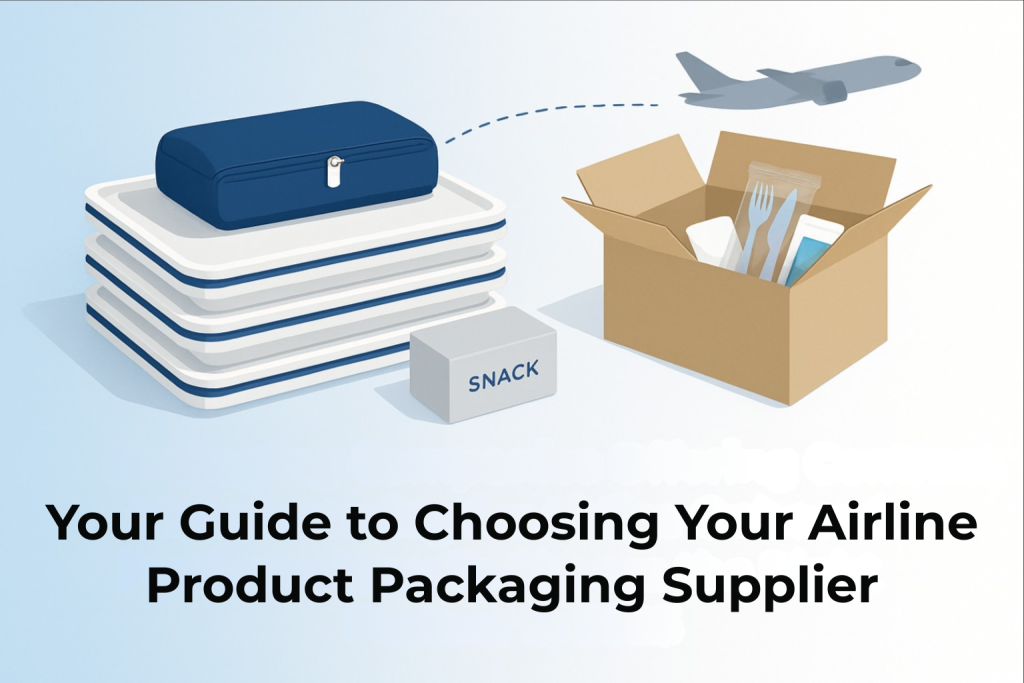
If you work in airline procurement, in-flight services or catering, you know how much pressure sits on small details. A tray that does not stack properly slows a whole galley. An amenity kit that tears too easily becomes a complaint. A flimsy snack box can turn a simple sector into a quality issue.
Packaging companies offering contract manufacturing for airline onboard products sit quietly in the middle of all this. They do more than print cartons. The right partner helps you design, produce, and kit onboard products so they move smoothly from factory to cabin and back again when rotable items are involved.
SuperPak is one example of a partner that focuses on integrated packaging, kitting and contract manufacturing for complex supply chains, including aviation projects. When you bring this kind of partner in early, you can treat packaging as part of your onboard system, not an afterthought.
If you are already seeing pain in your current trays, kits or packs, you can contact SuperPak for an initial conversation and a simple review of one or two key onboard products.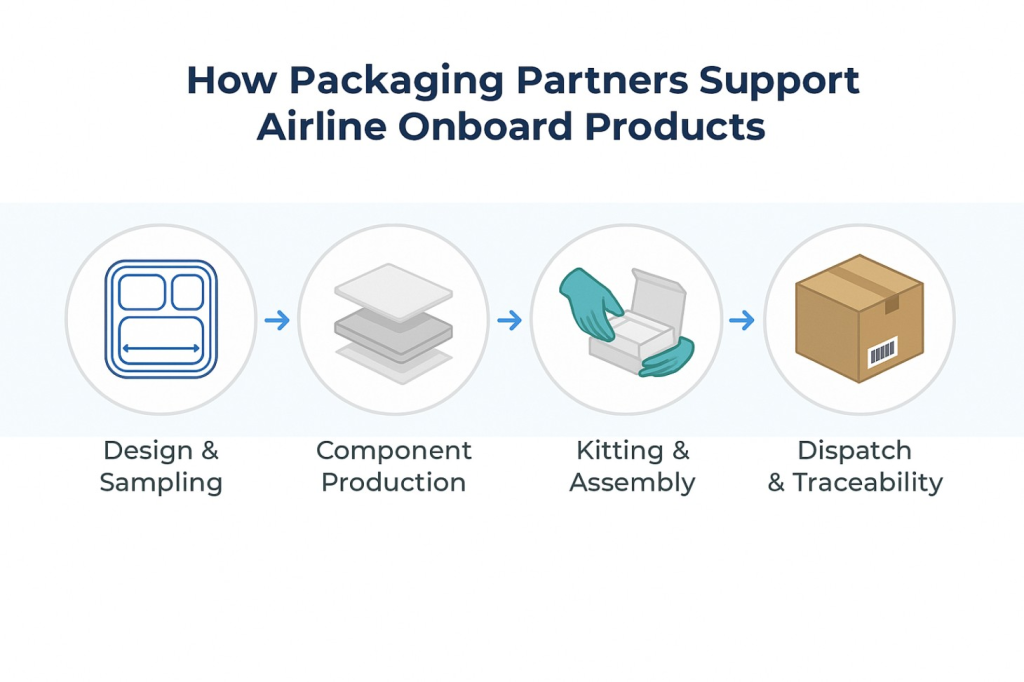
What Do Airline Onboard Packaging And Contract Manufacturing Partners Do?
At a simple level, these companies help you turn ideas for onboard products into repeatable, packaged units. They design the way items sit on a tray, they produce or source the physical parts, and they kit everything so that caterers and crew can work without friction. The same partner can support you from early samples through to regular production.
How are airline onboard products different from retail products?
Onboard products may look similar to retail packs, but they live in a different world.
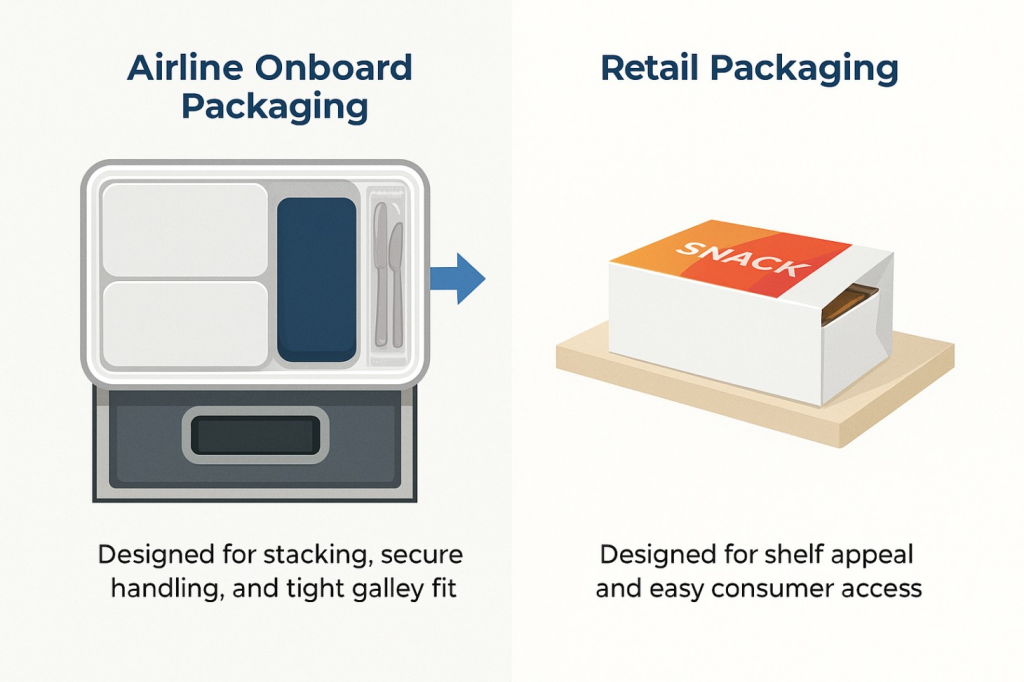
A snack or meal tray has to survive transport to the caterer, storage, loading, service on the aircraft, and disposal or return. At each step, people handle it quickly and often under time pressure. A retail pack can sit safely on a shelf. An onboard pack must move.
Space is fixed as well. Galley trolleys, inserts and lockers do not change size, so your packs must respect tight dimensions and clearances. A few millimetres of extra height on a lid can cause a trolley to jam or a door to resist closing.
Safety adds another layer. Items must not create sharp edges, shed loose parts or burn in unexpected ways. They must also cope with chilled or heated conditions and long hold times without falling apart. When a pack behaves badly in the cabin, you feel it at once.
For all these reasons, packaging for airline onboard products behaves more like equipment than a simple wrapper. It has to support a workflow, not only carry a logo.
Which airline onboard products can your partner support?
Most airlines work with a mix of onboard products, and a good packaging and contract manufacturing partner can usually support core categories such as:
- Meal trays for economy and premium cabins, including inserts and sleeves
- Snack boxes and bags for short haul or buy on board
- Amenity kits that combine several items into a single packed unit
- Small onboard retail packs that must hang, stand or stack neatly
- Hygiene and waste packs such as gloves, wipes and disposal bags
In some cases, they also support packaging and refurbishment steps for rotable trays or serviceware that return after use. You do not need to hand over every category at once. Many airlines start with one or two product families and expand once trust is built.
How does one partner handle design, kitting and assembly?
Most packaging-led contract manufacturers follow a similar loop.
They start with design and sampling. The partner spends time with your inflight and catering teams to understand tray layouts, trolley dimensions and crew routines. Based on that, they propose inserts, sleeves and outer packs that fit your aircraft and brand. You review samples together and refine them until the design feels right in the hand, not only on paper.
Once the design is agreed upon, they move into component manufacturing or sourcing. They produce or source thermoformed trays, cartons, labels or inserts, and try to standardise parts where they can. This makes future changes faster and helps reduce inventory complexity.
In kitting and light assembly, they bring those parts together into ready units. In controlled packing areas, they assemble sets such as snack boxes, amenity kits or non-food-contact contents for trays. They apply labels and barcodes that match your stock systems so that items can be scanned and tracked.
Finally, they handle dispatch and documentation. Packed units are prepared on pallets or in crates that your caterers and ground handlers can handle easily. Counts and batch information are recorded so that you can trace which version of a tray or kit moved on which route.
When this loop runs well, your teams see fewer surprises on the catering floor and fewer last-minute fixes in the galley. SuperPak is set up to support this full loop, from design and sampling through to kitting, labelling and dispatch for complex trays, kits and onboard-style products. If you want to see how this type of loop might work with your own SKUs, contact SuperPak to find out more.
How Are Packaging Partners Different From Caterers And Equipment Vendors?
Several partners touch the same tray, so the lines can blur. Understanding roles makes it easier to decide where to place work.
What is the difference between a caterer and a packaging partner?
The caterer is responsible for food and beverages. They manage sourcing, cooking, food safety plans, menu changes and final loading of meals onto flights. Their main goal is to make sure safe, consistent food reaches every passenger.
The onboard equipment or serviceware vendor focuses on rotable assets. They supply trays, carts, racks, oven inserts and other hardware that stays in your system for years.
The packaging and contract manufacturing partner work between those two. They make sure that disposable parts, inserts, sleeves, cartons and kits are ready for the caterer to load. Their main focus is protection, handling and presentation of the food and non-food items that sit on the tray or in the cabin.
They do not replace caterers or equipment vendors. Instead, they reduce the number of moving parts around them so your internal teams can work with a clearer set of interfaces.
When should you use a packaging and contract manufacturing company instead of many vendors?
Many airlines begin with a small vendor for cartons, another for trays, a separate supplier for foam, and a local company for amenity kitting. This can work for a time, especially in a simple network. Over the years, as routes, menus and aircraft change, gaps start to appear.
A route refresh that should take a few calls stretches into weeks, because several different suppliers must update drawings and tooling. Small misalignments build up. Parts do not arrive together. Someone ends up taping, stuffing or relabelling items on the line to make things work.
Moving to packaging companies that offer contract manufacturing for airline onboard products makes sense when you are refreshing several products at once, when you want to cut handovers, or when you need one owner for tray layouts and kit contents. With an integrated partner, you have a single design authority and a single point of contact for everything that sits on or around the tray.
How can the right packaging partner reduce rework in your onboard supply chain?
Because they control both design and kitting, these partners can remove weak points that often cause trouble.
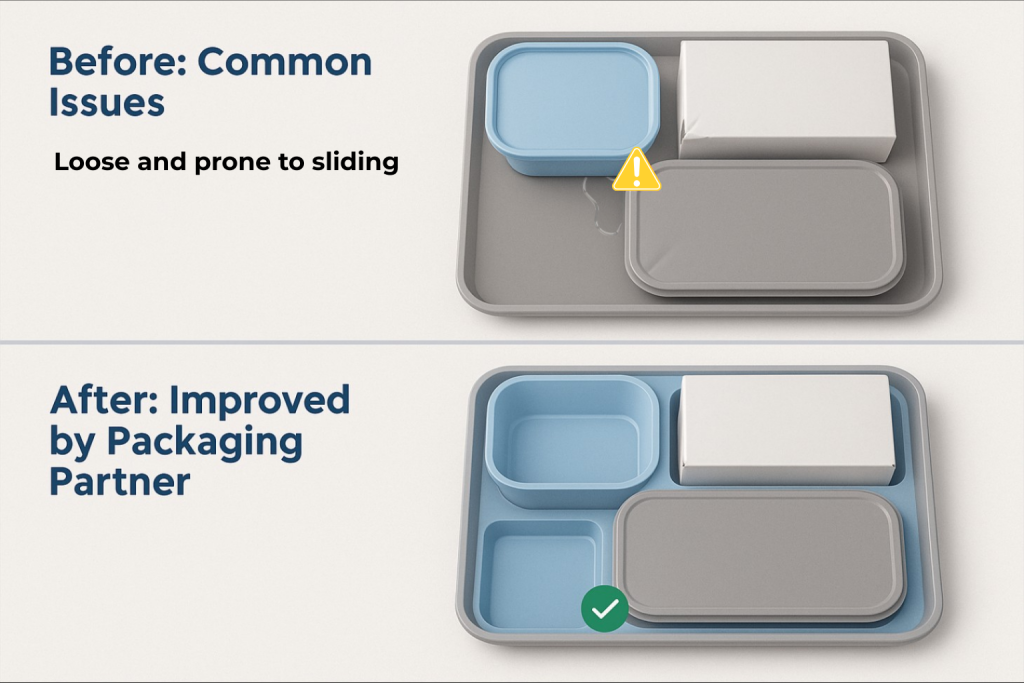
Imagine an economy meal tray where dessert cups slide during transport and press into the main dish lid. A packaging-led partner can adjust the insert to hold cups more firmly or change the tray layout so that items no longer collide. The same partner can test the new layout at the kitting line and with your caterer, then roll it out once it is proven.
Consider a snack box that tears when crew open it quickly. A partner who runs the kitting line sees this feedback early and can change the board grade, crease pattern or opening feature before complaints grow.
One Asian carrier, for example, reduced meal tray damage by redesigning the insert and consolidating kitting with a single packaging partner. The change cut rework at the caterer and reduced crushed items on board. A focused redesign and a short pilot delivered results that several years of piecemeal tweaks had not achieved.
If you want to explore similar improvements, book a 30-minute tray and kit review with SuperPak and walk through one or two of your current sets together.
What rules shape airline onboard packaging and contract manufacturing?
Airline onboard products live under food safety rules, cabin safety expectations and operational limits. A partner that understands this will save you from revisiting basic questions later.
Which food safety and quality standards matter here?
Detailed food safety plans sit with your caterers, but your packaging and kitting partner still needs to work in a controlled way. They should run clean, organised packing areas, manage foreign object risks, and follow clear work instructions so that every tray or kit matches the agreed specification.
They should also have a basic quality management system and be ready to support you during audits. You do not need them to carry every possible logo. What matters more is that they can show how they prevent mistakes, how they record issues, and how they handle non-conforming product when it appears.
How do aviation safety rules affect materials and design?
Cabin safety sets limits on what can sit on board. Some materials must meet flammability or smoke requirements. Products must not create sharp edges, small loose pieces or other hazards if they break.
This shapes many small design choices. The thickness of a tray wall, the shape of a corner, the way a clip holds a lid or a hanger fits on a rail all matter. Your packaging partner does not replace your airworthiness engineers, but they must be comfortable working to defined safety criteria and, when needed, coordinating external tests or approvals.
How do weight, galley space and workflow affect your pack-out?
Fuel cost and on time performance both link back to design. A tray that is slightly heavier or harder to handle might not seem serious in isolation. Multiply that across fleets and sectors and the impact can be large.
A good partner will ask early questions about trolley layouts, stacking patterns, crew routines and route types. They will look for ways to nest items, reduce part counts and keep pack-outs easy to handle without adding weight or complexity. They should also be willing to join you in live trials at caterer sites so that designs reflect real handling, not only drawings.
What Should You Look For In An Airline Onboard Packaging And Contract Manufacturing Partner?
Once you know your constraints, you can look more closely at what a partner brings.
Which core capabilities should your partner have?
For airline onboard products, it helps if your partner offers thermoforming for inserts and trays, carton and sleeve converting, basic foam or protective packaging, and kitting lines that can handle repeatable multi-part sets. It is also useful if they can support small design changes themselves instead of sending every detail to a third party.
Labelling and barcoding that integrate with your stock and scanning systems add another layer of control. Partners who already work in other regulated industries, such as medical or electronics, often have the process discipline that aviation expects, even if their early projects with you are modest.
SuperPak, for example, brings experience with complex assemblies, traceable packing flows and aviation-related projects. If you want to sanity check whether your current partner set covers these capabilities, you can send SuperPak a short summary of your key pack-outs and ask for a quick gap view.
Which certifications, audits and references should you ask for?
You can keep this simple. Look for a structured quality management system, such as ISO 9001, and environmental management, where it fits your goals. Ask about their experience with aviation or with similar high-expectation customers in other sectors.
References that you can speak to are very helpful. Where confidentiality does not allow that, ask for short, anonymous case examples with clear before and after numbers. These say more than a long list of certificates.
How can you tell if a partner supports both one-way and rotable products?
Many airlines use a mix of disposable and rotable items. Your packaging and contract manufacturing partner should be able to show how they design pack-outs that work with existing rotable trays or serviceware, and how they manage packaging and kitting for items that return after use.
They do not have to run full refurb lines, but they should understand how rotable items move through washing and inspection, and how packaging supports that loop.
If you are working with a mix of one-way and rotable items, schedule a short review with SuperPak, share your current tray range, and get concrete ideas to reduce complexity and damage.
How Can You Run A Low-Risk Pilot With A New Partner?
A pilot lets you test a new partner on real routes with limited risk. It also builds shared confidence.
How should you choose routes, cabins and SKUs for a pilot?
Start with a focused scope. Choose one region or cluster of routes where you can observe operations and get feedback easily. Pick one cabin, often economy, and one or two key onboard products such as a main meal tray set or a popular snack kit.
Share this scope with your partner and your caterer. Agree on how many units will run in the pilot, how you will label them, and how you will separate pilot units from normal units.
Which KPIs should you track for onboard packaging pilots?
A short list helps keep everyone aligned:
- Damage or breakage rate per number of trays or kits
- Preparation and load time at the caterer
- Crew feedback on handling and ease of use
- Passenger complaints linked to the tested products
- Waste levels at the end of flights
- Cost per passenger for the tested pack-out
Agree on these KPIs upfront and make sure everyone knows how you will measure them. A simple shared tracker that the caterer and your in-flight team update together is often enough.
How do you decide whether to scale up after the pilot?
At the end of the pilot, sit down with your partner, your caterer and your inflight team. Compare the KPIs against your current baseline and listen to qualitative feedback.
If damage is down, the crew find the packs easier to use, passengers are satisfied, and the cost per passenger is acceptable, you have a strong case to expand. If some results are mixed, treat this as a design loop rather than a failure. Adjust layouts, materials or work instructions, then run a shorter second pilot. A partner who believes in long-term work will be open to this kind of iteration.
What Common Mistakes Do Airlines Make With Onboard Packaging And Contract Manufacturing?
Knowing the common traps helps you stay clear of them.
Why is it risky to treat onboard packaging as only a branding layer?
When packaging decisions start with graphics alone, function often suffers. A tray may look good in a mockup but sit awkwardly in a trolley. A sleeve may carry strong branding but tear too easily when the crew are working quickly. A box may look premium yet be difficult to open in a cramped seat.
Branding should sit on a pack-out that already works for crew and passengers. Packaging companies offering contract manufacturing for airline onboard products should push to test the function in real use before locking visuals.
How does chasing the lowest unit price create a higher total cost?
A lower price per tray or kit can be attractive during sourcing, but it is not the whole picture. If a cheaper design increases scrap at the kitting line, adds minutes at the caterer, or leads to more complaints, the real cost per passenger is higher.
It is better to compare total cost per flight leg or per passenger, including material, handling, waste and service impact. A solid packaging and contract manufacturing partner will be willing to model this with you rather than focusing only on unit price.
Why should airlines treat packaging contract manufacturers as long-term partners?
Onboard programmes do not stand still. Menus change, routes grow or shrink, and aircraft enter or leave the fleet. If you treat your packaging and contract manufacturing company as a short-term vendor, each change becomes a full new project.
If you treat them as a long-term partner, they build knowledge of your specific cabins and workflows. Over time, they can propose standard parts, shared layouts and phased changes that smooth your work. This often brings more value than a short-term discount.
What Should Your Next Steps Be With Packaging Companies Offering Contract Manufacturing For Airline Onboard Products?
If you recognise your own challenges in this guide, it may be time to move from thinking to action.
How can you build a shortlist of packaging and contract manufacturing partners?
Start by looking for partners who combine packaging production with kitting and light assembly, have experience in regulated sectors, and can show projects where they managed complex trays or kits. Confirm that they run structured quality systems and are willing to support audits and site visits.
You do not need a long list. Two or three strong candidates are enough for useful conversations. SuperPak can sit on that shortlist as a reference point if you want to compare different ways of working.
What should you include in your brief or RFP?
In your first brief or RFP, share the list of onboard products you want support for, the cabins and routes where they are used, basic drawings or photos of current layouts, any known constraints such as weight limits or flammability requirements, and your main goals for the next one to two years.
Be clear about what success looks like. You might want a more stable cost, less waste, improved crew workflow or a smoother passenger experience. This makes it easier for partners to respond with realistic proposals and pilot ideas.
How can SuperPak support your next airline onboard project?
If you want a partner that can combine packaging design, production and kitting with experience in complex and regulated supply chains, SuperPak can help.
A simple way to start is to choose one or two of your current onboard products and share how they move through your system today. SuperPak can review those examples with you, highlight quick changes that could reduce damage or handling time, and outline a low-risk pilot that fits your routes and resources.
If you are ready to see what this could look like in your own operation, request a discovery call and demo with SuperPak. Use that session to walk through your key routes and onboard products, review your current trays and kits, and leave with a clear pilot plan and next steps. A short, focused conversation now can set up stronger, more reliable onboard products for many flights ahead.