
If you run a factory or an e-commerce operation in Singapore, you feel the weight of packaging every week.
Cartons, trays and foam compete with finished goods for space. A single missing insert can halt a line. Peaks in online orders can drain weeks of packaging stock in days. Rents and labour stay high, so keeping “extra of everything” is not a long-term solution.
With SuperPak, you do not have to treat packaging inventory as an afterthought. You can treat it as a system that you design and manage. SuperPak is headquartered in Singapore and gives you access to packaging design and development, production, supply chain materials, kitting, contract manufacturing, and packaging logistics and warehousing. When you combine those capabilities with clear internal rules, you can bring packaging inventory under control instead of constantly reacting.
Why Does Efficient Packaging Inventory Matter In Singapore In 2026?
How do packaging stockouts and overstocking affect your operations?
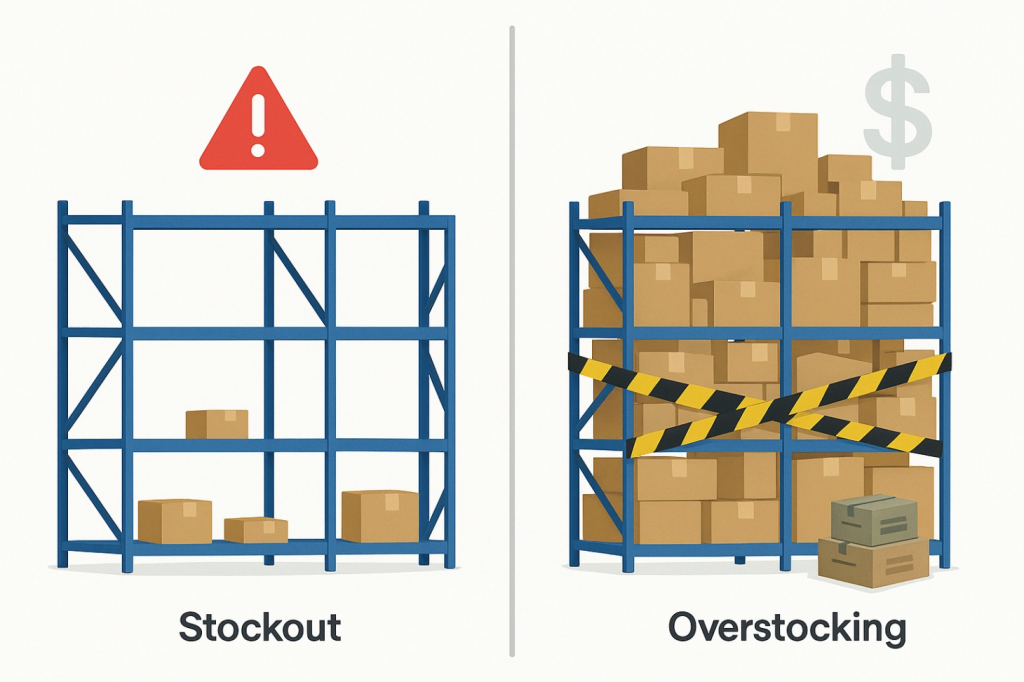
When packaging runs out, you feel it immediately. Lines wait for trays or inner boxes. Kits cannot be closed. Orders slip because the right shipper is missing. You lose productive hours, pay for urgent deliveries and increase error risk when teams try to improvise.
When you overstock, the pain is quieter but constant. You tie up cash in bulky, low-value items. Packaging occupies pallet positions that could hold finished goods. When products or regulations change, you are left with obsolete cartons and inserts that slowly turn into waste.
If you do not track these events, packaging inventory hides inside “warehouse issues” and never gets the structured attention it deserves.
Why are Singaporean manufacturers and e-commerce brands under extra pressure on packaging space?
In Singapore, every pallet position matters. Logistics and warehouse space is expensive and often tight. When you give long-term space to bulk packaging, you sacrifice room for finished goods, returns handling or value-added work.
E-commerce adds another layer. You need room for peak-season stock and repacking activities. If you keep all packaging on-site “just in case”, you lock in high space usage.
With SuperPak, you can move part of your packaging buffer off-site and rely on planned replenishment instead of keeping everything in your own warehouse. For a practical reference, see Packaging Logistics And Warehousing Services For E-Commerce: The 2025 Buyer’s Guide.
How Can You Get A Clear Picture Of Your Current Packaging Inventory?
How do you map packaging SKUs, usage and storage space in a simple way?
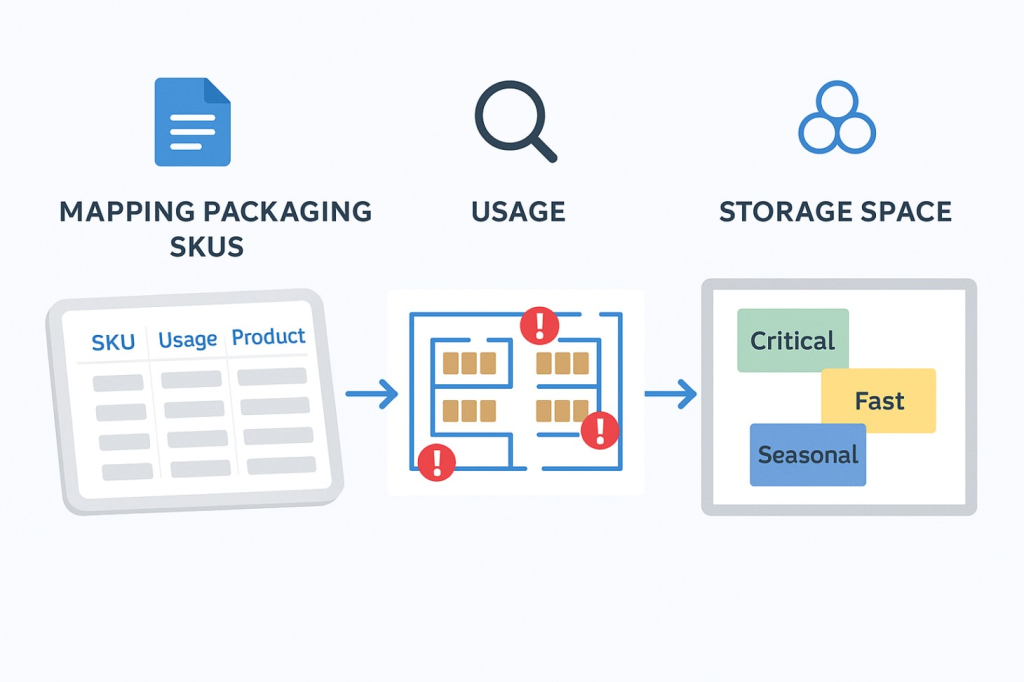
You improve packaging inventory only after you have a clear view of it. You can start with three simple passes.
First, map what you buy and use. Export a list of active packaging SKUs. For each one, note what it is used for, which product or customer it supports and how much you consume in an average and peak month. This tells you which items are fast movers, slow movers and critical.
Second, walk the warehouse. For the main SKUs, note how many pallet positions or bays they occupy and where congestion appears. Identify pallets of packaging that are not clearly labelled or rarely touched.
Third, group SKUs by role. Mark which are line critical and immediate use, which are fast movers with stable demand, which are bulky or seasonal and which are rare or project based. This gives you a first view of where consolidation or external support might help.
You do not need a complex tool to start. A clean list, a simple map and a few photos already give you enough material for decisions.
How can you use SuperPak’s design and part-fit analysis to reduce packaging SKUs?
Many inventory problems start at the design stage. If every new product gets a unique tray or box size, your SKU set grows even when differences are minor.
With SuperPak, you can treat design and part-fit analysis as levers to reduce this complexity. You can review your current cartons and trays and ask where you can standardise. You can consolidate similar carton sizes into a smaller set, design trays that handle several board variants or create modular inserts that support different bundles without new tooling.
Each consolidation step reduces the number of SKUs you need to hold and plan. Volumes per remaining SKU rise, which supports more efficient production and more credible JIT or VMI arrangements.
If you want a packaging-specific reference for this kind of consolidation, see How to Streamline Your Packaging Supply Chain: 5 Cost-Cutting Strategies for Electronics Manufacturers (2025 Guide), then apply the same logic to your box library, tray families, and inventory rules.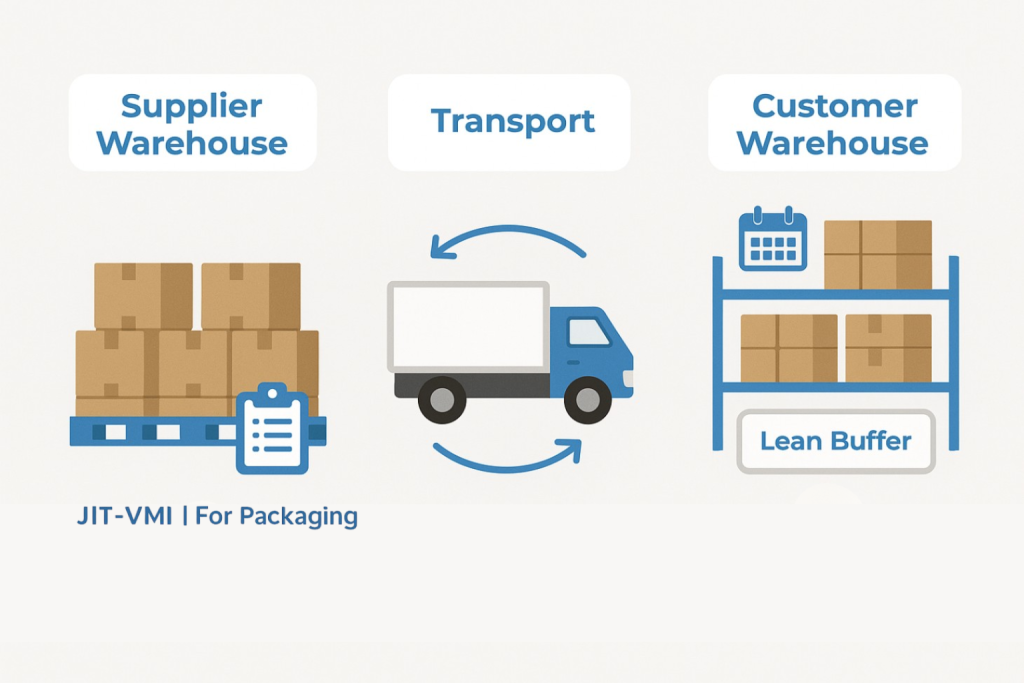
How Can JIT And Vendor-Managed Inventory Improve Packaging Stock Control?
What do JIT and vendor-managed inventory mean for packaging inventory?
Just-in-Time (JIT) packaging means you receive trays, inserts and cartons on a schedule that follows actual use closely. You keep a lean buffer on-site and rely on frequent, planned replenishment instead of storing months of stock.
Vendor-managed inventory means you and your supplier agree on target stock levels and rules. The supplier monitors your consumption or order patterns and initiates replenishment to keep stock within those targets. You keep ownership as agreed, but you no longer issue every purchase order yourself.
Packaging is a natural candidate for these models. Once demand stabilises, consumption patterns for standard cartons, trays and inserts are often predictable. These items can be produced in consistent batches and held in a partner’s warehouse rather than in your own facility.
How can you use SuperPak’s integrated supply chain support to manage packaging inventory?
With SuperPak, you are not just buying boxes. You have access to design, production, supply chain materials, kitting, contract manufacturing, and packaging logistics and warehousing through one partner.
You can use this scope to connect design choices, production plans and inventory models. You can agree in which standard cartons and trays SuperPak will hold in its warehouse as a buffer. You can align production runs with your forecast so replenishments arrive on a set cadence. You can let SuperPak handle kitting, so packaging components and product parts move together and draw down inventory in a controlled way.
For an e-commerce lens you can directly reuse for manufacturing, see Packaging Logistics And Warehousing Services For E-Commerce: The 2025 Buyer’s Guide. For the underlying service scope, start at Contract Manufacturing and Kitting.
If you want to start small, you can pick a short list of packaging SKUs, share their recent usage with SuperPak and ask for a simple replenishment concept to review.
How do you decide which packaging items are suitable for JIT or VMI?
You do not need to move every packaging item into JIT or VMI. You get better results if you choose the right starting set.
Good candidates are items with stable demand, reasonable lead times, consistent materials and sufficient volume. Main shipping cartons, common inserts and standard trays often meet these criteria.
Poor candidates tend to be highly customised items for single projects, packaging with long or uncertain lead times or SKUs that are clearly in decline.
You can use your mapping to tag each SKU as a candidate for JIT or VMI, a SKU that needs a local buffer, or a project-specific item. You can then sit down with SuperPak to test this classification against practical constraints and refine the list.
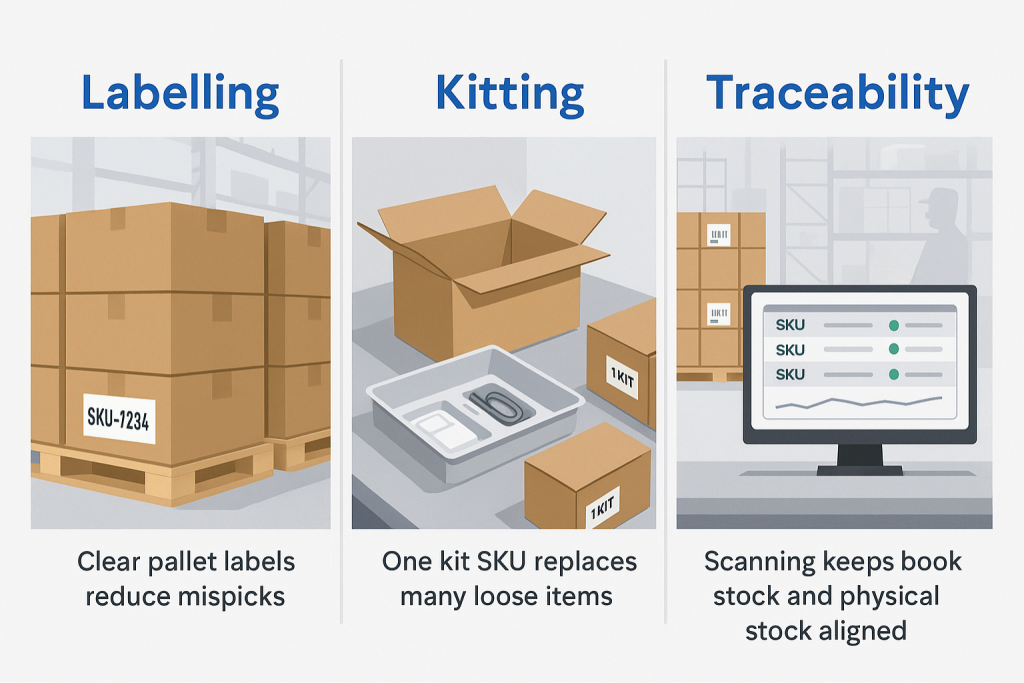
How Can Labelling, Kitting And Traceability Make Packaging Inventory Easier To Manage?
How does kitting help simplify packaging inventory counts and picking?
With kitting, you assemble several items into one defined unit. With SuperPak, you can outsource kitting and contract manufacturing so that packaging and product components travel together.
When you rely on kits, your store’s team pulls one SKU instead of several separate packaging components. Each product or order consumes a known number of kits, so usage is easier to forecast. Counts are simpler because you track kits rather than many loose items.
A device kit that includes the product, accessories, instructions and inner packaging illustrates the point. When SuperPak assembles this kit, you manage the kit pallets and the outer cartons that carry them. The internal packaging inventory is controlled by the kitting process itself rather than by ad hoc pulls from shelves. See Kitting and Contract Manufacturing for the service scope.
How can track and trace tools improve packaging inventory visibility?
Traceability tools support cleaner data and fewer surprises.
With SuperPak, you can build flows where packaging pallets carry clear labels with barcodes or QR codes. You can scan units at receipt, put-away, internal moves and issue to line. You can link scans to your inventory records so that book stock and physical stock stay aligned more often.
Basic labelling alone reduces mispicks and orphan pallets. When you add scanning, you improve cycle counts and audits. Over time, you can see which SKUs sit idle, which move too often and where replenishment breaks down.
If you want to align the “packaging stock” view with broader warehouse and fulfilment flows, use Packaging Logistics And Warehousing Services For E-Commerce: The 2025 Buyer’s Guide as a framework for labelling, staging, and planned replenishment.
How Can Reuse And Sustainability Support Packaging Inventory Efficiency?
How do collection and washing programmes reduce the need for new packaging inventory?
Reuse is not only an environmental tool. It also changes the amount of new packaging you must hold.
With SuperPak, you can run collection and washing programmes for selected reusable packaging such as trays, wafer boxes or protective containers. After use, you consolidate these items and send them back. SuperPak cleans and inspects them, and you place only approved units back into service.
With this loop, you rely less on buying new units. Your total usable pool includes both new and refurbished packaging, so you can lower purchase volumes and keep a smaller new-stock buffer for those items. You also reduce waste streams and show progress towards packaging sustainability targets. If you want to explore this capability, start with Collection and recycling washing.
How can standardising on recyclable formats simplify packaging stock?
Standardisation on recyclable formats links sustainability and inventory control.
With SuperPak, you can move parts of your range towards moulded pulp, recyclable cartons and other fibre-based solutions and reduce the variety of materials you use. When several product families share a core set of formats, you hold fewer SKUs, buy in larger and more predictable quantities and make recycling easier for downstream partners.
You simplify purchasing, storage and disposal. You support a cleaner sustainability narrative and make it easier to build leaner replenishment models around a smaller, more focused packaging range. You can anchor the “format” discussion by reviewing Molded Pulp and Thermoforming Products, then deciding where fibre-first standardisation is realistic.
How Should You Measure The Impact Of Better Packaging Inventory Management?
Which KPIs show that packaging inventory is under control?
You will know your efforts are working when a few key metrics move in the right direction.
You can track:
- Packaging inventory turns
- Space used by packaging
- Packaging-related stockouts
- Urgent replenishment events
- Damage and rework related to packaging
You can review these indicators monthly and contact SuperPak to walk through the results and possible improvements. Higher turns with acceptable risk, less space devoted to packaging, fewer stockouts and fewer rush orders are all signs that your packaging inventory model is moving in the right direction.
How can you run a 30 to 90 day pilot with SuperPak’s packaging logistics and warehousing?
You reduce risk by testing new approaches in a controlled pilot.
You can run a 30 to 90 day pilot with SuperPak by choosing one or two product families or channels, baselining your packaging levels, space usage, stockouts, urgent orders and damage, and then agreeing a clear model with SuperPak for that scope. You specify which SKUs sit at SuperPak, which remain on-site, what min and max levels apply and what delivery rhythm you want. You update labels and kitting where needed and brief your team.
During the pilot, you review consumption, deliveries and issues with SuperPak each week and adjust rules if required. At the end, you compare metrics against your baseline and decide whether to extend the model to more SKUs or sites.
You can draw on SuperPak’s packaging logistics and warehousing guidance and contract manufacturing scope to shape this pilot so it fits the way SuperPak already works with customers.
What Should You Do Next If You Want SuperPak To Help Manage Your Packaging Inventory Efficiently?
Efficient packaging inventory management is about making packaging predictable, visible and proportionate. You want the right packaging to be available where and when you need it, without letting it absorb more space and cash than necessary.
In Singapore, where space is costly and e-commerce and regional distribution are now permanent features, you cannot afford to leave packaging inventory unmanaged. With SuperPak, you can combine your own knowledge of products and demand with external strengths in design, production, kitting, collection and washing, and warehousing.
You can start by mapping your current packaging SKUs, usage and space, selecting a realistic pilot area, and then approaching SuperPak with that information and your goals. You can review SuperPak’s resources on streamlining the packaging supply chain, kitting and packaging logistics so that you arrive prepared.
When you are ready to move ahead, contact SuperPak and request a focused discussion on packaging inventory management. Share your SKU list, your main pain points and your targets for the next 12 months. With that input, you and SuperPak can design a packaging inventory strategy that fits your operations, frees up space and gives you clearer control over the packaging that supports every shipment you send.