
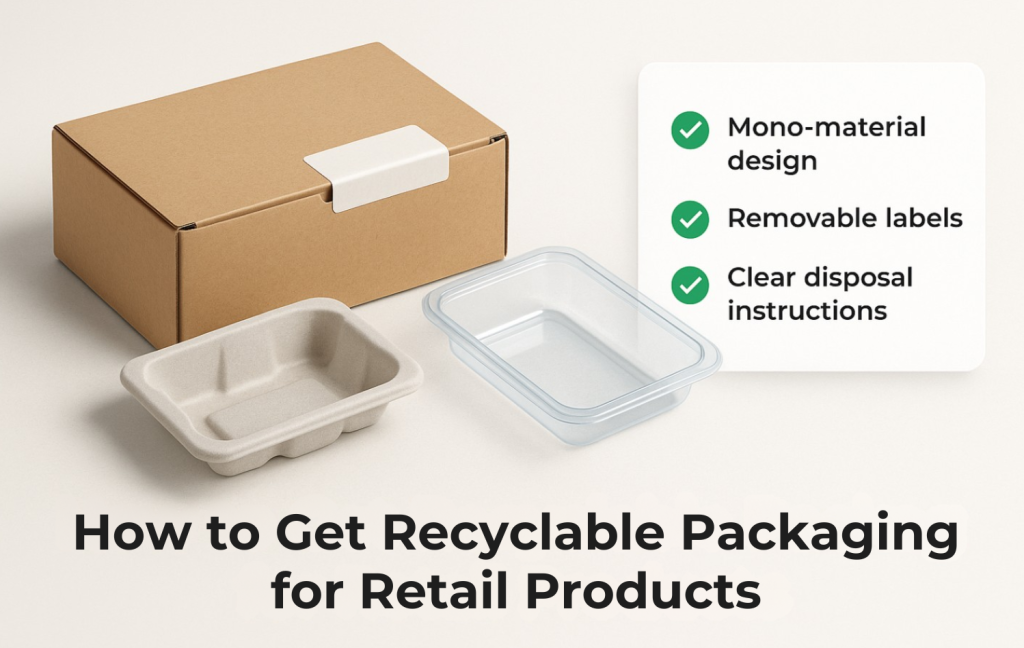
A practical 2025 buyer’s guide from SuperPak for Singapore and Southeast Asia
You want packaging that protects the product, looks right in the hand, runs smoothly through fulfilment, and can be recycled where your customers live. We help teams do this every week. In this guide, we show you how we approach recyclable packaging at SuperPak: the materials we recommend, the design rules that keep recyclability intact, and the four-week pilot we use to turn intent into a reliable standard. Everything here reflects what we actually deliver today, including thermoformed trays, molded pulp, cartons and retail boxes, EPE foam where required, design support, and managed kitting and assembly. For an at-a-glance view of everything we do, see Our Services.
Contact SuperPak to start your pilot. Share two representative SKUs, and we will map a fibre-first concept and a tray-plus-carton concept you can test in four weeks. We supply samples, a simple KPI sheet, and a decision memo at the end of the month.
What “Recyclable” Means In Practice
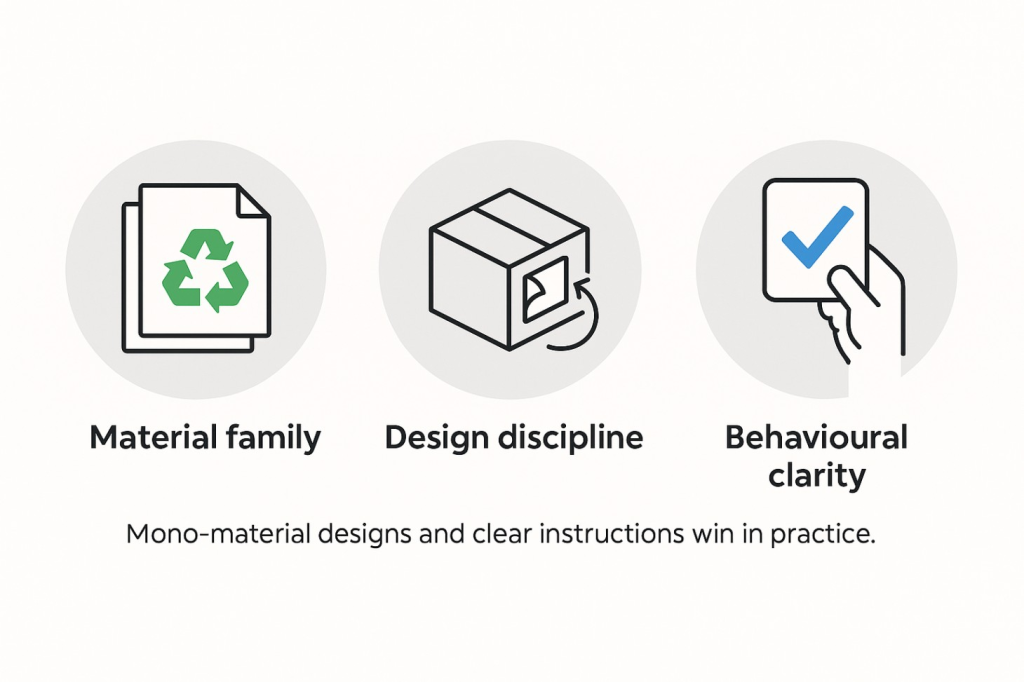
When we say recyclable, we mean a real outcome in the collection systems your customers use, not a logo on a flap. Three factors decide that outcome:
- Material family. Fibre and certain plastics have predictable end-of-life paths. The simpler the family, the easier the sorting.
- Design discipline. Labels, windows, coatings, and mixed layers often decide recyclability in practice. Removability matters as much as the base material.
- Behavioural clarity. Customers act on short, specific instructions. Good design still fails if disposal is unclear.
Two implications follow. Mono-material designs win for predictability. Behaviour should be tested with a short pilot rather than assumed from theoretical statements. We build these principles into the artwork brief, RFI, purchase order, and pilot sheet so everyone works to the same rules.
As part of the setup, we add a one-page recyclable design explainer to the artwork pack. It lists permitted materials, confirms that labels must be removable, discourages glued windows, and standardises on fibre-compatible tapes. Designers appreciate constraints that are clear at the start rather than introduced after the creative is done.
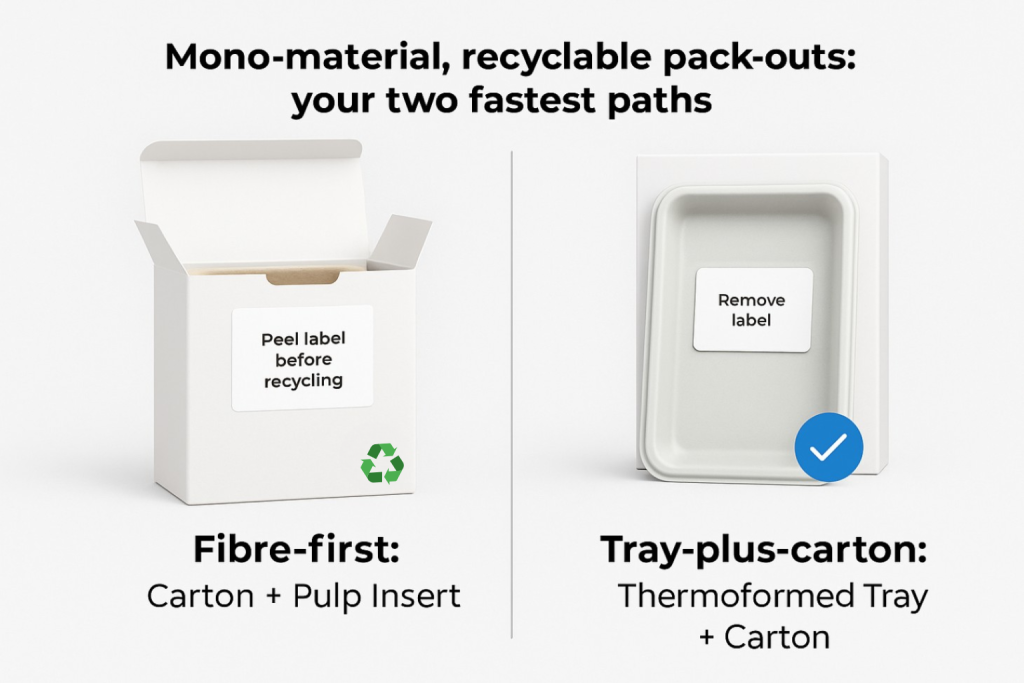
Our Simplest Path: Mono-Material By Default
Mono-material is the fastest route to a recyclable outcome we can control together. It does not mean compromising protection or presentation. It means using disciplined choices to achieve both.
Fibre first: cartons and molded pulp
For a large share of retail products, fibre is the most straightforward option. Corrugated cartons are familiar and easy to flatten. Molded pulp inserts are formed from recycled paper fibres and hold products in place without foams or laminated structures, where the use case allows. When we combine a thin-wall retail box with a molded pulp insert, we often get a protective pack, quick to assemble, and simple to recycle.
Why fibre works
- One material family for outer and insert, which keeps sorting simple
- Fast assembly with a single fibre-compatible tape and inserts that locate quickly
- Tunable pulp geometry to secure awkward shapes without adding films
- Clear disposal lines customers recognise: “Remove label. Flatten the box. Recycle with paper.”
Request fibre prototypes from SuperPak here. Ask for a thin-wall carton and a molded pulp insert prototype for two SKUs. We will ship samples, provide bench instructions, and gather early feedback with you.
Plastics with discipline: thermoformed trays
Some products need precise nests, stable presentation, or abrasion control that fibre alone cannot provide. Our thermoformed trays are vacuum- or pressure-formed from sheet, then trimmed, barcoded, and assembled as required. For electronics, cosmetic sets, medical accessories, and higher-value items, a tray reduces scuffs, keeps orientation, and speeds pack-out.
How do we keep tray-based builds recyclable
- Stay within one polymer family for the tray and any lid, where possible
- Avoid glued carton windows that customers cannot remove
- Specify removable labels so plastic and paper part company at the end of life
- Keep inks and adhesives simple and compatible with the intended stream
Speak with SuperPak about tray concepts. Share your most returned or scuff-sensitive SKU. We will propose a tray-plus-carton concept and run a side-by-side pilot against a pulp-plus-carton build so you can quantify the difference.
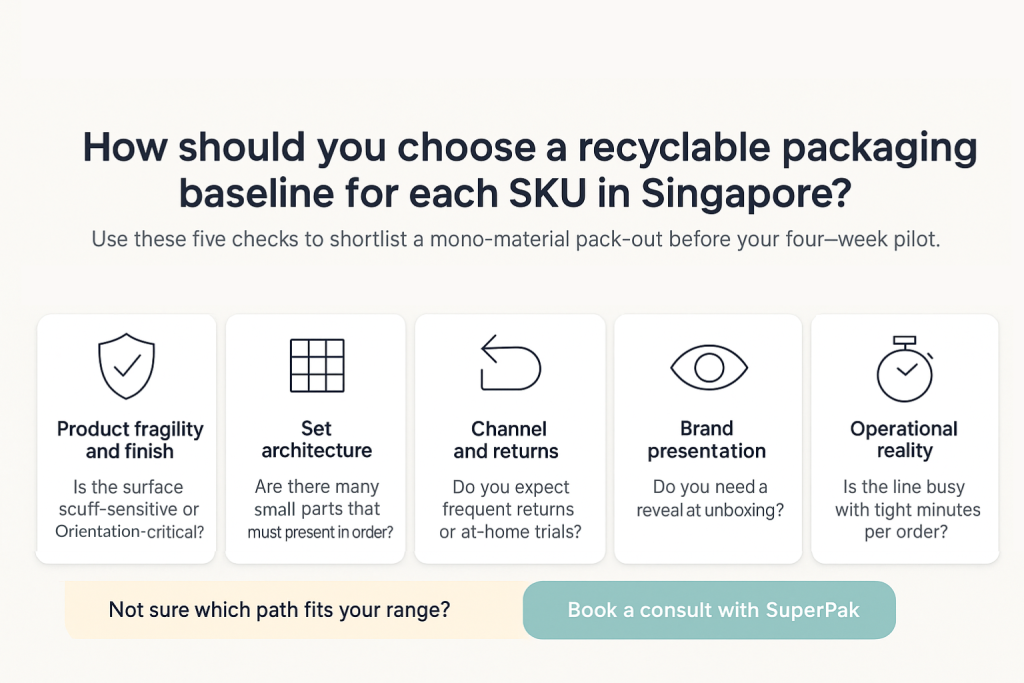
How Should You Choose A Recyclable Packaging Baseline For Each SKU In Singapore?
Use this simple flow to pick a sensible baseline before piloting:
- Product fragility and finish
- High scuff sensitivity or critical orientation → shortlist tray + carton
- Moderate protection needs and flexible orientation → shortlist pulp insert + carton
- Set architecture
- Many small parts in a fixed order → shallow tray pockets
- Few larger parts → pulp pockets or die-cut fibre
- Channel and returns profile
- High returns or at-home trial → openings and closures, customers can manage without tearing
- Low returns → prioritise assembly speed and right-sized cartons
- Brand presentation
- Need a reveal → clear tray under a carton lid, removable labels, no glued windows
- Need a reveal → clear tray under a carton lid, removable labels, no glued windows
- Operational reality
- Busy lines → fewer tapes, fewer steps, one mono-material flow
Need assistance? Book a consult with SuperPak. In thirty minutes, we will review fragility, presentation needs, returns profile, and line speed, then shortlist a recyclable baseline you can trial next month.
Which Recyclable Pack-Outs Work Best By Retail Category In Singapore?
Not every SKU needs the same defence. Below are proven, mono-material playbooks we use across fashion, electronics and FMCG in Singapore and the region. Start with these baselines, then tune during your four-week pilot.
Fashion and soft goods
For robust apparel, a kraft mailer with a tear strip is efficient and familiar. Premium pieces and gift sets benefit from a thin-wall retail box printed with water-based inks. Since returns are common, we add a second adhesive strip or supply a paper return label that overlays the original. The line stays in the fibre family, assembly is quick, and customers know how to flatten and recycle.
Baseline options
- Mailer-first: Kraft mailer + tear strip + fibre-compatible tape
- Carton-first: thin-wall corrugated + water-based inks + single paper tape
- Returns: second adhesive strip or overlay return label
Electronics, accessories, and small devices
We start with the finish sensitivity and the number of components. Where scuffs and orientation matter, a thermoformed tray with a carton protects the product and presents it neatly. Labels on the tray are removable, and the outer remains fibre for straightforward disposal. Where orientation is less critical, a molded pulp insert can secure parts cleanly without adding plastic.
Baseline options
- Tray + carton: precise nests, consistent facing, removable tray labels
- Pulp + carton: lighter accessories and multi-piece sets with simple orientation
FMCG and non-food retail
Geometry drives the insert. Regular, sturdy items suit a die-cut fibre insert. Irregular items benefit from shallow pulp pockets that hold shape and feel intentional when the box opens. On-pack instructions are short and placed near the opening to reduce confusion.
Baseline options
- Carton + die-cut fibre for simple shapes
- Carton + shallow pulp pockets for irregular profiles
Which Design Details Decide Whether Your Packaging Is Recyclable In Singapore?
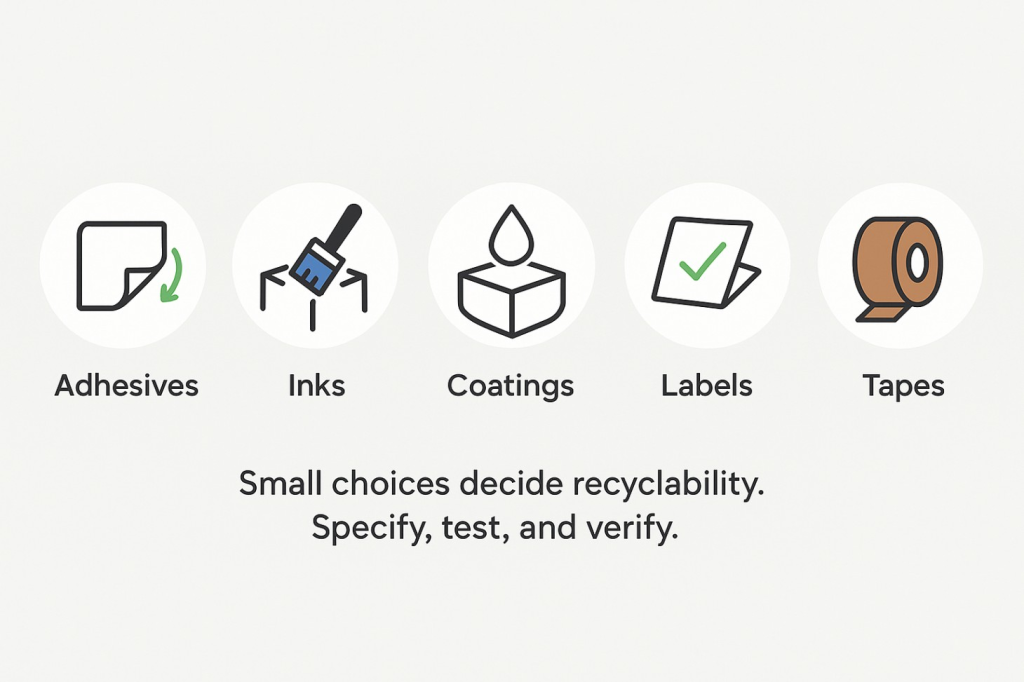
Small choices have big consequences. Labels, adhesives, inks, coatings, windows and tape selection determine if a mono-material pack is recycled in practice. Below are the rules we apply at SuperPak, plus a simple three-peel QA step to keep lines clean and customers confident.
- Adhesives. Labels must peel without tools. We specify peel on your real substrates and test again after ageing.
- Inks. Water-based for fibre. Keep heavy coverage away from tear zones so boxes flatten cleanly.
- Coatings. Use only where necessary and confirm compatibility with the intended stream.
- Labels. Removable on trays and cartons. For high-speed lines, use a release that peels cleanly without tearing fibres.
- Tapes. Standardise on one fibre-compatible tape to reduce bench errors and keep disposal simple.
Fast QA habit: the three-peel test
- Peel three labels from three cartons and one tray daily in the incoming inspection
- If one fails, quarantine the lot for a quick check before it reaches the line
Get SuperPak’s verification pack. We will adapt our six-item RFI and PO checklist to your SKUs and suppliers so claims stay conservative and provable.
How Does Our Four-Week Pilot Prove Recyclability And Cost In Singapore?
A short, measured pilot replaces debates with data. One month is enough to compare two options per category and pick a winner with confidence.
Week 0: How do we set up clean baselines?
We begin by selecting two representative SKUs per category so results reflect your real range, not edge cases. Together we lock the specifications and dielines for two candidate pack-outs per SKU, then brief packers on assembly steps and label placement using clear bench instructions with photos. We also fix channels and destinations up front so shipping comparisons are fair, and we align on the exact metrics to capture each week, including damage rate, pack-out time, dimensional weight, disposal clarity and any data you need for internal or external packaging reporting.
Week 1: What happens when we start shipping?
Both options ship side by side under normal volumes. We time pack-out for each order to capture a clean minutes-per-order baseline and note any assembly friction that slows hands or causes inconsistency. Bench instructions are tuned in real time when we spot wasted motion or awkward tape angles. In parallel, we record dimensional weight against your current packaging so you can see early if right-sizing is moving carrier charges in the right direction.
Week 2: How do we review performance and adjust?
Mid-pilot, we analyse damage and returns by SKU and pack-out to see whether protection is working as intended. We mine reviews and support tickets for packaging keywords that signal friction at unboxing. A short customer survey checks opening experience, disposal clarity and perceived quality, so we are not guessing about behaviour. Where customers are confused, we refine the on-pack message and placement, then continue shipping to validate the change.
Week 3: How do we confirm the cost drivers?
With two weeks of shipments logged, we quantify cost impacts. We check carrier fees where dimensional profiles changed and compare material spend at pilot volumes against your baseline. If you capture packaging data for internal governance or a reporting plan, we verify that the pilot is filling those fields cleanly so nothing needs to be rebuilt later. Any operational notes from the line are folded into the draft standard, so training time is minimised at rollout.
Week 4: How do we choose and document the winner?
At month-end, we freeze the better option per SKU group, supported by the measured deltas in damage, speed, dimensional weight and customer clarity. We record the final specifications, KPIs and change-control rules so small substitutions cannot break recyclability later. The outcome is a one-page decision summary for management and a tidy pack of files your team can use to roll the standard across the next range without re-debating fundamentals.
Run the pilot with SuperPak. We will supply samples, bench instructions and a simple KPI sheet for damage, pack-out time, dimensional weight and disposal clarity, then present a decision memo in week four. Contact SuperPak to schedule your pilot and shortlist the two SKUs you want to test.
Which Common Mistakes Derail Recyclable Packaging In Singapore, And How Do We Prevent Them?
Even strong intentions can miss the mark if small details slip. Here are the five issues we see most often, and how we handle them so your mono-material plan holds up in the real world.
Non-removable labels
This is the most frequent failure. We specify removable labels for trays and cartons, then run peel tests on your actual substrates after ageing. If a batch fails at incoming inspection, we quarantine and correct it before it reaches the line.
Glued window films
A glued PET window on a carton can make the whole panel non-recyclable. If you need visibility, we use a clear tray under a carton lid or a protective film that the customer removes during opening.
Water-resistant coatings
Certain coatings reduce fibre recovery. We only approve them when necessary and confirm compatibility with the intended recycling stream. Where possible, we move performance to structure rather than chemistry.
Too many tape types
Mixing tapes slows packing and confuses end users at disposal. We standardise on one fibre-compatible tape that holds on the bench and peels cleanly for customers.
Ambitious sustainability copy
Claims without documents create risk. We avoid recycled-content percentages and certifications unless you hold the supporting paperwork. Clear disposal instructions are safer for your brand and more useful for customers.
Request a packaging review from SuperPak. Send us one shipped sample and a short note on your top concerns. We will review labels, adhesives, windows, coatings, and tapes against a mono-material standard, share quick wins, and outline a clean path to a four-week pilot. Contact SuperPak.
Where SuperPak Can Help
A recyclable outcome depends on small decisions across inserts, trays, boxes, labels, and instructions. Managing these with several vendors adds handoffs and ambiguity. As a single accountable partner, we remove friction and keep change controlled.
What we deliver
- Thermoformed products for precision nests and consistent presentation
- Molded pulp for fibre-first cushioning and tidy end of life
- Cartons and retail boxes sized for protection and cost
- EPE foam where shock protection is required and fibre is not suitable
- Design support and part-fit analysis to tune geometry and wall thickness
- Kitting and assembly so label placement, tapes, and messages are consistent
How we work with you
- Develop a tray-plus-carton concept and a pulp-plus-carton concept for two SKUs
- Build samples, run small tests where useful, and co-run the four-week pilot
- Present a clear recommendation with evidence that your finance and operations teams need
Book a consult with SuperPak. If you want a thirty-minute review of your range and a path to a recyclable baseline next month, our team is ready to help. Contact SuperPak.
Frequently Asked Questions
Is a PET-family tray always recyclable in Singapore?
It depends on the whole design and local sorting. A tray with a non-removable label or a glued film can be treated as non-recyclable in practice. We keep to one polymer family, specify removable labels, and validate outcomes in the pilot.
Are compostable films better than recyclable plastics for mailers? It depends on the infrastructure. Where collection for compostable materials is inconsistent, a recyclable fibre mailer is usually more predictable. We test both options, gather disposal feedback, and choose the route that balances protection, speed, and clarity.
Do labels and adhesives really matter? Yes. They are the most common reason a mono-material design fails at the end of life. We specify removable labels and fibre-compatible tapes in the RFI and confirm them again at the purchase order stage, then verify peel on incoming goods.
Can we keep a luxury presentation and still be recyclable? Yes. We use clean carton boards with water-based inks, a fibre insert for structure, and a removable band or sleeve for branding. We skipped-glued windows. If you want a reveal, we use a clear tray under a carton lid and keep labels removable.
Your next steps with us Start with two SKUs. One should be scuff-sensitive or high-value. The other should be a high runner that causes packing friction. We will prepare two concepts for each, one fibre-first and one tray-plus-carton, and set up a four-week pilot that captures damage rate, pack-out time, dimensional weight, and disposal clarity. At the end of the month, you will have a clear recommendation that meets operational needs and stands up to a cost review.
Contact SuperPak to get started. Tell us the two SKUs you want to pilot, the channel you sell through, and any recurring complaints. We will propose concepts, ship samples, and help you run a clean comparison.
Conclusion
Recyclable packaging becomes manageable when choices stay simple and measurable. We define recyclable in the context of your customers, design mono-material by default, and specify removable labels, compatible inks, and sensible tapes. We verify claims with a short, repeatable pack of documents and run a four-week pilot that tracks damage, pack-out time, dimensional weight, and disposal clarity. The result is a pack-out that ships well, looks right, and can be recycled in the places your buyers live.
Speak with SuperPak today. Whether you need fibre-first molded pulp, thermoformed precision trays, right-sized cartons, or a managed pilot, our team at SuperPak is set up to support you end to end. Contact SuperPak.